

Structured water in theory and practice
Editor’s note: This is an edited transcript of Steve Diver’s talk from the 2025 Acres U.S.A. Eco-Ag conference. You can get access to all the conference talks at eco-ag.com.
In my workshops I describe the three pillars of eco-agriculture as the integration of minerals, biology, and energy.
Under the minerals pillar, you’re aiming for crop vitality, nutrient density and resilience to pests. This is done through holistic soil tests, mineral balancing, sap analysis and sophisticated soil and foliar blends with minerals and trace elements. Pioneers like William Albrecht and Carey Reams taught us how to aim for food quality and pest control through balanced nutrition.
The biological pillar focuses on carbon farming and soil organic matter to provide habitat for soil microbes. That’s why eco-farmers employ compost, cover crops, biodiversity, low-till, compost extracts and microbial inoculants. In turn, this promotes robust soil microbial communities, which perform their ecosystem services like nutrient cycling, manufacture of biotic glues tied to good soil structure and infiltration, and natural disease suppression. This is how nature works in prairies and forests. That’s why it helps to design and envision agroecology and regenerative agriculture as “natural systems agriculture.”
There’s a story about a jazz trombonist in New York City who played with all the greats. One day, the symphony orchestra was short a trombonist, so they asked him to play a concert on short notice. The orchestra performed brass-heavy selections by Beethoven, Mahler and Strauss — it didn’t matter, this trombonist knocked it out of the park. Afterwards the conductor asked him, “Where did you learn to play like that?” This cool dude replied, “Listen, man, first you learn to play classical, then you can play jazz.”
This is where we’re at with eco-agriculture. First farmers need to learn the fundamentals of mineral balancing and soil biology as an alternative to chemical inputs. The third pillar, which encompasses biophysics and bio-energetics, ties the whole eco-ag approach together.
The purpose of bio-energetics is to increase the coherence and vitality of living systems. Biophysics gets into energy medicine, quantum biology and holistic agriculture. It looks at the biological influences of biomagnetism, bioesonance, geopathic frequencies and other subtle energies. This is the third pillar of eco-agriculture. While a lot is already known about bio-energetics, it is still viewed skeptically. However, that is changing with growing awareness of quantum biology, and I believe it will become more commonplace.
Water and Cymatics
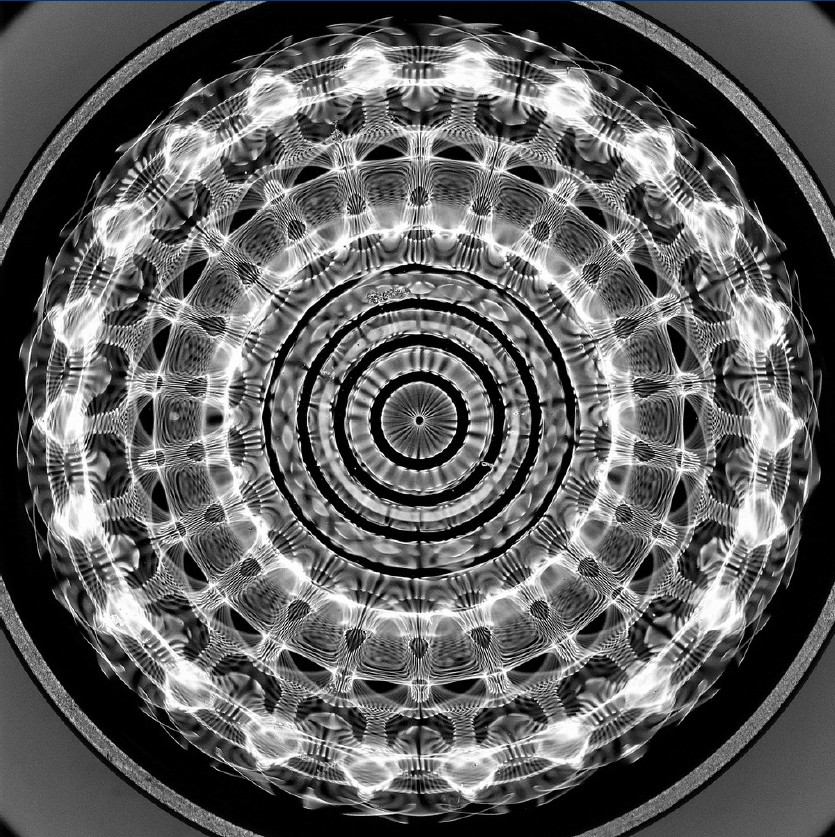
Water is very fluid. It can dance and rearrange shapes in picoseconds due to its dipole structure, nuclear spin, hydrogen bonding and electron pairing.
Water responds to its environment — sound, electromagnetic frequencies, the frequencies of gems and minerals, geometric shapes and human consciousness. It can store and transmit information, which is known as the memory of water.
Various companies and researchers make structured water devices that can revitalize and quickly influence the molecular structure of water to promote health in biological systems. Structured water is known variously as hexagonal water, activated water, magnetized water, vitalized water, coherent water, informed water and imprinted water.
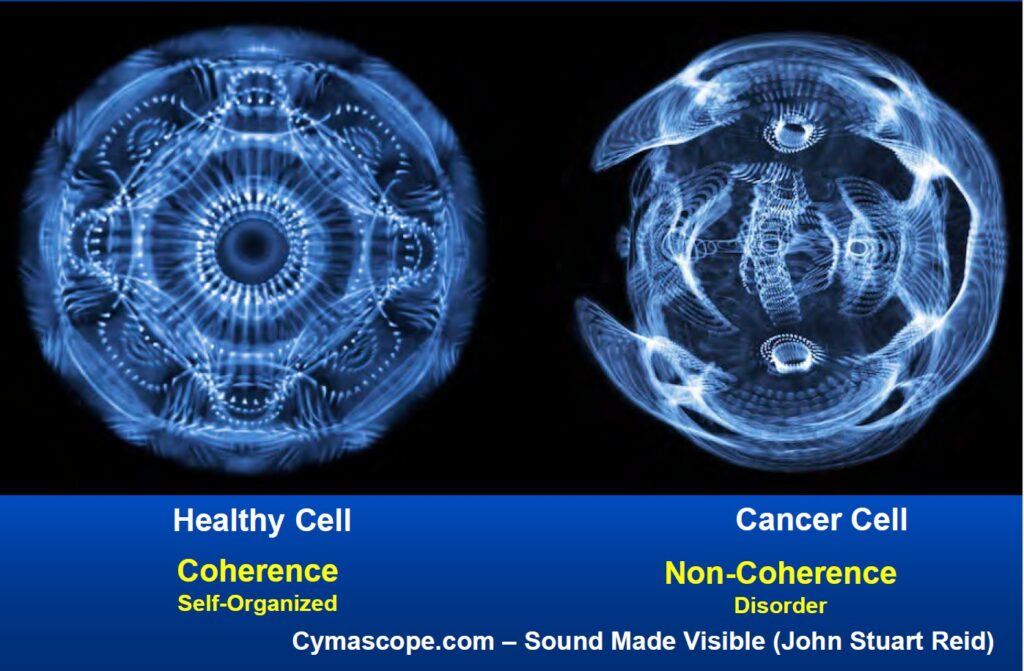
If you set a plate on a speaker, fill it with water, and create sounds with a frequency generator, the water responds to these acoustic frequencies and develops standing waves with fractal patterns and shapes (Figure 1). Depending on the circular or rectangular shape of the vessel, the frequency and amplitude from the generator, and viscosity of the water, these standing waves can appear as mandalas, radial and oval and grid-like patterns, and geometric shapes. The field that studies these lines of force — these standing waves — is called cymatics.
Researchers have shown that cymatics can distinguish between healthy cells and cancerous cells (Figure 2). A healthy cell has coherence. This means it’s self-organized. It has a natural shape — a standing wave that looks like a mandala. Everything is ordered. In contrast, a cancerous cell lacks this coherence. It lacks symmetrical organization, it’s out of whack since the cells are stressed, and you can immediately see this using cymatics.
Water Physics
It is widely accepted in science that water exists in three phases — liquid, solid (ice) and vapor (steam). The new biology recognizes a fourth phase of water, the gel phase, which has been thoroughly studied and described by Dr. Gerald Pollack, a professor of bioengineering at the University of Washington.
Water has over five dozen anomalous properties and behaviors. It has a high surface tension, it is a universal solvent, it has high cohesion, it binds with other water molecules, and it adheres to surfaces. Water has one negatively charged oxygen and two positively charged hydrogen atoms. The angle between the two hydrogen atoms is 104.5 degrees. Two legs come off the oxygen atom, known as electron pairs, so the water molecule is shaped like a tetrahedron. When water molecules start binding together, they also form a tetrahedron.
Water is one of the smallest molecules on Earth; only hydrogen and helium are slightly smaller. To put nano-size into perspective, if you looked at cells as an empty balloon, you could fit 20 billion water molecules inside a bacterial cell and 20 trillion water molecules inside a human cell. There are one sextillion water molecules in a drop of water — one billion trillion. It is also ubiquitous — every living microbial, plant, and animal organism on planet Earth is largely composed of water.
Within each water molecule, there’s a tug-of-war between the hydrogens and the oxygen; this creates a polar dipole and an electrostatic field. The protons inside the hydrogen atoms can either spin in the same direction or in opposite directions.
Water structure is based on hydrogen bonding. Water molecules can build and reshape into different structures in picoseconds — one trillionth of a second. They’re dancing, they’re flickering, and they’re constantly binding and reshaping. Water molecules can exist as a monomer, a dimer, a trimer, a pentagon or a hexagon and onwards; 20 water molecules form a dodecahedron. In bulk liquid water, laboratories have found 100-to-280-moleculer structures.
Structured Water
Professor Emilio Del Giudice, the late Italian quantum physicist, said that water occurs in two states — non-coherent and coherent. In the non-coherent state, bulk water flickers between molecular clusters of low density. In other areas, it self-organizes into these 100- to 280-molecular clusters, which leads to coherence. In coherent water, molecules oscillate in unison; it acts as a resonant medium for storage of energy and information, and it can receive and transmit electromagnetic signals involved in cellular communication. Light passing through coherent water is more structured and less chaotic.
Life exists on Earth because of four things: water, electromagnetic frequencies, the chemical elements, and our stable global climate. Biological organisms have co-evolved with and are shaped by the interaction between cosmic and terrestrial electromagnetic frequencies and water. Nowadays these include EMFs (electromagnetic frequencies) and ELFs (extremely low frequencies). There’s a substantial difference between man-made electronic smog EMFs, which cause biological stress due to their polarized fields, and natural frequencies and ELFs, which generate bioresonance and rejuvenation. Water influences the shape and function of every cellular organelle and cellular membrane. The helical shape of DNA and its protein recognition is directly tied to the structure of water.
This is where it shifts into the new biology. Pollack’s studies found that structured water has a hexagonal shape — the same as ice — which creates a liquid crystal. The hexagon is common in nature. Bees make hexagonal honeycomb, and most snowflakes are hexagonal. In cells, EZ water forms next to hydrophilic surfaces such as membranes, organelles and DNA. Hundreds of thousands of water molecules form hexagonal lattice structures in these interfacial spaces. Gel-phase water excludes particles and substances; that is why it’s called exclusion zone or EZ water.
Moreover, EZ water functions like a battery. Water inside the exclusion zone is negatively charged, while water just outside this zone is positively charged; this creates electrical potential. Further, EZ water absorbs and stores radiant energy from infrared light. Like Emilio Del Giuidice’s theory on Coherent Domains, EZ water has coherent properties that may explain water’s anomalous behaviors, including the memory of water — which makes better sense when you recognize water is an electromagnetic medium.

In holistic health, it’s recognized there is a spectrum of electronegative potential in cells. Higher negative potential relates to healthier cells. When this negative potential drops below a certain point, your body is more susceptible to degenerative diseases and cancer. That’s why I promote drinking water that is run through both a carbon filter and an inexpensive structured-water device.
Vortices and Living Water
One explanation suggests structured water devices strip water of existing molecular structures — along with industrial-pipe memories — followed by revitalization. Some people think structured water forms hexagonal micro-clusters, which are able to pass through tiny openings in cells called aquaporins. Regardless of the mechanism, it seems clear structured water is more easily assimilated by cells.
To understand enlivened water, it helps to visualize mountainous regions of the U.S. such as the Ozarks, the Appalachians, or the Rockies. Water flows out of tree-covered hills and mountains, cascading and bubbling over rocks in streams and rivers, creating vortices and ripples. It’s got rhythm. It’s moving. It’s oxygenating. This is how water naturally exists in nature.
Industrial water leads to stagnant or dead water. It sits inside water towers for extended periods. Then it is compressed and forced through metal pipes with right angles — it loses its vitality.
Structured water devices enliven “stagnant water” to create living water or revitalized water. The two primary modalities for creating structured water are vortexed water and magnetized water.
Viktor Schauberger, a naturalist and inventor who lived in Austria, is famous for his pioneering work with vortex water technology based on biomimicry. He believed modern technology was destructive because it forced water into straight lines and rigid pressures, whereas water in nature moves in spirals and vortices. He designed log flumes that carried heavy logs in shallower water by using egg-shaped cross-sections, by using guide vanes in curves to promote implosion, and by enhancing buoyancy by mixing cold stream water with sluice water at intervals. Schauberger’s motto was “comprehend and copy nature.”
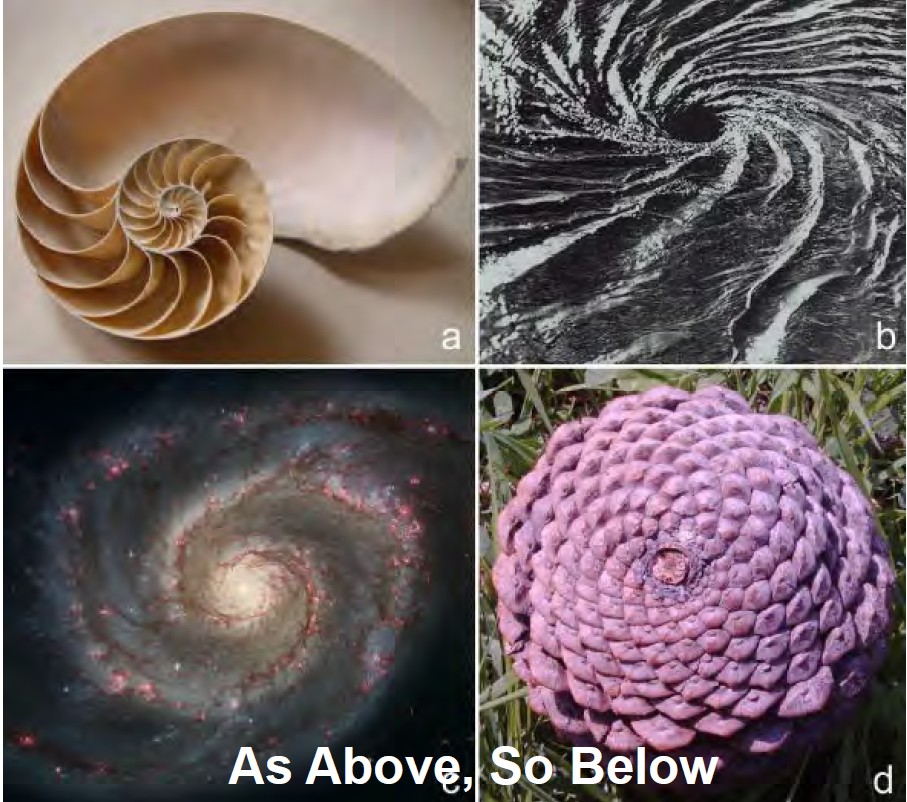
Schauberger understood the power of the vortex, wrote an equation for hyperbolic cones, and developed implosion technologies such as hyperbolic funnels and spiraled water pipes. He said there are two kinds of movement — centrifugal or outward-spiraling, which generates heat and has explosive force, and centripetal or inward-spiraling, which is naturally cooling and generates energy, also known as implosion. Schauberger insisted implosion technology is how we should model systems. In nature, we can see this spiral pattern — such as the Fibonacci sequence — repeatedly at the macro scale (our spiraling galaxy) and at the micro scale (a pinecone) (Figure 3).
Biodynamics and Flowforms
Theodor Schwenk was another pioneer who contributed to our understanding of holistic water quality. Schwenk came out of the anthroposophical movement, which was influenced by Rudolf Steiner, the founder of biodynamic agriculture. It’s important to remember that biodynamics was the premier humus-farming system of the 20th century. In addition, it is known for image-forming qualitative assessment methods such as Pfeiffer circular paper chromatography. Steiner recognized subtle energies —the software behind the hardware — and gave indications on their use in holistic medicine and biodynamic agriculture.
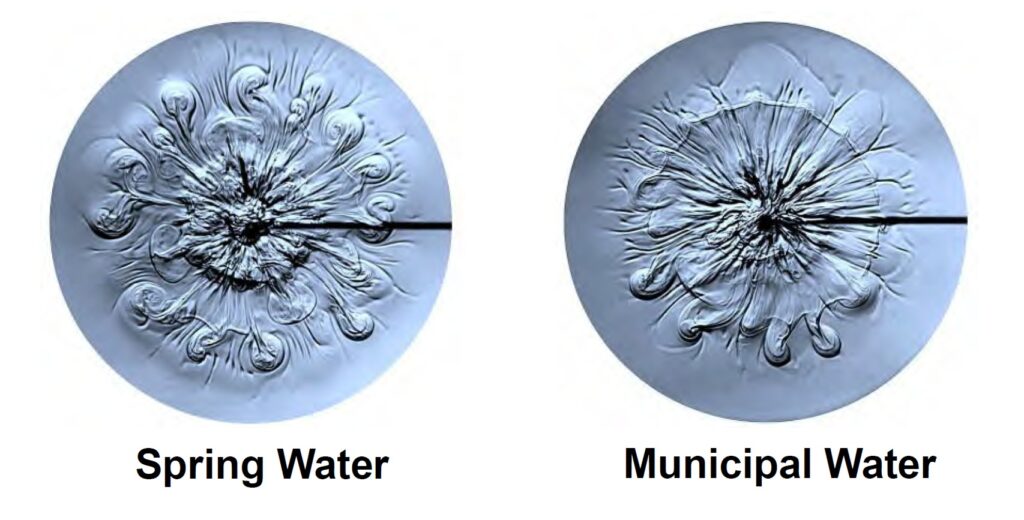
Schwenk developed the drop-picture method at the Institute for Flow Sciences. It is a qualitative image-forming technique used to assess the vitality and quality of water. This method relies on photography to capture images of vortices and patterns that appear after a sequence of water droplets land on a sample solution (Figure 4). You can see that spring water is fully expressed with vortices, concentric balanced structure, and rosette forms. In contrast, the municipal water image lacks this level of organization. It has fewer vortices. You can easily see the difference in water quality, and your cells can perceive these differences on biophysical and quantum levels.
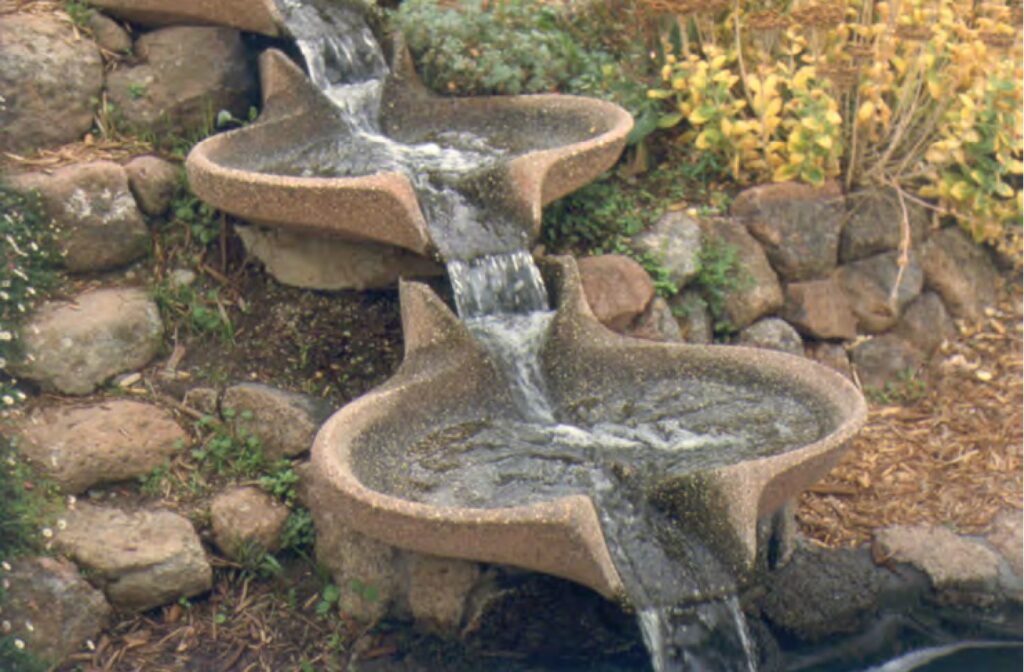
Through collaborations with John Wilkes at the Institute for Flow Sciences, Schwenk’s group is also known for the development of flowforms (Figure 5). A flowform mimics the meandering, rhythmic movement of water. When farmers activate the biodynamic field sprays, instead of the traditional hand-stirring method they can dynamize water by running it through a flowform.
While the biodynamic stirring process — creating a clockwise water vortex, then reversing the vortex direction by stirring counter-clockwise over the course of twenty minutes to one hour — was embraced by both Steiner and Schauberger, few people realize it was an old peasant farmer practice in Austria.
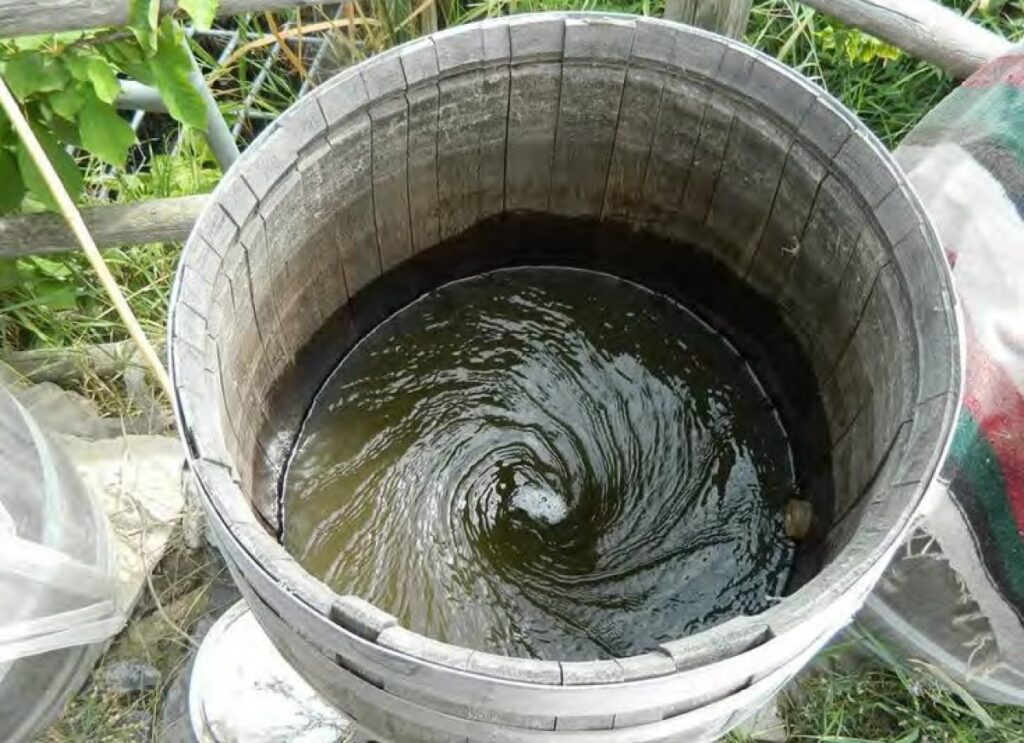
Biodynamics has two field sprays. The first is horn manure, or BD 500, which is tied to calcium forces, horizontal plant growth and soil humus formation. The second is horn silica, or BD 501, which is tied to silica forces, upright growth and atmospheric energy. Again, you’ve aiming for rhythmic balance. In the dynamizing process — whether hand-stirred or with a flowform — coherent water absorbs the energetic signature of these field preparations. When applied as field sprays, water droplets convey this coded information onto the farm. The biodynamic preparations provide a combination of bio-physical substance and bio-energetic force.
Structured Water Devices
Structured water devices work by several mechanisms. The unit developed by Clayton Nolte is one of the better-known ones in the United States. Inside the pipe it’s packed full of spheres. When water passes through the device, it simulates water cascading over rocks in streams and rivers. It forms dozens of vortices in all directions, clockwise and counterclockwise. The water is revitalized and enlivened.
Another type of device uses cavitation to create nanobubbles, which are extremely small. Nanobubbles can remain in solution for weeks or even months, so you can develop elevated levels of dissolved oxygen. You can easily get up to 12 parts per million of dissolved oxygen with cavitation units.
Magnets are also popular with structured water devices. While Davis and Rawls said south pole magnets should be used to treat water, some of these magnetized water devices use sophisticated orientation of positive and negative polarities to achieve their desired effect. Magnetizing water reduces surface tension and viscosity, increases dissolved oxygen, influences the pH and electroconductivity, and increases the flow rate. It can mitigate scaling and biofilms in pipes. With vortexed and magnetized water, you get enhanced nutrient uptake and increased cell permeability.
Geopathic frequencies are another way to energize or structure water, for example via gems, minerals and shungite. Other modalities that are integrated with structured water devices include geometric shapes, scalar energy, agricultural frequencies and coherent water placed inside a wand or vial.
Practical Results
I manage the Horticulture Research Farm at the University of Kentucky. It’s a busy place that includes a working organic farm — the UK-CSA with 250 members. In addition, I explore my own research interests and have acquired and evaluated several structured water devices.
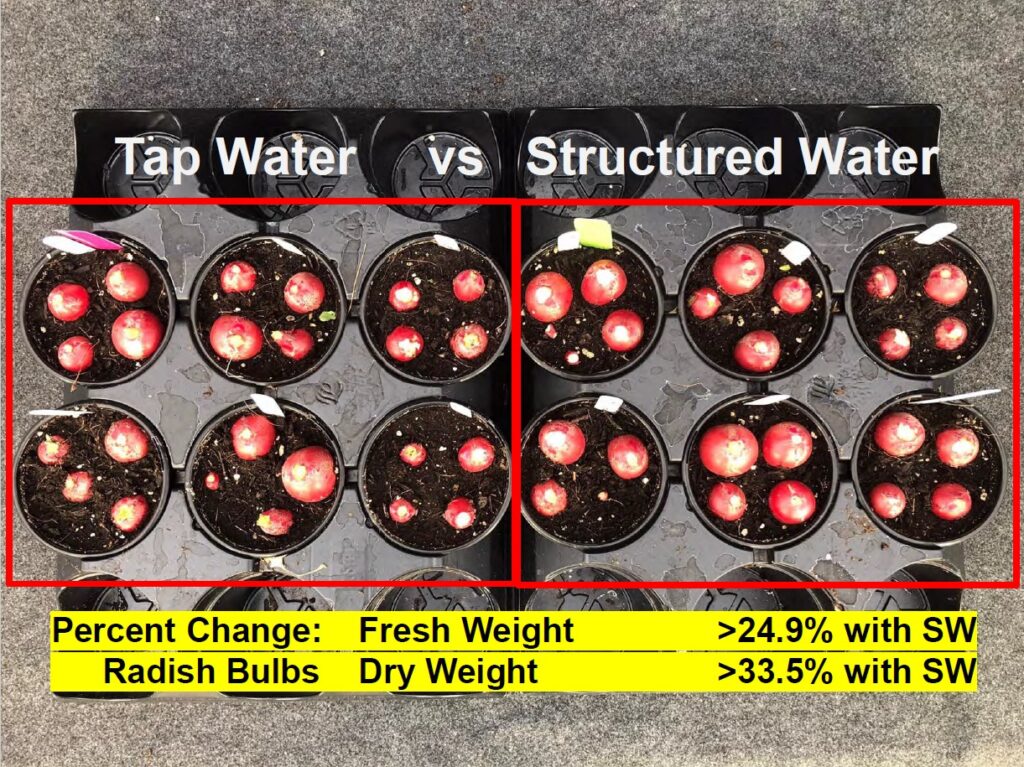
One of the devices we have tested is the Super Imploder, designed by Dan Winters. It features both a double vortex nozzle and powerful magnets. You attach it to a garden hose, municipal tap water goes in one side, structured water comes out the other side, you water your plants, and that’s it.
We grew radish and tomato seedlings, and after two weeks you could already see the difference in seedling growth between the municipal tap water and structured water treatments. Tomato seedlings had 55 percent greater fresh weight with structured water at the thinning state, nineteen days after planting. At maturity, the radish bulbs had 25 percent greater fresh weigh and 34 percent greater dry weight using structured water vs tap water.
Now let’s be realistic: you won’t always see these kinds of dramatic differences, but to me it provided proof of concept that structured water devices have merit. Think of a bell-shaped curve. On one end of the spectrum, a small percentage of farmers will get outstanding and impressive results. In the middle bulge, which represents most of the crowd, results will be moderate. On the other end, results might be poor to nil. This is normal with many agricultural products and technologies. Results vary based on local factors and environmental conditions. Plus, we’re not talking about the kind of crop boost you get from 10 tons of compost. We’re talking about adopting a bio-energetic tool that supplies revitalized water to all of your plants and animals.
Everybody has EZ water in them because that’s how water works in cell biology. When you eat fruits and vegetables, you’re consuming structured water because it naturally occurs inside plant cells. There are many natural ways to enhance your biophysical health — living with circadian rhythms, eating healthy foods, exercising, etc. These water-structuring devices are bio-energetic tools that are gaining traction. They are a practical implementation of the third pillar of eco-agriculture: biophysics.