



Total digestive assays detect potential, but biology is needed to release the nutrients trapped in your soil
Soil testing has come a long way, and growers now have access to many different tools. One of those tools is the total digestive assay, which is often promoted as a way to see everything a soil contains. It is a powerful test, but it only answers part of the question every grower really cares about: “How do I maximize yield potential?”

The gap between what a soil holds and what a plant can access can be bridged, in large part, on biology and other environmental factors. Learning how to measure and influence the biology is where much of the opportunity in modern soil management lies.
What Is the Total Digestive Assay?

Normal soil tests, like the Mehlich-3 or ammonium acetate extraction, use a mild acid or a salt solution and are designed to estimate the fraction of nutrients that is currently extractable. Weak-acid chemistry is meant to loosely imitate the acidity of root exudates, giving an estimate of availability rather than total content.
The total digestive assay, on the other hand, is a strong-acid test. It uses nitric or hydrochloric acid to break down the soil matrix and pull nearly everything off the soil colloid. The result is a complete inventory of the nutrients present in a sample, including phosphorus, calcium, and potassium that may be locked away in mineral structures or held in organic matter. In short, it shows the grower the full mineral reservoir rather than just the portion sitting at the surface.
Used well, the total digestive assay has real value. It can reveal whether a soil already carries large reserves of a given nutrient. This, in turn, shapes the decision of whether to apply more fertilizer or to invest instead in a more biologically active system that can unlock what is already present.
But there is a critical piece the assay does not measure: biological activity itself. A useful way to frame the test is as a measurement of potential, and the key that unlocks that potential is, largely, biological activity. A high total nutrient level is not a promise that the crop can reach that nutrient when it needs it. What looks like a shortage on a tissue test may not be a shortage of the nutrient at all. It may be a shortfall in the biological systems responsible for making that nutrient available.
How Do Nutrients Get Bound in the Soil?
If your total digestive report shows abundance but your standard soil test shows deficiency, the problem may not be the nutrient’s quantity but the function of the living system around it. Several mechanisms hold nutrients in forms that plants cannot immediately use.
Positively charged nutrients such as potassium, calcium, magnesium, and ammonium are drawn to the negatively charged surfaces of clay and organic matter. A large share of soil potassium is bound tightly within the crystalline lattice of clay minerals or in parent material such as granite. It may be present, but it is not liquid currency that the plant can spend until biological or chemical weathering sets it loose. Phosphorus tells a similar story; in many soils, it is held in highly stable forms, precipitated with calcium where pH is high or with iron and aluminum where pH is low. Calcium tends to sit closer to its available level, with one notable exception: calcareous soils carrying limestone fragments hold a massive, slow-release reservoir that a standard test will never fully capture. Magnesium behaves much like the other cations, cycling between exchange sites and the soil solution.
Release happens through a handful of natural processes. As minerals weather, dissolve, and break down, nutrients are freed into the soil solution. Roots and mycorrhizal fungi exude acids that dissolve nutrients from clays and minerals, increasing their availability. While many forces drive the tie-up and release of nutrients, biology plays a large role in cycling and unlocking reserves that have accumulated over many seasons.
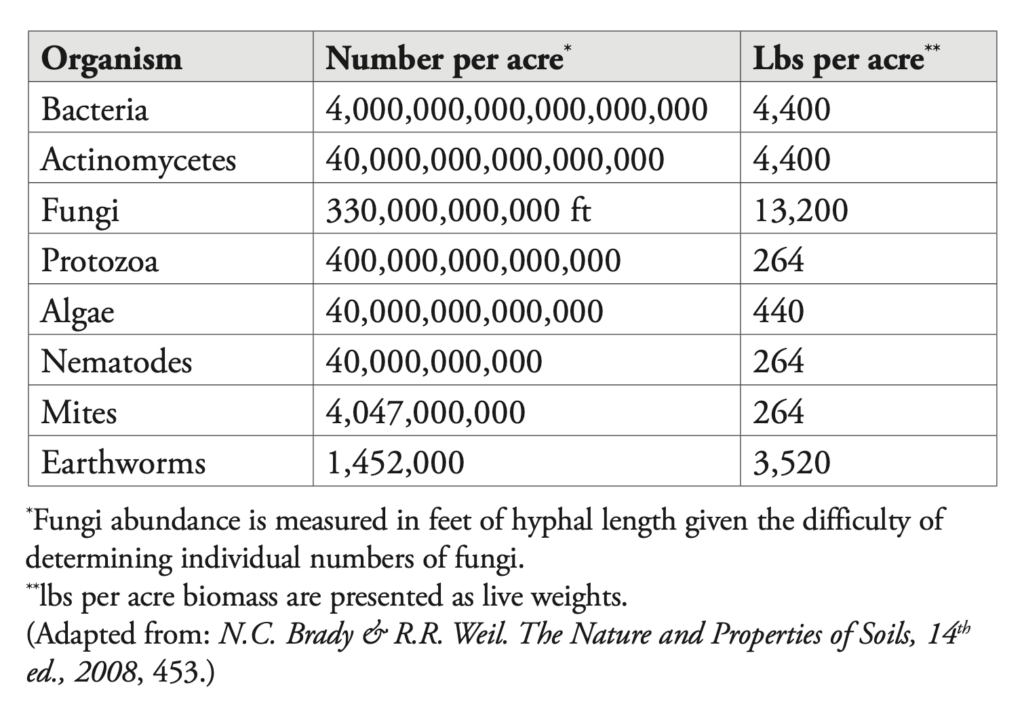
Beneficial microbes can transform bound forms into soluble ones, an effect that is especially important for phosphorus. Through a process of solubilization, certain bacteria and fungi secrete organic acids and other compounds that dissolve bound minerals, freeing phosphorus and several micronutrients into the soil water.
Biology does considerably more than simply release nutrients; it governs the timing, the location, and the chemical form of that release. Roots are not passive bystanders. They feed microbes with carbon-rich exudates, and, in return, those microbes mobilize nutrients in the immediate root zone. This carbon-for-nutrients exchange is among the most important mechanisms in any soil because it concentrates biological activity exactly where the plant stands to benefit most.
Methods of Measuring Soil Biology
If biology is the missing variable, the natural next step is to measure it. Several tools exist, each with its own strengths and blind spots.
Phospholipid Fatty Acid (PLFA) Analysis
A PLFA test is an advanced biological assessment that measures living microbial biomass. It identifies the presence and balance of beneficial bacteria, fungi, and protozoa. Phospholipids are core components of the cell membranes of all living organisms, and because they break down quickly once an organism dies, measuring them gives an accurate read on microbes that are alive and active.
A laboratory extracts these fatty acids and uses gas chromatography to identify the distinctive signatures of different microbial groups. The test will not name every organism precisely, but it is excellent at showing relative shifts in abundance and community structure as management changes. When PLFA reveals a stronger or better-balanced community, that generally points to greater capacity for nutrient turnover, though it does not by itself prove that nutrients are reaching the crop.
Genomic (DNA) Testing
Genomic testing involves sequencing DNA from a soil sample to detect microbial and sometimes pathogen signatures. Unlike PLFA, which reflects living biomass and broad community structure, DNA sequencing can identify many organisms far more specifically, including microbes tied to nutrient cycling and disease pressure.
The important caveat is that DNA does not indicate activity. A genomic test can detect an organism even when it is dormant, dead, or present at very low functional levels. A pathogen signature does not guarantee disease, and the presence of a beneficial microbe does not guarantee soil health benefits. These tests can also be costly, and without a clear management decision attached to them, they sometimes generate more questions than answers.
Haney Test
The Haney test bundles several biological indicators. Soil respiration, or CO2 burst, is one of the strongest; it measures how much carbon dioxide a soil releases after a drying-and-rewetting cycle and serves as a proxy for microbial activity. Water-extractable organic carbon reflects the carbon source most readily available to microbes, so higher values usually mean more labile carbon feeding the community. Water-extractable organic nitrogen estimates the organic nitrogen pool that microbes can work on and gradually mineralize. Finally, the ratio of organic carbon to organic nitrogen indicates whether the food supply reaching microbes is balanced, and it feeds into the overall soil health score.
Adding Biology to the System: Targeted Inoculation
Once a grower understands what minerals are locked up and how the biology is performing, the question becomes whether to add organisms to the system. Targeted biology can be a worthwhile strategy, but it works best when supported with other soil health practices to support a stable environment and with adequate food sources for the biology.
For phosphorus, the best-documented solubilizers include Bacillus, Pseudomonas, Aspergillus, and Penicillium, along with arbuscular mycorrhizal fungi. These organisms release organic acids and phosphatase enzymes that release inorganic phosphate or convert organic phosphorus into plant-available forms.
Potassium has its own roster of microbes, commonly cited ones being Paenibacillus species, Bacillus mucilaginosus, and Bacillus edaphicus. These microbes can weather potassium-bearing minerals and release the nutrient into solution, largely through organic acid production and alteration of mineral surfaces. The effect is real, but it is highly soil-specific because it depends on whether a field’s potassium is locked in micas, feldspars, or other forms that microbes can actually break down.
Calcium and magnesium can be released by certain microbes but are often unlocked in more indirect ways. Biology supports their movement indirectly by producing acids, improving root growth, building aggregation, and shifting the chemical environment so they travel more freely through the system.
There are potential pitfalls to inoculation. Introduced organisms are sensitive to heat and ultraviolet light, which can kill them before they ever establish. Just as often, they fail for lack of food, arriving in a system that cannot sustain them.
This is precisely where regenerative principles earn their keep. By building living roots, diversity, armor on the soil surface, and a steady supply of carbon, a grower creates the conditions in which added biology can survive and thrive rather than fizzle out.
Ways to Track Improvement On-Farm
As we add new practices on the farm and introduce biology, it is important to track the changes over time. There are many simple methods that can showcase improving soil health.
Lab assays tell you what the soil contains and what its microbial community looks like, but the most convincing evidence of change shows up visibly in your soil. The tests below cost little, need almost no equipment, and can be repeated in the same spots, season after season. The goal is not a single number but a trend: structure that improves, water that moves, and life that becomes visible.
Soil Aggregation Tests
As biology builds, microbial exudates, fungal hyphae, and root exudates glue mineral particles into stable aggregates that hold together, breathe, and let water and roots move freely. Two simple field tests can help you watch this develop.
The spade test is the quickest way to see soil structure and how it changes over time. Dig a small pit and lift out an intact block of soil. The blade smears the cut face, so use a pocketknife to gently break the smear away and expose the soil as it sits. Look at three things: roots, color, and structure. Healthy soil shows abundant fine roots, a darker color from organic matter, and crumbly, rounded aggregates rather than dense plates or hard clods. Do this often across your farm, and take pictures to show the variations across fields and over time.
The slake test measures how well those aggregates hold together when wet — a direct reflection of the biological glues binding them. Take an aggregate, rest it on a piece of wire mesh, and lower it into a clear container of water, then watch how long it holds its shape and how completely it stays intact. A biologically rich soil holds together for several minutes, while a degraded soil slumps and falls apart almost immediately.
Water Infiltration
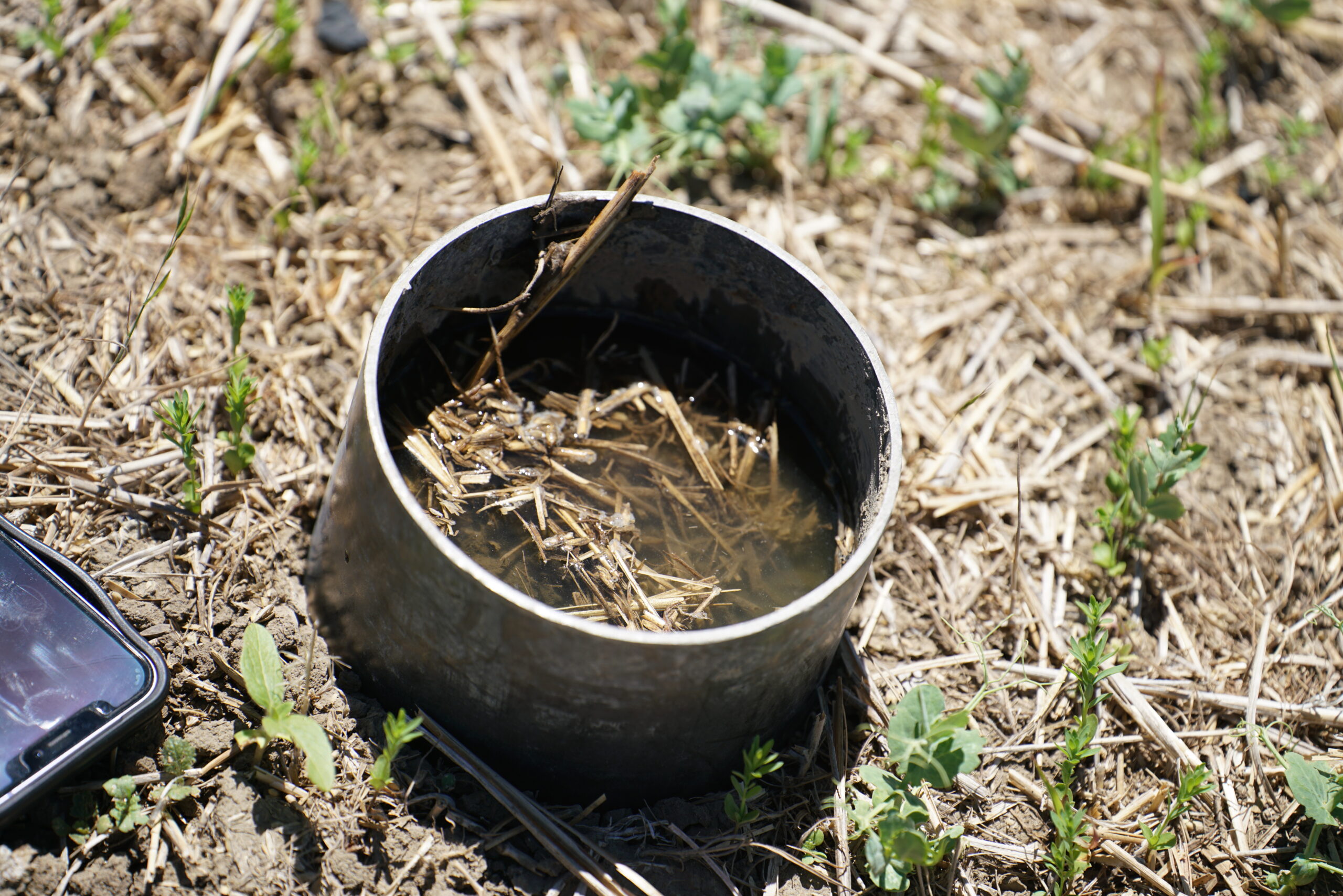
How quickly water enters the soil is one of the most practical indicators of improving health. As structure develops, water moves into the profile with ease, recharging the soil and reaching roots rather than eroding valuable topsoil. The simplest way to measure this is an infiltration ring: drive a ring of known diameter a set depth into the surface, add a measured volume of water, and time how long it takes to soak in. Done the same way in the same spots, a shortened infiltration time is evidence that the soil structure is improving.
Visual Differences
Finally, do not underestimate what your own eyes can tell you. Color is one of the clearest signs: as organic matter and biological activity build, soils tend to darken, and a richer, darker profile usually reflects more carbon and a more active microbial community. Worm castings are another telling marker.
From Potential to Performance
The most useful way to think about your soil is as a system of potential waiting to be unlocked. Chemistry tells you what is present, biology determines what becomes available, and the two only meet when the living system around the roots is healthy enough to do its work. A grower who understands that relationship can stop chasing deficiencies on paper and start asking a more productive question: is the biology in place to access what the soil already holds?
The good news is that the answer is something you can build, and you can see the results over time. Pair the lab work with the simple field tests and lean on regenerative practices to support biology. Over time, the darkening color, the aggregation, and the water that disappears into the profile all indicate soil that is learning to feed its crop from reserves that were there all along.