Acres U.S.A.® Magazine
  • Articles
    • News
    • Ecological farming
      • Climate
      • Environmental Issues
      • Farm management & planning
      • Human health
    • Livestock
    • Farm
    • Crop
      • Crop management practices
        • Ag technology
        • Cover crops
        • Crop nutrition
          • Crop protection
          • Diseases
        • Crops
        • Fruits
    • Soil
    • Opinion
  • Resources
    • Magazine
    • Online Learning
    • Newsletters
    • Free Articles
    • Blog
  • Magazine Issues
    • 2026
      • February 2026
      • January 2026
    • 2025
      • December 2025
      • November 2025
      • October 2025
      • September 2025
      • August 2025
      • July 2025
      • June 2025
      • May 2025
      • April 2025
      • March 2025
      • February 2025
      • January 2025
    • 2024
      • December 2024
      • November 2024
      • October 2024
      • September 2024
      • August 2024
      • July 2024
      • June 2024
      • May 2024
      • April 2024
      • March 2024
      • February 2024
      • January 2024
    • 2023
      • December 2023
      • November 2023
      • October 2023
      • August 2023
      • July 2023
      • June 2023
      • May 2023
      • April 2023
      • March 2023
      • February 2023
      • January 2023
    • 2022
      • December 2022
      • November 2022
      • October 2022
      • September 2022
      • August 2022
      • July 2022
      • June 2022
      • May 2022
      • April 2022
      • March 2022
      • February 2022
  • About Us
    • Our History
    • Our Staff
    • Contact Us
    • Community
      • Soil Health Primer Resources
  • Events
    • Eco-Ag Conference
    • Farm Weird Event
    • Viroqua On Farm Event
  • Subscribe
  • Login
  • Register
No Result
View All Result
  • Articles
    • News
    • Ecological farming
      • Climate
      • Environmental Issues
      • Farm management & planning
      • Human health
    • Livestock
    • Farm
    • Crop
      • Crop management practices
        • Ag technology
        • Cover crops
        • Crop nutrition
          • Crop protection
          • Diseases
        • Crops
        • Fruits
    • Soil
    • Opinion
  • Resources
    • Magazine
    • Online Learning
    • Newsletters
    • Free Articles
    • Blog
  • Magazine Issues
    • 2026
      • February 2026
      • January 2026
    • 2025
      • December 2025
      • November 2025
      • October 2025
      • September 2025
      • August 2025
      • July 2025
      • June 2025
      • May 2025
      • April 2025
      • March 2025
      • February 2025
      • January 2025
    • 2024
      • December 2024
      • November 2024
      • October 2024
      • September 2024
      • August 2024
      • July 2024
      • June 2024
      • May 2024
      • April 2024
      • March 2024
      • February 2024
      • January 2024
    • 2023
      • December 2023
      • November 2023
      • October 2023
      • August 2023
      • July 2023
      • June 2023
      • May 2023
      • April 2023
      • March 2023
      • February 2023
      • January 2023
    • 2022
      • December 2022
      • November 2022
      • October 2022
      • September 2022
      • August 2022
      • July 2022
      • June 2022
      • May 2022
      • April 2022
      • March 2022
      • February 2022
  • About Us
    • Our History
    • Our Staff
    • Contact Us
    • Community
      • Soil Health Primer Resources
  • Events
    • Eco-Ag Conference
    • Farm Weird Event
    • Viroqua On Farm Event
  • Subscribe
No Result
View All Result
Acres U.S.A.® Magazine
No Result
View All Result
Home Ecological farming Farm management & planning

True Cost

Maureen Ash by Maureen Ash
September 2, 2024
in Farm management & planning, September 2024
0
True Cost

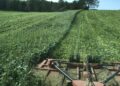
Cultivating potatoes (Courtesy of Maureen Ash)

0
SHARES
428
VIEWS
Share on FacebookShare on Twitter

A few reasons someone might want to pause before voting for cheaper potatoes

Maureen Ash

My husband and I are retired potato farmers who used to supply organically grown spuds to co-ops, restaurants and the odd grocery store.

One late autumn I walked through a local supermarket and noticed that I could buy 50 pounds of potatoes for less than five dollars. This was four times cheaper than the cheapest spuds we’d sold. I marveled briefly but wasn’t surprised.

When we first started growing potatoes, we sent in a card for a free issue of a magazine billing itself as the magazine of the potato industry. The issue arrived, slick and filled with ads for muscular herbicides, pesticides, fertilizers and machines. We didn’t subscribe, of course, but have received it faithfully ever since. One issue featured an article about how the environmental movement has been discredited on every front but one: education. Schools are still teaching our kids that global warming is a possibility, that some chemicals can be bad for people and animals, and that the rainforests are in danger. The article warned that if we aren’t careful, our kids could be turned into environmental activists.

This is the first paragraph of another editorial: “The author and columnist Llewellyn H. Rockwell, Jr. says that both environmentalism and socialism put the government in charge of the economy, but that they differ in one important aspect: ‘Socialism promises ‘prosperity’ for all, whereas environmentalism promises to make us all poorer, for the benefit of bugs and weeds.’” The editor goes on to dismiss Rachel Carson as an eco-poet. The issue discussed pest and weed control, and it reminded me a bit of what the bartender says: Name your poison.

When she was a young teen, my daughter entered a 4-H cooking contest. We took a recipe for coffee cake from one of her books and modified it—instead of white flour, she used our own whole wheat, hand-ground flour. Instead of shortening, she used ground flax seed. Rather than sugar, she used our own maple and sorghum syrups. 

It was a good contest, and Marian learned a lot from it. It was an educational experience for me, too, because I noticed that on Marian’s score sheet, the judge had checked the highest boxes for everything about the coffee cake except that it was not as nutritious or as cost-effective as it could have been.

I disagree on those points—I think anything made with whole-grain flour, the omega fatty acids in flax, and all the minerals available in sorghum and maple sugar is bound to be more nutritious than most of the foods I’ve seen at a 4-H function. Let’s be honest, though: coffee cake. Not exactly health food no matter how you slice it. But I think most about that cost-effective note.

We’re all doing our best to wring the most out of our dollars. It goes against anyone’s grain to waste money. But some people are in a position that allows them to stand back a bit and to consider not just the immediate need and the cheapest way to meet it. Many of us are less hand-to-mouth than that and can think about the upstream effects of our purchases, such as whether they were grown or produced in ways that harm the earth or the workers involved in those products’ journeys to our homes.

Even if I do consider these things, I don’t always not buy the item. Maybe I just need it, and my need cancels out my desire to use my purchasing power for good. Maybe there are two items, and one is so much more expensive than the other that I just can’t rationalize buying it. But in the main, I do try to consider what my high school economics teacher said over and over: your dollar is your vote. We can vote for the kind of world we want each time we spend our money.

Cost-effective potatoes, though? Well, you can buy potatoes for less than you can buy mine, I know that. Here’s the story of a potato grown on our farm.
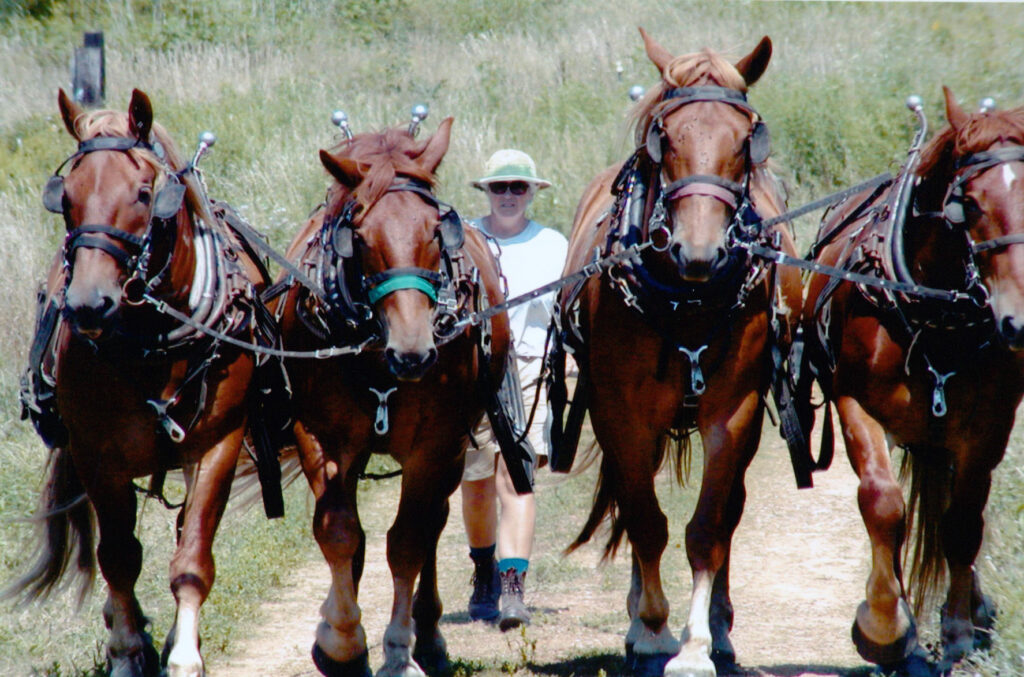
Driving team (Courtesy of Maureen Ash)

It was grown from an untreated seed potato. No synthetic chemicals were used to grow the seed potato, and no chemicals were applied to it to retard or promote sprouting. The seed piece was planted into our field, which was prepared for it through the rotation of crops, each of which was chosen for its effect on the potato’s healthy growth. Alfalfa roots fixed nitrogen, hairy vetch added more, and buckwheat smothered weeds and created a finer seedbed for our small potato piece.
Two horses pulled the potato planter — I drove, and my husband or one of the kids rode behind, ensuring that the planter was positioning a seed piece every six inches along the row. Five days later, I cultivated and hilled the potatoes with a team of horses — Katrina and Stella, or Martin and Margaret, maybe. I continued cultivating and hilling the crop until the plants were big and sprawling enough to shade out weeds.

Potato bugs are an enormous pest for potato growers. We battled ours through a combination of means. One, we planted in eight-row strips, each strip separated by a width of grass or clover, in which insects that prey on potato-bug larvae live. This alone reduced the number of potato bugs we dealt with. We also sprayed with a fish emulsion foliar feed to give the plants a boost, and if we were seeing more larvae than we liked, we’d add in some Bt, Bacillus thuringiensis, a bacteria that stops the larvae from eating the plants. 

Sometimes, when cultivating, I’d see down the row ahead that a plant had larvae on it. Then I’d stop the team so the plant was below me and I could just reach down and pick the evil little things off right then.

As the vines died back, we’d begin digging potatoes, using two horses on a spinner, which plowed the potatoes up and then threw them to the side. It was an amazing machine. We had to pick up the potatoes, load them into crates on the wagon, bring them down to the barn, put them through the washer, sort and pack them, and store them in the potato room. Finally, we could call the local store and ask if they needed potatoes that week!

The cheaper potatoes, now as then, are grown from treated seed pieces that were grown in soil treated up to eleven times with a variety of fumigants, fertilizers and herbicides BEFORE the seed piece was planted. The seed potato grew in this weedless, wormless, almost lifeless soil, was sprayed repeatedly with herbicides and pesticides, was harvested by a parade-float-sized digger that of course was pulled by a tractor larger than would fit in our barn, and was washed, treated with anti-sprouting compound, and trucked everywhere potatoes are sold.

The good thing about the cheaper potatoes is that people without a lot of money can afford more of them than they can of ours. I understand that.

Commercial potato growers aren’t mean spirited or out to destroy the earth — they work hard and are justifiably proud of what they produce. Farming on that scale takes commitment and grit. But I have to ask — is this the best use of their talents, work ethic and desire to grow food for people on earth? Maybe they’d like to have smaller operations without so many moving parts. Maybe they’d like to have a lower chemical bill and, for that matter, a lower chemical burden in their bodies, and those of their kids.

I’m not saying everyone should use horses to grow potatoes, or should only buy potatoes grown by farmers who use horses to grow them. Horses have their own effect on the land, not always good. I’m pondering it myself, to tell the truth, though I see little danger that farmers in the future are going to flock to buy teams of horses to use in their fields. 

I just want to point out the reasons someone might want to pause before voting for the cheaper potatoes, if they can afford the ones we and other small-scale, organic, and sustainable farmers grow. A greater demand for organic, regeneratively grown potatoes would lead to more farms like ours dotting the landscape, more families in the community, more activity on small-town Main Street, less erosion of soil into the rivers, fewer synthetic chemicals being made (less money going to Big Ag), fewer synthetic chemicals in the food we eat, and fewer synthetic chemicals in our soil, water, plants and bodies. 

To me, that seems like a pretty good buy. 

Albert Einstein may have turned physics sideways with his musings, but the economics of our home, Planet Earth, have remained immutable. You get what you pay for, even with potatoes.

Maureen Ash is the author of Holding the Lines: Horses, Hard Work, Love, and Potatoes, published by Acres U.S.A.

← Previous View from the Country Next Letters →
Tags: horse powerOrganicPotatoes
Maureen Ash

Maureen Ash

Maureen Ash is the author of Holding the Lines: Horses, Hard Work, Love, and Potatoes, published by Acres U.S.A.

Next Post
October 2024 • Issue #640

October 2024 • Issue #640

  • Trending
  • Comments
  • Latest
The Most Important Livestock in Our Fields

The Most Important Livestock in Our Fields

July 1, 2024
Glyphosate Does What It’s Designed to Do — Kill

Glyphosate Does What It’s Designed to Do — Kill

February 19, 2025
The Take-Half, Leave-Half Fallacy

The Take-Half, Leave-Half Fallacy

July 1, 2025
White snakeroot

Toxic Forages?

September 1, 2025
We Don’t Need Another Bridge — We Need an Off-Ramp

We Don’t Need Another Bridge — We Need an Off-Ramp

3
Under One Roof

Under One Roof

3
A Rose By Any Other Name

A Rose By Any Other Name

2
Terra Preta’s Biological Advantage

Terra Preta’s Biological Advantage

2
Don’t You Dare Disparage Sugar!

Don’t You Dare Disparage Sugar!

February 3, 2026
February 2026 • Issue #656

February 2026 • Issue #656

February 1, 2026
Fungal Exchange Capacity

Fungal Exchange Capacity

February 1, 2026
ECO-MEETINGS

ECO-MEETINGS

February 1, 2026

Recent News

Don’t You Dare Disparage Sugar!

Don’t You Dare Disparage Sugar!

February 3, 2026
February 2026 • Issue #656

February 2026 • Issue #656

February 1, 2026
Fungal Exchange Capacity

Fungal Exchange Capacity

February 1, 2026
ECO-MEETINGS

ECO-MEETINGS

February 1, 2026

About ACRES USA

Acres U.S.A.® Magazine

Acres U.S.A.® is North America’s oldest publisher on production-scale organic and regenerative farming. For more than 50 years, our mission has been to help farmers, ranchers and market gardeners grow food profitably and sustainably, with nature in mind.

Visit Our Advertisers

Magazine Issues

  • News
  • 2025
    • June 2025
    • May 2025
    • April 2025
    • March 2025
    • February 2025
    • January 2025
  • 2024 Articles
    • December 2024
    • November 2024
    • October 2024
    • September 2024
    • August 2024
    • July 2024
    • June 2024
    • May 2024
    • April 2024
    • March 2024
    • February 2024
    • January 2024
  • December 2023
    • December 2023
    • November 2023
    • October 2023
    • August 2023
    • July 2023
    • June 2023
    • May 2023
    • April 2023
    • March 2023
    • February 2023
    • January 2023
  • December 2022
    • November 2022
    • October 2022
    • September 2022
    • August 2022
    • July 2022
    • June 2022
    • May 2022
    • April 2022
    • March 2022

Contact Acres U.S.A

  • Contact Us
  • About Us
  • Advertise With Acres U.S.A.
  • My Subscription

Learn

  • Resources
  • Events
  • Magazine
  • Newsletters
  • Free Articles
  • Webinars
  • Online Courses
  • Bookstore

Our All Socials

Follow With Us...

  • My account
  • News
  • Ecological farming
  • Refund and Returns Policy
  • Privacy & Policy

© 2024 Acers USA Magazine

Welcome Back!

Login to your account below

Forgotten Password? Sign Up

Create New Account!

Fill the forms below to register

All fields are required. Log In

Retrieve your password

Please enter your username or email address to reset your password.

Log In
No Result
View All Result
  • HOME
  • ARTICLES
    • News
    • Farm
    • Ecological farming
    • Livestock
    • Crop
      • Crop management practices
      • Cover crops
      • Crop nutrition
      • Crop protection
      • Crops
      • Ag technology
    • Soil
    • Opinion
  • RESOURCES
    • Magazine
    • Online Learning
    • Newsletters
    • Blog
    • Free Articles
  • MAGAZINE ISSUES
    • 2025
      • June 2025
      • May 2025
      • April 2025
      • March 2025
      • February 2025
      • January 2025
    • 2024
      • December 2024
      • November 2024
      • October 2024
      • September 2024
      • August 2024
      • July 2024
      • June 2024
      • May 2024
      • April 2024
      • March 2024
      • February 2024
      • January 2024
    • 2023
      • December 2023
      • November 2023
      • October 2023
      • August 2023
      • July 2023
      • June 2023
      • May 2023
      • April 2023
      • March 2023
      • February 2023
      • January 2023
  • ABOUT US
    • Our History
    • Our Staff
    • Contact Us
    • Community
      • Soil Health Primer Resources
  • EVENTS
    • Eco-Ag Conference
    • On-Farm Viroqua Event
    • Farm Weird
  • SUBSCRIBE
  • Login
  • Sign Up
  • Cart

© 2024 Acers USA Magazine

Are you sure want to unlock this post?
Unlock left : 0
Are you sure want to cancel subscription?