
It is possible to move from an agriculture that relies on chemical management to one that is more friendly to nature and that reduces, or even eliminates, the application of agrochemicals.
Once upon a time here on Earth, there was a perfect natural balance between soil, plants, animals, carbon, and microorganisms. Every day, organisms did what they had to do to survive until the time came to complete their cycle and become part of the soil — a different form of life.
Nature integrates everything: from what we can observe with the naked eye to the chemical, physical, biochemical, and biophysical elements that we can only understand through the sciences — the life in the soil and its relationship with plants, animals, and humans.
This relationship was explained by botanist and organic farming pioneer Albert Howard, who said the health of soil, plants, animals, and humans is one and indivisible; it is like a “domino effect” — pushing one domino causes the others to fall.
We Get the Plants We Deserve
There is no form of life without sunlight — and it’s free! Scientist William R. Jackson reminds us that thanks to photosynthesis, we take advantage of intangible energy that is always possible to materialize.
In living beings, the healthier the organism, the better its use of solar energy. For example, manmade photocells to capture solar energy are very efficient when they are new, but over time they require revisions and maintenance.
The same happens with plants — each leaf is a “photocell” that captures energy and transforms it into sugars to feed microorganisms. The plant can also store energy in the form of carbon or can transfer it to other living organisms through root exudates. These cycles confirm Antoine Lavoisier’s law: energy is neither created nor destroyed; it is only transformed.
After the sun, the second most important element is water, which represents between 65 and 85 percent of the weight of all living things. It is also the means of transport of nutrients within the organism. All processes are made possible by water. Together with sunlight and oxygen in the air, water is vital for survival.
The balance of these elements is a determining factor in the quality of the food we eat. How long has it been since you tasted a fruit or vegetable with a real, intense flavor that was so delicious that it literally awakened your senses? We have let small changes in taste pass us by and have normalized it.
We are what we eat, but we also get the plants we deserve. The apparently positive response to the use of chemical fertilizers and the eagerness to seek more yield per hectare at relatively low cost provoked the excessive and indiscriminate use of these synthetic chemical inputs.
On the one hand, we obtained yields; yet on the other, we sacrificed nutrition. Plants began to get sick. Insects we considered pests did not arrive to attack them, but to warn us of the damage we are causing to our crops.
New Opportunities
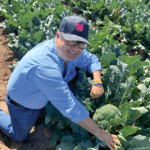
Fortunately, we are at a time when it is still possible to reverse the damage — starting by seeing pests as allies and not as enemies. More and more farmers are implementing good agricultural practices; as a farmer from Guanajuato whom I admire says, “you have to be gentle with the soil.”
To the farmers who risk livelihoods each agricultural cycle, I want to share with you that there are other ways, different from the traditional ones, to deal with insects; there are other means to increase yields without aggressive fertilization. And this is possible starting with small changes in our usual practices, which will gradually allow us to recover the fertility of the soil, increase the efficiency of photosynthesis in plants, and thus raise the energy of the same to produce more and better fruits.
These small changes determine what we will become, for better or worse. When we are young, and we eat lots of processed foods and bad carbohydrates, with little protein or vegetables, we run the risk of developing chronic diseases such as diabetes, hypertension, and other serious ailments. While it is true that some very fortunate people will not develop any disease, many with this type of diet are more likely to get sick at an early age. As alternative health specialist Barbara O’Neal explains it, genetics is what loads the gun, and lifestyle pulls the trigger. If you have a genetic predisposition and don’t eat right, you are more likely to get sick at an early age.
This context may worsen if we do not nourish ourselves with quality food. The current agri-food system has been characterized by producing more food but with low nutrient content and, in the worst cases, with high levels of toxic residues.
But, I reiterate, reversing this situation is possible by recovering the health of soils with regenerative practices. In her book For the Love of Soil, agroecologist Nicole Masters makes a comparison between conventional agriculture and the metamorphosis of a caterpillar to become a butterfly: to achieve an extraordinary change it is very likely to go through certain processes that will be painful.
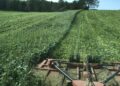
It is possible to move from an agriculture that functions 100 percent based on chemical management to one that is more friendly to nature and that reduces, or even eliminates, the application of agrochemicals. But this implies looking at things from another perspective. Insects do not attack crops; they approach them because the plants have low energy or poor nutrition. The plants are intoxicated because they have only
received synthetic fertilizers, because the soils accumulated salts and toxins season after season, until one day, they stop working and become compacted. This, in short, is what characterizes destructive agriculture.
Our soil, where it all begins, increasingly has lower carbon levels. Carbon is the structure of all organic molecules, and without it, we have less and less retention of nutrients, moisture, and microbiology.
Carbon helps the soil to condition, to breathe, because a soil that breathes provides an aerobic environment, which is synonymous with health and balance in microbiology.
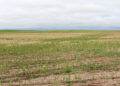
Agriculture is an economic activity that, like any other, allows us to gain experience by learning from mistakes. I remember a year in which it rained a lot at the beginning of wheat planting in the Yaqui Valley (Sonora). In order not to lose days, I tried sowing on the wet, compacted soil. The results were very bad; yields were very low. The soil had no air, and therefore the microbiology that grew there was anaerobic. I “hanged” the plant because the roots did not develop. In short, it was one of my worst harvests.
But that is how I learned, and year after year, I have tried to do things at the right time, with the right tools for each moment.
Human Health Relies on the Health of Nature
I can’t say for sure, but I believe that today’s droughts reflect what we are doing wrong in agriculture. It seems to me a logical consequence of years of deforesting without replenishing the trees that filter much of the oxygen we breathe and allow us to attract rainfall and maintain stable temperatures.
This, combined with intensive agriculture and intensive livestock farming, ends up having a negative impact on human beings as well. How can we be healthy in an environment that is not healthy? This is like a cancer, which can be fatal if we do not detect it — and attack it — in time.
But there is still time. Let’s start with small changes that favor ecological agriculture, based on a strategy of sustainability, productivity, and responsibility. This is possible. Rome was not created in a day, and the soil will not recover over the course of a single season. But with perseverance and constancy, we will achieve soils with more life and, therefore, more fertility.
Let’s keep doing this together. Have courage!
Sergio Dabdoub is the founder and CEO of Novedades Agrícolas DASA, a leading Mexican regenerative agriculture company.