• Home
  • Events

    Upcoming Events

    • Menoken Farm Field Day
    • Eco-Ag Conference
    • View all events →

    Recent Webinars

    • Kyle Richardville
    • David Montgomery
    • Gary Zimmer
    • Taylor Henry
    • Fernando Falomir
    • Megan Neubauer
    • David Knaus
    • View more webinar replays →
  • Bookstore

    Books by Category

    • Soil Health
    • Livestock & Animals
    • Gardening & Homesteading
    • Farm Business
    • Health & Food

    Books by Collection

    • New Releases
    • The Albrecht Volumes
    • Acres U.S.A. Published
    • Eco-Ag Speakers
    • Soil Health Educators

    Books by Level

    • Beginner
    • Intermediate
    • Advanced
    • Kids

    Featured

    • Explore Jon Stika's New Book →
  • Resources

    Continue Learning

    • White Papers
    • Online Courses

    Where to Find Us

    • Acres U.S.A. Podcast
    • YouTube Channel
    Facebook Instagram X-twitter Linkedin
    • Join our Newsletter →
  • Articles

    Articles by Topic

    • News
    • Ecological Farming
    • Livestock
    • Soil Health
    • Opinion

    Articles on Crops

    • Cover Crops
    • Crop Nutrition
    • Disease & Pests
    • Fruits & Nuts
    • Ag Technology

    Magazine Issues

    2026
    • January
    • February
    • March
    • April
    • May
    • June
    • July
    • August
    2025
    • January
    • February
    • March
    • April
    • May
    • June
    • July
    • August
    • September
    • October
    • November
    • December
    2024
    • January
    • February
    • March
    • April
    • May
    • June
    • July
    • August
    • September
    • October
    • November
    • December
    • Explore the archives →
    • Subscribe to the magazine →
  • About

    About Us

    • About Acres U.S.A.
    • Meet Our Team
    • Our History
    • Eco-Ag Achievement Award

    Contact Us

    • 970-392-4464
    • support@acresusa.com

    Acres U.S.A. LLC
    PO Box 351
    Viroqua, WI 54665

    • A New Era of Eco-Ag →
Subscribe
HOME
Events
  • Upcoming Events
  • Menoken Farm Field Day
  • Eco-Ag Conference
View all events
  • Webinars
  • Kyle Richardville
  • David Montgomery
  • Gary Zimmer
  • Taylor Henry
  • Fernando Falomir
  • Megan Neubauer
  • David Knaus
Bookstore
  • Books by Category
  • Soil Health
  • Livestock & Animals
  • Gardening & Homesteading
  • Farm Business
  • Health & Food
  • Books by Collection
  • New Releases
  • The Albrecht Volumes
  • Acres U.S.A. Published
  • Eco-Ag Speakers
  • Soil Health Educators
  • Books by Level
  • Beginner
  • Intermediate
  • Advanced
  • Kids
Resources
  • Continue Learning
  • White Papers
  • Online Courses
  • Where to Find Us
  • Acres U.S.A. Podcast
  • YouTube Channel
Facebook Instagram X-twitter Linkedin
Join our Newsletter
Articles
  • Articles by Topic
  • News
  • Ecological Farming
  • Livestock
  • Soil Health
  • Opinion
  • Articles on Crops
  • Cover Crops
  • Crop Nutrition
  • Disease & Pests
  • Fruits & Nuts
  • Ag Technology
  • Magazine Issues
2026
  • January
  • February
  • March
  • April
  • May
  • June
  • July
  • August
2025
  • January
  • February
  • March
  • April
  • May
  • June
  • July
  • August
  • September
  • October
  • November
  • December
2024
  • January
  • February
  • March
  • April
  • May
  • June
  • July
  • August
  • September
  • October
  • November
  • December
Explore the archives
Subscribe to the magazine
ABOUT
SUBSCRIBE

The Power of Perennials

Mark Shepard by Mark Shepard
May 2, 2026
0
Home Ecological farming
0
SHARES
50
VIEWS
Share on FacebookShare on Twitter

By managing photosynthesis, disturbance, and canopy structure, farmers can create regenerative ecosystems that capture more energy than traditional 2D cropland

Mark Shepard

As farmers and ranchers, we’re in the solar energy business. 

The sun shines on the green leaves and stems of our crop plants and is the driver of photosynthesis. During photosynthesis, plants take in carbon dioxide from the air, and the energy from photosynthesis is used to connect carbon, hydrogen and oxygen and turn it into simple sugars. Simple sugars such as glucose are then reassembled to make more and more complex molecules. The product of these processes, whether in the form of a grain or a leaf or a vegetable, as well as the minerals contained in them, are the crop yields that we depend on for our livelihood. At the end of the day, a farmer or rancher’s yield and income are directly related to how much photosynthesis happens on our site. 

Not all energy from photosynthesis turns into a marketable product, however. Some of the energy is used by the plant to make more complex molecules such as starches, oils, flavors, aromas, and colors, and for the general metabolism of the plant. 

An eco-farm doesn’t run on synthetic fertilizer; it runs on the energy and nutrients from photosynthetically fixed carbon, cycling through life, death, and decay. The greater the photosynthesis, the more potential energy we have. The growth and metabolism of decomposer organisms—the lifeblood of our soil—is fueled by the energy stored in organic matter: the Net Photosynthetic Productivity (NPP). 

What Is NPP? 
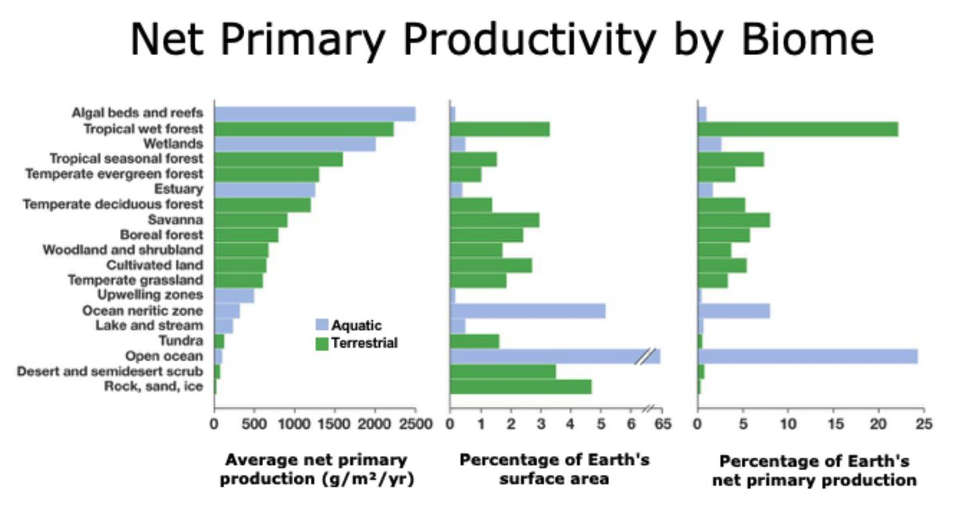
Productivity by biome (Freeman, S. Biological science. Pearson/Benjamin Cummings)
Savannas capture a full 30 per cent more energy per acre than on cropland or pasture.

NPP represents the energy plants capture from sunlight through photosynthesis, minus what they use during respiration. This is stored in plant biomass first. Some is added to the soil in the form of root exudates, and some is consumed by graziers or decomposers and returned to the soil. NPP is equivalent to our energy “net margin.” Net margin, or net profit margin, measures the percentage of revenue remaining as profit after deducting all operating expenses. 

The annual rate of biomass accumulation in live plants, live animals and soil organic matter in a particular land area is termed the Net Ecosystem Production (NEP). It’s the balance of how much carbon is stored versus how much is used in metabolism, lost through volatilization, or harvested.

When NEP is positive, carbon is building up. The ecosystem is storing more energy than it uses. But when it turns negative? That’s a flashing red light. A negative NEP means the system is breaking down faster than it’s growing — a telltale sign of degradation. This is the classic divide between agriculture that is regenerative versus that which is degenerative. 

If you are adding more to your “ecosystem savings account,” you’re on the right path. 
Disturbance: A Double-Edged Sword 

Nature is no stranger to disturbances. Fires, storms, and grazing animals all play their role. Managed well, they create opportunities for regeneration. When mismanaged, though, they send NEP into the red. Clear-cuts, overgrazing, and monocultures strip ecosystems of their resilience. The amount of live biomass shrinks, organic matter decomposes faster than it’s replenished, and carbon escapes into the atmosphere.

When disturbance outpaces recovery, soil fertility declines. You’re no longer growing the carbon that fuels the decomposers. Without the decomposers, plant nutrients remain locked away in organic matter, unavailable to plants, and crop yields decline. Well-timed disturbance of the appropriate kind (mowing, tillage, grazing) is what we do to feed the decay cycle and strategically release nutrients for our crops and for building soil. 

Since we’re in the business of capturing as much sunlight as possible and turning it into harvestable biomass, it is in our best interests to create a system that maximizes photosynthetic surface area and accumulates the most biomass. The “devil in the details” is that we have to figure out how to convert NPP into dollars! 

The image accompanying this article is a list of various terrestrial biomes and the average NPP for those systems. Notice that cultivated land has an NPP of around 600 grams of photosynthate produced on every square meter of land. If you were to switch from growing annual grains to growing a perennial grassland harvested by graziers, you really wouldn’t be gaining any net photosynthesis. The NPP of grasslands is roughly the same as annual crops, but you should be better off financially because grazing doesn’t require equipment for tillage, cultivation and harvest. Custom-hire someone once to seed your pasture, then mow and fertilize with cattle. 

Now take a look at the NPP for a savanna. Savannas include trees, shrubs, vines, and canes at various stages of growth within a matrix of grassland, with approximately 30-60 percent woody canopy closure. The grass grows well; animals have protection from the sun, wind, and rain; and the system captures approximately 900 grams of photosynthate per square meter. I.e., there’s a full 30 percent more energy capture per acre in a savanna system than on cropland. If slightly lower yields occur in our alley crop or pasture (research at the University of Missouri shows otherwise) we can afford it because we’re capturing 30 percent more energy. 

As the trees and shrubs in a savanna grow, they develop a deeper, more convoluted canopy structure. This increases the photosynthetic surface area of the system, which increases until right before the canopy closes. Once the canopy closes, grasses will die out. Total NPP is greater (nearly twice that of an annual crop field, at 1,200 grams per square meter), but we’ll be in a forest, and the diversity of opportunities declines. You can do just about everything in a savanna that you could do in a forest, but you can’t do everything in a forest that you could in a savanna. 

Remember: net canopy photosynthesis—and hence the amount of photosynthate available for growth, maintenance and reproduction—is a product of total canopy leaf area. Leaf area just prior to canopy closure sets the upper limit on canopy photosynthesis and therefore sets the limit on the amount of “gross photosynthetic income” that is available. 

In an agroforestry system, whether we’re growing crops or grazing animals, our job becomes managing light and shade. We want to keep our system in the optimum range where there is enough light for productive crops and pasture, yet enough shade to get the benefits of cooling, wind protection, ample decay products and extra yields. Whenever the canopy is about to close and grass growth slows down, it’s time to harvest some trees (as saw logs, pulp, firewood, branches for animal feed, or mushrooms). Once the canopy is opened up, we can add more or different woody species to the system. 

Once our system has reached this stage, it can be managed in perpetuity as a strategically disturbed ecosystem that harvests twice the sunlight as an annual crop field and that cycles nutrients in a guided way. We have become participants in the dance of life itself.

← Previous Growing Bananas Next Apples: Biologically Grown →
Tags: Net photosynthetic productivitySavannas
Mark Shepard

Mark Shepard

Mark Shepard is a land designer and consultant and is the author of Restoration Agriculture, Water for Any Farm and the Water for Any Farm Technical Manual.

Next Post
Yes, There Are Enough Organic Wastes

Yes, There Are Enough Organic Wastes

  • Trending
  • Comments
  • Latest
The Most Important Livestock in Our Fields

The Most Important Livestock in Our Fields

July 1, 2024
Glyphosate Does What It’s Designed to Do — Kill

Glyphosate Does What It’s Designed to Do — Kill

February 19, 2025
USDA organic seal over American farm land

Losing Organic Farms

September 18, 2026
The Take-Half, Leave-Half Fallacy

The Take-Half, Leave-Half Fallacy

July 1, 2025
We Don’t Need Another Bridge — We Need an Off-Ramp

We Don’t Need Another Bridge — We Need an Off-Ramp

3
Under One Roof

Under One Roof

3
A Rose By Any Other Name

A Rose By Any Other Name

2
Terra Preta’s Biological Advantage

Terra Preta’s Biological Advantage

2
Blaming the Wolves

Blaming the Wolves

September 16, 2026
Running Dry

Running Dry

September 10, 2026
What Are Lactating Steers Trying to Tell Us?

What Are Lactating Steers Trying to Tell Us?

September 3, 2026
Remembering Wendell Berry

Remembering Wendell Berry

September 2, 2026

Recent News

Blaming the Wolves

Blaming the Wolves

September 16, 2026
Running Dry

Running Dry

September 10, 2026
What Are Lactating Steers Trying to Tell Us?

What Are Lactating Steers Trying to Tell Us?

September 3, 2026
Remembering Wendell Berry

Remembering Wendell Berry

September 2, 2026

Don't miss an update!

Stay informed on what's new in the Acres U.S.A. community: new articles, upcoming events and resources for regenerative farmers.

Acres U.S.A. is North America’s oldest publisher on production-scale organic and regenerative farming. For more than 50 years, our mission has been to help farmers, ranchers and market gardeners grow food profitably, regeneratively, and with nature in mind.

Facebook Instagram X-twitter Youtube Linkedin Spotify

SHOP

  • Bookstore
  • Online Courses
  • Giftcards

ABOUT

  • About Acres U.S.A.
  • Our Team
  • Eco-Ag Acheivement

LEARN

  • Events
  • Magazine
  • Newsletter
  • Webinars
  • Free Articles
  • Online Courses

Contact Us

Acres U.S.A. LLC
PO Box 351
Viroqua, WI 54665​
info@acresusa.com
970-392-4464
  • Manage My Subscription
  • Advertise with Us
No Result
View All Result
  • HOME
  • ARTICLES
    • News
    • Farm
    • Ecological farming
    • Livestock
    • Crop
      • Crop management practices
      • Cover crops
      • Crop nutrition
      • Crop protection
      • Crops
      • Ag technology
    • Soil
    • Opinion
  • RESOURCES
    • Magazine
    • Online Learning
    • Newsletters
    • Blog
    • Free Articles
  • MAGAZINE ISSUES
    • 2026
      • June 2026
      • May 2026
      • April 2026
      • March 2026
      • February 2026
      • January 2026
    • 2025
      • December 2025
      • November 2025
      • October 2025
      • September 2025
      • August 2025
      • July 2025
      • June 2025
      • May 2025
      • April 2025
      • March 2025
      • February 2025
      • January 2025
    • 2024
      • December 2024
      • November 2024
      • October 2024
      • September 2024
      • August 2024
      • July 2024
      • June 2024
      • May 2024
      • April 2024
      • March 2024
      • February 2024
      • January 2024
    • 2023
      • December 2023
      • November 2023
      • October 2023
      • August 2023
      • July 2023
      • June 2023
      • May 2023
      • April 2023
      • March 2023
      • February 2023
      • January 2023
  • ABOUT US
    • Our History
    • Our Staff
    • Contact Us
    • Community
      • Soil Health Primer Resources
  • EVENTS
    • Eco-Ag Conference
    • Farm Weird
  • SUBSCRIBE
  • Login
  • Sign Up
  • Cart

© 2024 Acers USA Magazine

Lost Password?