
The origins of anti-organic rhetoric in the 1950s
Can organic farming feed the world?
For over seventy years, most agronomists and soil scientists have said that the answer is no. The belief that organic farming is unscientific has been passed down from one generation of researchers to another through informal conversations in labs, in the hallways at conferences, and over a beer after a hard day of field work. For decades, making derogatory comments about organic farming has been as much a part of ag lab culture as rooting for the university football team.
Even today, when most agricultural universities have at least one faculty member doing organic research, anti-organic sentiment lingers among older agronomists and some of their students. They may regard organic farming as a “nice niche” to sell to privileged consumers, but there’s no way it could feed the world. Only the best conventional agriculture can do that!
But where did the idea that organic farming couldn’t feed the world come from in the first place? Why is “feeding the world” the biggest argument against organic farming? Why do American agronomists feel like it’s their responsibility to feed the world? And why have agricultural scientists in general been so opposed to organic farming?
The answer to all of these questions lies in the early 1950s — at the beginning of the Cold War.
The Age of Science
The general American public first heard about organic farming in 1945, when Russell Lord wrote a review of J.I. Rodale’s new book Pay Dirt for the New York Times Magazine. But front-page news that August was focused on something much bigger — the atomic bombs that the United States dropped on Hiroshima and Nagasaki.
Even though conventional explosives had killed far more people and destroyed more buildings earlier in the war, the atomic bomb was exceptionally terrifying because it split the fundamental particle of all matter — the atom. And it was American scientists who had unlocked the secrets of nature to create the bomb. As historian Paul Boyer writes in his book By the Bomb’s Early Light, scientists were held in “near veneration” after the war.
But the bomb also brought fear. Maybe science was getting too dangerous. If scientists had the power to create a weapon that could split the atom, what else might they do? The future of scientific research after the war was by no means assured. Given the right incentives, the United States could have called for a ban on future nuclear research, destroyed the weapons production facilities, and withdrawn from global politics.
Fearful of losing their newfound prestige and power, scientists worked hard to make sure that wouldn’t happen. In July 1945, Vannevar Bush wrote a report to the president titled Science: The Endless Frontier, in which he argued that scientific research was essential to national security. “Without scientific progress no amount of achievement in other directions can ensure our health, prosperity, and security as a nation in the modern world,” he warned. Terrifying as the atomic bomb might be, it would be far worse if an enemy nation came up with a more destructive weapon first.
Even in times of peace, Bush argued, scientific progress was essential. Most of his report focused on medicine, labor-saving technology, and defense. But “great advances in agriculture are also based upon scientific research,” he added. “Plants which are more resistant to disease and are adapted to short growing seasons, the prevention and cure of livestock diseases, the control of our insect enemies, better fertilizers, and improved agricultural practices, all stem from painstaking scientific research.”
Though Bush’s recommendations were not followed to the letter, the Department of Defense invested heavily in scientific research after the war. During the 1950s, a third of all research in private industry and 75 percent of research in aerospace and electronics was funded by defense money.
University research programs in all areas mushroomed after the war, fueled both by the influx of defense spending and a surge of new college students funded by the G.I. Bill. It was a time of unprecedented growth for all kinds of scientific research — and agronomists wanted to make sure they got their piece of the pie. All they needed to do was to argue that their research was essential for national security.
Fighting Communism with Food
During and after World War II, speculation abounded as to why Germany and Japan had become so aggressive. One popular theory was that these relatively small nations had become overpopulated and were unable to feed themselves on their own land. And if it could happen once, it could happen again. Overpopulation, the reasoning went, causes resource exhaustion, which causes hunger, which causes political instability, which causes Communist insurrections, which causes danger to American interests, which causes war. Historian John Perkins named this chain of events “population-national security theory” in his book Geopolitics and the Green Revolution.
Predictions of an impending global catastrophe caused by overpopulation abounded in the late 1940s. Population researchers Guy Irving Burch and Elmer Pendell argued in their 1945 book Population Roads to Peace and War that democracy was “like a flower that cannot survive where the weeds of overpopulation crowd.” If population growth was not immediately checked and reversed, “we may as well give up all hope of continuing civilized life,” ornithologist William Vogt wrote in his 1948 book Road to Survival. “We shall rush down a war-torn slope to a barbarian existence in the blackened rubble.”
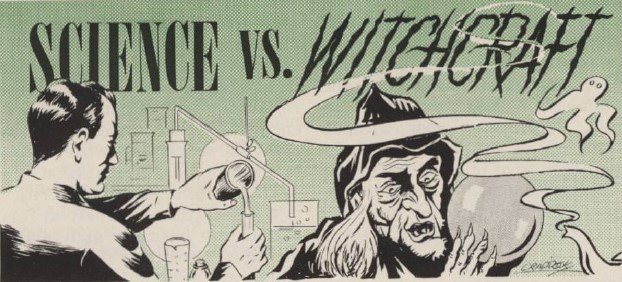
Such doomsday rhetoric didn’t fit well with the scientific optimism of the day. Agronomists agreed that prewar food production techniques couldn’t feed the world’s growing population. But “modern science has made entirely possible the production of ample food for all the people of the world,” agricultural economist Howard Tolley wrote in 1945. Starvation wasn’t inevitable, he argued. Science — and science alone — could save the day.
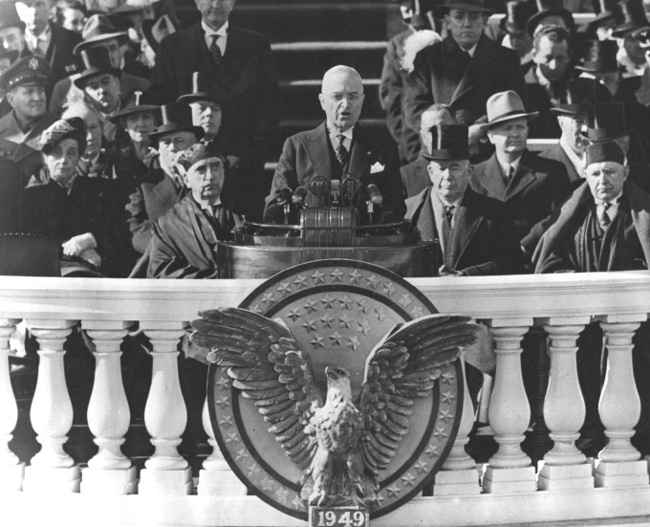
The belief that scientific agriculture was the only way to feed the world and prevent the predicted famines became an essential part of American foreign policy. International agricultural development was part of U.S. President Harry Truman’s 1949 “Point Four” speech. “We must embark on a bold new program for making the benefits of our scientific advances and industrial progress available for the improvement and growth of underdeveloped areas,” he argued.
“Our aim should be to help the free peoples of the world, through their own efforts, to produce more food, more clothing, more materials for housing, and more mechanical power to lighten their burdens,” Truman continued. “Democracy alone can supply the vitalizing force to stir the peoples of the world into triumphant action, not only against their human oppressors, but also against their ancient enemies — hunger, misery, and despair.”
It was true that in 1949, American agriculture wasn’t much more productive than anywhere else in the world. But that was about to change. Agronomists knew that they had a secret weapon that could double or triple agricultural yields overnight: chemical fertilizers. Once farmers in America and around the world started using fertilizer at the recommended rates, it would begin the greatest era of agricultural productivity the world had ever known. And they emphasized that science was the key to unlocking those high yields.
Threats to the Fertilizer Industry
With memories of World War II still fresh in everyone’s minds, the news that the United States had entered the Korean War on June 25, 1950, came like a shock of cold water. No, not again! The U.S. hadn’t yet officially declared war, but if it did, would it be total war again? Would there be price controls, rationing, and food shortages? Most importantly from the agronomic point of view, would fertilizer be rationed like it had been during World War II?
By September, it was becoming obvious that the Korean Conflict was not going to be World War III. The U.S. never officially declared war, and there were no price controls or rationing. But just as panic about the possibility of fertilizer rationing was subsiding, agronomists’ plans for feeding the world with fertilizer faced a new threat. A U.S. House of Representatives committee, chaired by James J. Delaney, was going to hold a series of hearings on the possible dangers of chemicals in food. And chemical fertilizers were on the list of suspects.
To counteract both of these threats, the chemical fertilizer industry, soil scientists and agronomists launched a massive campaign to defend fertilizers. The main tact that they took, as anti-communist sentiments rose to a fever pitch during the McCarthy era, was to argue that fertilizers were the only way to feed the world and stave off communism. Therefore, any attack on the fertilizer industry was an attack on freedom and democracy.
“A high standard of living is the arch foe of communism,” journalist Paul Sandars emphasized in 1951. “The fertilizer industry … holds the key that will unlock the door to bigger incomes, to a higher standard of living, and to better health throughout this great land of ours.”
The scientists who testified at the Delaney hearings quickly discovered that the only reason fertilizers were on the list of suspect chemicals at all was because J.I. Rodale and other organic leaders had claimed that chemically fertilized plants were nutritionally inferior to organically fertilized plants. Rodale had also claimed that some chemical fertilizers — including the relatively benign superphosphate — caused cancer.
Furious at the suggestion that their lifesaving and war-preventing chemical fertilizers might be unhealthy, many of the witnesses at the Delaney hearings included snide remarks or outright attacks on organic farming in their testimonies. Their main tactic was to portray anyone who had a problem with chemical fertilizers as an unscientific quack.
“In spite of this outstanding record of achievement, the use of chemical fertilizers is being attacked in this country by a small and very vociferous group,” warned Richard Bradfield, an agronomy professor at Cornell University.
“For years critics of the fertilizer industry have tried to make the term ‘chemical’ a scare word,” Russell Coleman, president of the National Fertilizer Association, concurred. “They have tried to implant in the public mind the idea that a chemical product is the result of some sort of black magic, hence undesirable. A so-called natural product, according to this mythology, is just the opposite and embodies all the worth-while virtues…. There is more than a superficial resemblance between the attitudes of the organic cultists and those of the witch doctor.”
The Delaney Committee did give J.I. Rodale a chance to testify and defend himself against his critics. Rodale gave a lengthy summary of organic farming methods and his concerns about the long-term health effects of chemical fertilizers. But by the time he testified at the hearings, the Committee had already listened to many Ph.D. soil scientists and agronomists, and they were skeptical of Rodale’s lack of credentials.
“So your experience — I am not being critical, don’t misunderstand — your experience has been principally in the editing and accounting field, and the manufacture of electric wire?” asked Thomas Abernathy, a representative from Mississippi.
“I could list 15 new observations in gardening that I discovered,” Rodale countered. “You see, I am just a man of general intelligence. I want to demand a few minutes, because the purpose of what you are doing is to try to belittle me.”
“No, no,” Abernathy said quickly.
“What you are doing will be taken up by the opposition and they will make capital of it,” Rodale insisted. “Don’t let the college professors say there is no evidence. It is like going to the criminal elements and saying, ‘You police crime.’ It may be far-fetched as an example, but there is some element of truth in it. The college professor gets money for research. His job is based on the money given by the chemical fertilizer factories. At least half of the money in our agricultural experimental stations comes from the chemical fertilizer companies.”
But Rodale was outnumbered. Only one other organic farmer, Leonard Wickenden, testified in the Delaney hearings. The majority consensus was that chemical fertilizers were essential to feed the world — and that organic farmers were cultists, quacks and witch doctors.
The Cold War Begins
“Some of the Nation’s most eminent soil and plant scientists appeared before the committee to present their views on the use of fertilizers in the United States,” the Delaney Committee wrote in their final report in May 1952. “Without exception, every witness emphasized the necessity for the employment of fertilizers on most soils of the country to insure an adequate and sustained supply of food crops of high nutritive value.”
To the relief of agronomists across the country, the Delaney Committee concluded that “no reliable evidence was presented to this committee to indicate that the use of chemical fertilizers presents a hazard to man or animals” and that “the situation existing in the field of fertilizers does not reveal any need at this time for Federal legislation.” The crisis was averted. There was no danger that fertilizers would be regulated or banned.
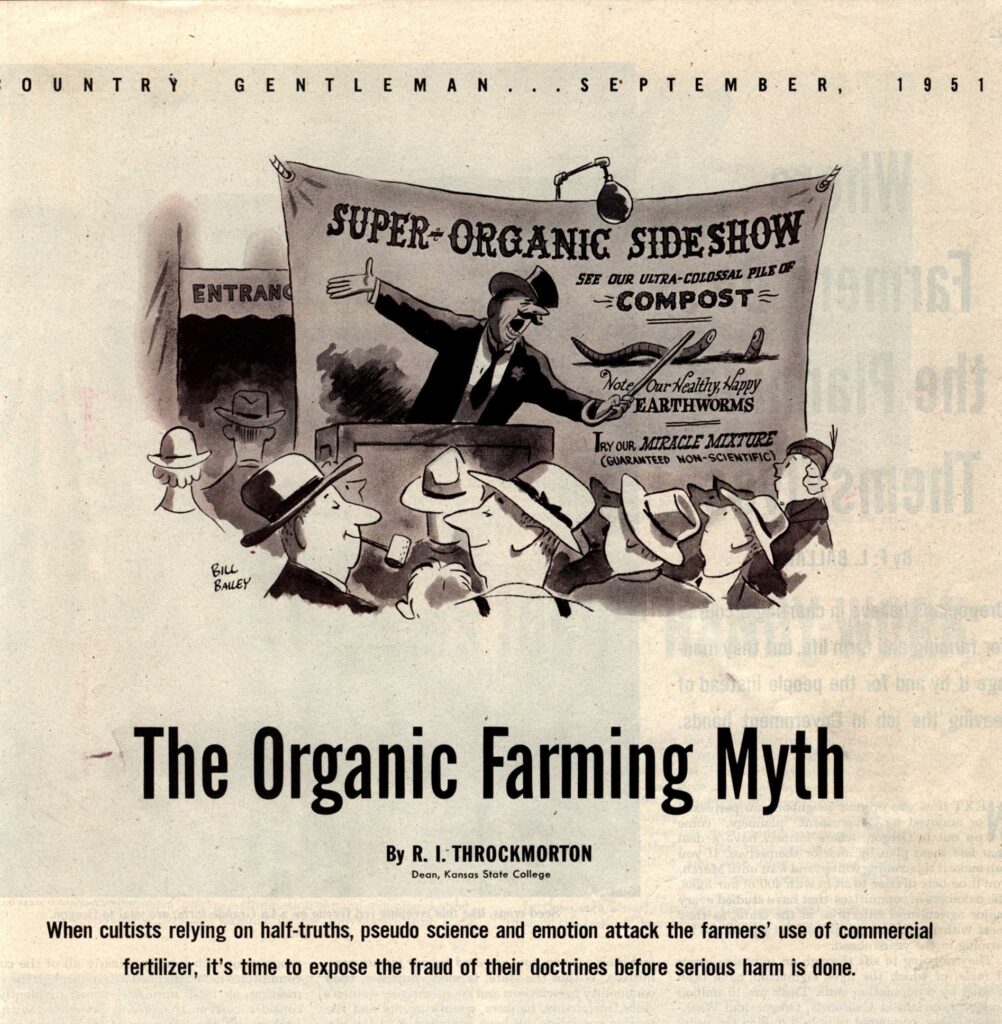
But the agronomists were still uneasy. Sure, they had convinced Congress that chemical fertilizer was vital—but what if those organic cultists succeeded in duping the public into wanting to buy organically grown produce? Ray I. Throckmorton made the first attempt to get the truth as he saw it out to the public by attacking organic farming in a 1951 article for the farming magazine Country Gentleman. It was reprinted in Reader’s Digest a year later. For the next two decades, almost every mention of organic gardening or farming in a mainstream popular publication was negative, thanks to the efforts of agronomists and fertilizer industry representatives.
Until the late 1980s, it was taboo to even mention organic farming in a favorable light at a major agricultural university. Agronomists would attack organic farming in their classes, sometimes even reading letters from organic farmers in a derogatory tone to their students. In agricultural universities during the early Cold War, mentioning organic farming favorably was almost on par with being a Communist sympathizer. In a sense it was, according to their logic. After all, if organic farming couldn’t feed the world, and feeding the world was the only way to fight Communism, then widespread adoption of organic farming would mean giving the Communists the upper hand and maybe starting World War III!
While this stigma against organic farming began to collapse in the late 1980s, some of its legacies linger on in agricultural universities today. They can be found in the omission of information on organic nutrient cycling in soil fertility classes, in research project choices and funding, and in ongoing discussions about feeding the world.
Few agronomists today know about this history. Yet it has profoundly shaped agricultural research in the United States. As agricultural universities become more open to doing research on soil biology and organic systems, it’s time to acknowledge this history and realize that the belief that organic farming couldn’t feed the world was based on Cold War politics, not scientific research.
Anneliese Abbott is the author of Malabar Farm: Louis Bromfield, Friends of the Land, and the Rise of Sustainable Agriculture, and she runs the site historyoforganic.com. She has a master’s degree in agroecology from the University of Wisconsin-Madison and farms with her family in Otsego, Michigan.