
An overview of the benefits, specific practices and seasonal uses of cover crops
The rising costs of synthetic fertilizers, combined with the growing demand for sustainable farming practices, have led the agricultural sector to seek out innovative, effective solutions. Among these, the strategic use of cover crops has emerged as a powerful tool for prescriptive applications, addressing specific agronomic challenges both above and below the soil surface. Cover crops are increasingly recognized for their role in reducing reliance on chemical inputs and serving as a natural source of nutrients. This dual function makes them not only a cost-effective and environmentally friendly alternative to traditional farming methods but also a targeted approach to managing soil health and crop productivity.
Cover crops offer a practical means to improve soil structure, retain moisture, suppress weeds and increase organic matter. Commonly used cover crops include legumes like clover and vetch, grasses such as rye and oats, and brassicas like radish and mustard, each selected for their ability to meet specific agricultural needs.
Addressing Agronomic Problems with Covers
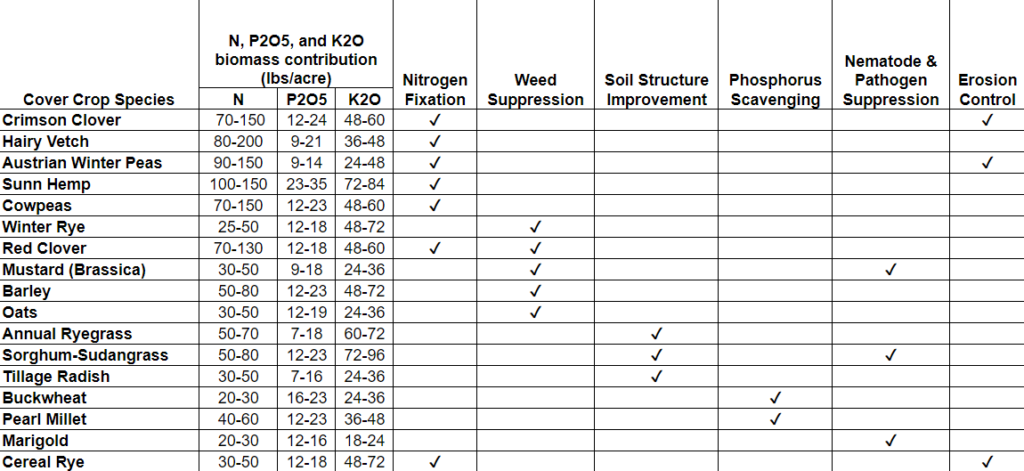
Figure 1 outlines the targeted benefits of cover crops, such as organic matter development, soil structure improvement, weed suppression and pest management.

Weed Suppression and Pest Management
One of the primary advantages of cover crops is their ability to suppress weeds and manage pests. For instance, both rye and clover can reduce weed biomass by up to 80 percent due to their rapid growth and dense canopy, which crowds out weeds. Rye also releases allelopathic chemicals that inhibit the germination and growth of certain weed species, reducing the need for herbicides.
Mustard cover crops can reduce weed populations by 50-75 percent through physical suppression and the release of biofumigant compounds from glucosinolates, which also help in managing soilborne pests such as nematodes. This dual action makes mustard an effective tool for integrated pest management.
Soil Structure Improvement
Cover crops are also instrumental in improving soil structure and nutrient cycling. Deep-rooted species like radishes are particularly effective at breaking up compacted soils, improving water infiltration, and enhancing root penetration for subsequent crops. Studies have shown that radishes can reduce soil bulk density from 1.5 g/cm³ to 1.2 g/cm³, significantly improving soil health.
Leguminous cover crops, such as crimson clover and hairy vetch, play a crucial role in nutrient cycling by fixing atmospheric nitrogen. This can contribute between 70 and 200 lbs of nitrogen per acre annually, depending on the residue amount. This natural process reduces the need for synthetic nitrogen fertilizers by up to 50 percent, resulting in substantial cost savings.
Sorghum-sudangrass adds up to 5,000 lbs of organic matter per acre, which enhances soil microbial activity, nutrient retention and overall soil tilth. The added organic matter also improves the soil’s water holding capacity by 10-20 percent.
Using Cover Crops as a Fertilizer Alternative
As fertilizer prices continue to rise, the use of cover crops such as crimson clover offers a viable alternative by fixing significant amounts of nitrogen in the soil. The economic value of this nitrogen contribution can be equivalent to $50-100 per acre, depending on current nitrogen prices. Moreover, cover crops like clover and vetch contribute substantial amounts of phosphorus and potassium, with a field planted with crimson clover yielding 150 lbs of nitrogen, 10 lbs of phosphorus, and 50 lbs of potassium per acre, which significantly reduces the need for commercial fertilizers.
In the Midwest, using rye as a winter cover crop in a corn-soybean rotation has been shown to reduce weed pressure by 70 percent and decrease herbicide use by 30 percent. Additionally, rye cover crops can scavenge residual nitrogen, preventing it from leaching and thus improving nitrogen efficiency for subsequent crops. In the southeastern United States, incorporating hairy vetch into a wheat rotation has increased available nitrogen by 80-120 lbs per acre, resulting in a 15 percent increase in wheat yield without additional synthetic fertilizers.

Termination, Challenges and Considerations
Cover crops must be managed properly to avoid competition with cash crops for resources such as water and nutrients. Terminating cover crops like rye 2-3 weeks before planting cash crops can prevent moisture competition and facilitate crop establishment.
While the initial costs for establishing cover crops may be higher, the long-term benefits, such as reduced input costs and improved yields, often outweigh these expenses. A cost-benefit analysis conducted on a farm in Pennsylvania showed that the use of cover crops reduced total input costs by 20 percent over five years, leading to a net increase in profitability of $150 per acre annually.
Table 1 provides a detailed summary of cover crop species and their prescriptive agronomic benefits, including their NPK contribution as a fertilizer offset.
Seasonal Planting Guide
The choice of cover crops depends largely on the season and the specific agronomic goals of the farmer. Cool-season crops, which thrive in the cooler temperatures of early spring and fall, include species like cereal rye, oats and clover. These crops are typically planted as the weather begins to cool in the fall or as soon as the soil can be worked in the spring. Warm-season crops, which flourish in the warmer months of late spring and summer, include cowpeas, sorghum sudangrass and sunflowers. These crops are planted after the risk of frost has passed and the soil has warmed up sufficiently.
Figure 2 provides a visual guide to planting cover crops throughout the year, showing what to plant, when to plant, what crops to follow up with, or what to avoid planting after.

Guides for Prescriptive Uses and Planting
When it comes to incorporating cover crops into your agricultural practices, having the right resources is crucial for success. Seed companies like Green Cover Seed and GO Seed offer a wide range of cover crop seeds tailored to various soil types and climates. These companies provide tools like the SmartMix Calculator to help farmers design custom cover crop mixes suited to their specific needs. ASTA offers a comprehensive interactive map to help farmers locate nearby cover crop seed dealers. This resource is particularly useful for ensuring that farmers have access to high-quality, locally adapted seeds that can enhance both productivity and conservation efforts.
Additionally, resources like the Managing Cover Crops Profitably guide and the Cover Crop Decision Tool from the Midwest Cover Crops Council offer valuable insights for making informed decisions about cover crop selection and management. Along with this, many university extension programs offer region-specific guides and recommendations for cover crop use. These resources often include planting dates, seeding rates and management tips that are crucial for maximizing the benefits of cover crops.
The use of diverse cover crop mixes is increasingly popular, as they address multiple soil health objectives such as improving nutrient cycling, enhancing soil structure and managing pests. This trend is fueled by the growing interest in sustainable farming and government incentives. Companies like GO Seed are at the forefront of breeding cover crops with enhanced traits, including disease resistance and cold tolerance.
Advances in seed coating technology are also boosting germination rates and the reliable establishment of cover crops. Additionally, the “planting green” practice, where cash crops are planted directly into living cover crops, is gaining traction. This method improves soil health and reduces weed pressure, though it requires careful management to prevent competition between the crops.
Targeted cover crop applications offer a powerful tool for addressing agronomic problems both above- and belowground. By improving soil health, reducing chemical inputs and providing natural nutrients, cover crops can significantly contribute to more sustainable and cost-effective farming practices. Farmers are encouraged to explore and experiment with different cover crop strategies, supported by data and expert recommendations, to find the best fit for their specific operations.
Patrick Freeze is a soil health scientist, research and development manager, and technical specialist at Ward Labs. He earned his Ph.D. in soil chemistry from Washington State University where he studied soil health and heavy metal chemistry as a USDA NIFA Needs Fellow and in Thailand as a U.S. Fulbright Scholar.