

John Kempf interviews Erwin Westers, an innovative Dutch grower who harnesses a technique called Flächenrotte to drive soil biology, improve seed vigor, and boost whole-system resilience
Kempf. Tell us a little bit about your context and the scope of your operation.
Westers. We have a biodynamic seed farm in the north of the Netherlands, at the border of the sea. We own a part of the dyke that keeps the Netherlands dry from the sea, and we own a part of land that is outside the dyke, which is a salt marsh.
Kempf. What are the various crops you’re producing seed for?
Westers. We are producing seed for potatoes, radish, kale, turnips, nasturtium, and a lot of wildflowers also, and lupins. It varies every year. We have a couple seed buyers in Germany, Austria, and Switzerland, two in the Netherlands, and even one in North America.
Kempf. What does higher-quality seed look like exactly? What are some of the parameters you’re trying to achieve, and how are you approaching that?
Westers. If you buy a seed, most people look at the germination rate. And that is one of the most easy-to-research parameters of a seed. But vigor is also important, and seed companies don’t always put that on the label. We have seen that by giving seeds a very good life on our farm, the farmer or gardener who buys the seeds gets a better plant.
I had an “aha” moment about 10 years ago. We didn’t have enough untreated seed potatoes from one farmer, so we got more seed from another farmer. We grew them on the same amount of land right next to each other. The plants were optically the same, without optical disease, and they were checked in the laboratory, and the field was treated all the same. But when we harvested, I saw that on one part of the field there was much more rhizoctonia disease on the tubers — those ones have to be thrown out because they damage the sprout the next year. And the yield was 25 percent less.
That farmer I bought these seed potatoes from did something that gave me a worse harvest. And if that holds true for a seed potato, which is a big storer of nutrients, I realized that must also translate to smaller seeds.
Kempf. How do you measure vigor?
Westers. If you have different seed lots, and you put them next to each other, you can clearly see the difference. The one that grows rapidly or develops best in the first two or three weeks, when most of the energy is coming from the seed, has the most vigor.
Kempf. A friend of mine purchased arugula seed from a mainstream seed supplier, planted most of what he had purchased, and had some leftover. And the arugula seed that he planted, he harvested most of it, but some of it he let go to seed. He had worked for years to build up his soil microbiome and soil mineral balance. He harvested seed from some of the arugula that he had planted, and he had much larger seed size — he had about a third of the seeds per pound as the original seed that he had purchased. And then he planted what he had leftover side by side with his own seed, and his seed that he had saved from the larger seed size reached harvest size 11 days earlier than the seed that he had purchased.
Westers. I’ve heard the same story. This is a problem with the big seed companies. A lot of their stock seed is produced in greenhouses under very hygienic conditions because they’re afraid of every kind of virus and disease. But that means it’s a monoculture.
Kempf. Is it grown in sterile media?
Westers. Dead soil is sterile media.
Kempf. Actually, it might be worse than sterile!
Westers. Probably. So, we get that seed, and then we have to make best of it. That’s not always easy because with these brassicas that we grow, for the first two weeks, the energy comes from the seed and the microbiome. We have a lot of pests like flea beetle, and we try to help the seeds with nutrition and with compost extracts and stuff like that.
We now try to solve this — and it seems pretty effective — by sowing the brassica with a companion crop. We use a mixture of buckwheat, fenugreek, and flaxseed.
Kempf. Are you actually harvesting seed from that combination?
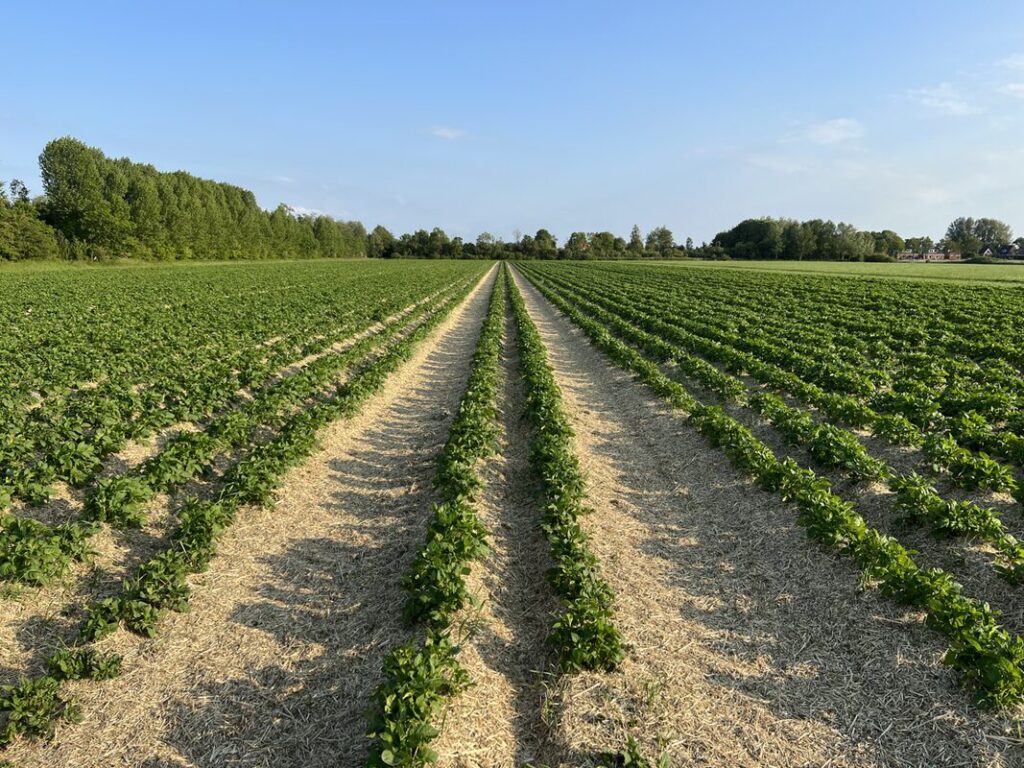
Westers. Yeah, but since we pick seeds with different sizes, they’re very easy to separate. And we sow together with an undersowing. That means for most crops, we sow about five to 10 kilograms per hectare of the actual seed crop, which can be a mustard or a garden cress or a radish, and then about 15 to 20 kilos of an undersowing. We choose those plants so that, when they get harvested with the seed, they have a seed size that is very easy separable.
But most of these seeds are perennials or biennials like grass and clover, so they won’t produce seed the first year. They stay vegetative, and that is the main goal of this understory. All of our seed crops will have a vegetative and a reproductive state, as you know. Some of them are vegetative in year one and then reproductive in year two, and a couple of them, the annuals, have both states in one year. But either way, there is a big part of the season where there are no photosynthesis products flowing to the soil life. This is where this undersowing takes over.
Kempf. You are trying to optimize your understory so that it is in a vegetative state and photosynthesizing while the seed that you are primarily targeting and growing is in the reproductive state and is not at optimal photosynthesis.
Westers. Exactly. Our main photosynthesis period is in the summer months. In a normal system, a seed crop would be harvested in August, and the soil would be tilled shallowly, and a cover crop would be sown that would mostly be a frost-vulnerable cover crop that would die in November. If you add up all the vegetative photoenergy that you get in a year in that system, it will maybe be three or four months of the total 12 that you harvest photoenergy — and that’s not during the most photo-intensive months of the year — in the middle of the summer.
In our system, though, with a seed crop after a seed crop, which is an annual, with an undersowing, we get about 48 to 50 weeks of the year with a vegetatively growing crop.
Kempf. Wow. So, you have three different strategies that may overlap. You have a strategy of planting an annual intercrop — an annual into a biennial seed crop, or vice versa, where you’re planting biennial intercrops with an annual seed crop. And/or you are planting seed crops that have two very different seed sizes that you can easily separate.
Westers. Yes. The undersowing is actually a biannual, but it is often a perennial. You could let it go to the next year, but we terminate it, and the next crop comes in. That can be a potato or carrot or a next seed crop.
It has not been easy figuring out what plants to put in the understory and how to manage that, because we have a lot of different seed crops. We used to have a lot of different mixtures, but now we have just one, which we vary a bit. This mixture consists of one-third grasses and one-third clovers. These clovers must not be trifolium clovers, but medicago species, because those have a different nitrogen root profile — more of an ammonium root profile than a nitrate root profile. This is important because we have encountered a lot of thistles. And the third part is herbs. I think it’s this three-way compartmentalization that gives a very nice, full pallet of food sources to the soil.
Kempf. Can you tell us a little bit more about this combination of a grasses and clovers and herbs, or forbs? What are the things you’ve found to work well?
Westers. The grasses that stay pretty low are the ones that are biannual. If you saw them in spring, they don’t go to bloom in that year. We swath-mow everything for harvest. And there are a lot of really short perennial high-root-biomass grasses like timothy grass and ryegrass.
Then there are legumes — the medicago species, of which alfalfa is one. Also black medic, bird’s-foot trefoil, sweet clover.
And then for herbs, plantain, chicory, poppyseed, cornflower, caraway, cilantro, coriander. Those are more like the spices on the plate, but they’re very important.
Kempf. I don’t want to lose sight of your comments about nitrate and ammonium because this is such an important concept — this understanding of redox reactions in soil and what that means for soil’s disease suppressing, or disease enhancing, characteristics. But you mentioned changing the Canadian thistle population, which is a very important topic for many growers. Tell us a little bit more about how all this came about.
Westers. Okay. I became a farmer in 2006, but as a kid, I did not care for farming. I studied psychology and business, so I don’t have any agricultural study — only what I learned here on the farm from my father. My parents transitioned this farm in 2000 to organic after he realized he was spraying the same compound as Agent Orange, albeit in a lighter dose. In 1997, my sister, who was then seven, wanted to eat a ripe grain of wheat from the field, but my father had just sprayed it, and he couldn’t explain to his seven-year-old daughter why he would put a chemical on food.
I came to the farm in 2006, and I saw that we had an organic system — we applied manure, and we followed the rules, and we had a very good system — but it was still conventional, just with other tools. We still killed everything.
We did not have animals, which meant all the manure that we were supposed to use had to be imported. And with that organic manure came weeds like dock and other weeds that we had not seen here before, and also a lot of garbage. It made us think, why do these grasses and clovers — this feedstock — have to go through an animal to become food for the soil? In nature that does not happen — not every grass plant gets eaten and pooped out before it’s able to feed the next grass plant. We also saw that by tilling the soil less we had better soil structure and needed less fertilization.
That made us hopeful to maybe develop a system where we wouldn’t need imported manure. We had a very technical approach. We tried to calculate how much nitrogen, phosphorus and potassium we had in the cover crop and what was needed for the next crop.
But we were pretty alone in that in the Netherlands. We had very few people here who could tell us how that would work. So my father found these two advisors in Germany, Friedrich Wenz and Dietmar Näser, who were giving courses on a minimum-till organic system with a lot of cover crops and very little animal manure.
But it was still on a very technical basis. You have a mixed cover crop, and then you have these special machines to make them go away, and then you sow your next crop. And that worked sometimes, and sometimes that did not work. It was not until 2014 that they used the term regenerativ Landwirtschaft, which was, I think, the first time I heard “regenerative agriculture,” albeit again in a different language. From that time on, they expanded their focus onto microbiology and nutrients.
If you have a winter-tolerant cover crop, you have a living root all year, and that’s what we want. The thing is, with these cover crops, they want to continue growing in spring — because that’s what they do! They also want to set seed. So, you have a cover crop in spring that is going for a race, and you as a farmer have to terminate it, but that’s unnatural. You have to turn in a green-growing plant, because you can’t do it with a burndown chemical. And turning in biomass into the soil is unnatural, and it’s also not compatible. That green-growing plant has a lot of energy — you can tell because if you mow your grass and you lay it in a heap, an hour later you can stick your hand in and it’s warm. It’s microbial energy.
If we do that in the soil — we turn in this cover crop that’s lush and vegetative in spring — we turn in a lot of microbial energy, but also a lot of fresh carbohydrates, proteins and other metabolites that are in those plants. We want those to be the next feedstock for the following cash crop. The microbes cut these green plants into pieces and then reform them into their own microbial bodies. Some enzymes and minerals are needed. And then you have this microbial population that has grown and that can be taken up by the cash crop.
The green plant is gone. You have bare soil, and you can sow your next crop. But the microbes are still cutting apart these green plants, and that environment might not be the best environment for seeds. The microbes have taken these complete proteins and cut them all into pieces, into these very simple non-protein nitrogen compounds. But then, if you move the soil, that scent or frequency is a calling card for all the insects and diseases. So, you have all these seed flies that eat your seeds.
And that explains why, before, when we were just using cover crops and minimum-till, one time we’d have good emergence, and the next time half of the seed wouldn’t come up and was rotting. We thought we were working with nature, but we were not. We were doing something that’s not happening in nature. Maybe a deer will stand on grass and that part of the green grass will be turned into the soil, but normal green plants aren’t turned into the soil. They die first. We want to maximize that part in agriculture, but we must take into account the process if we want to do so.
Kempf. Thank you for that context. So, how are you terminating? And how are you incorporating your companion plants or cover crops? Are you no longer incorporating them as green manure? Are you killing them first?
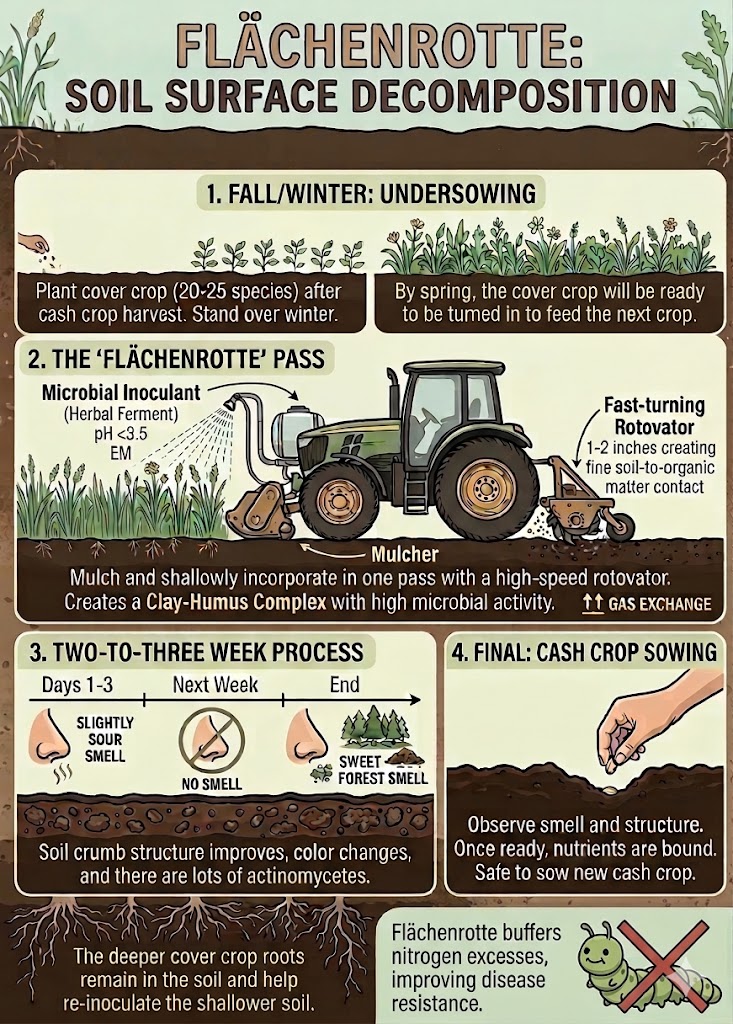
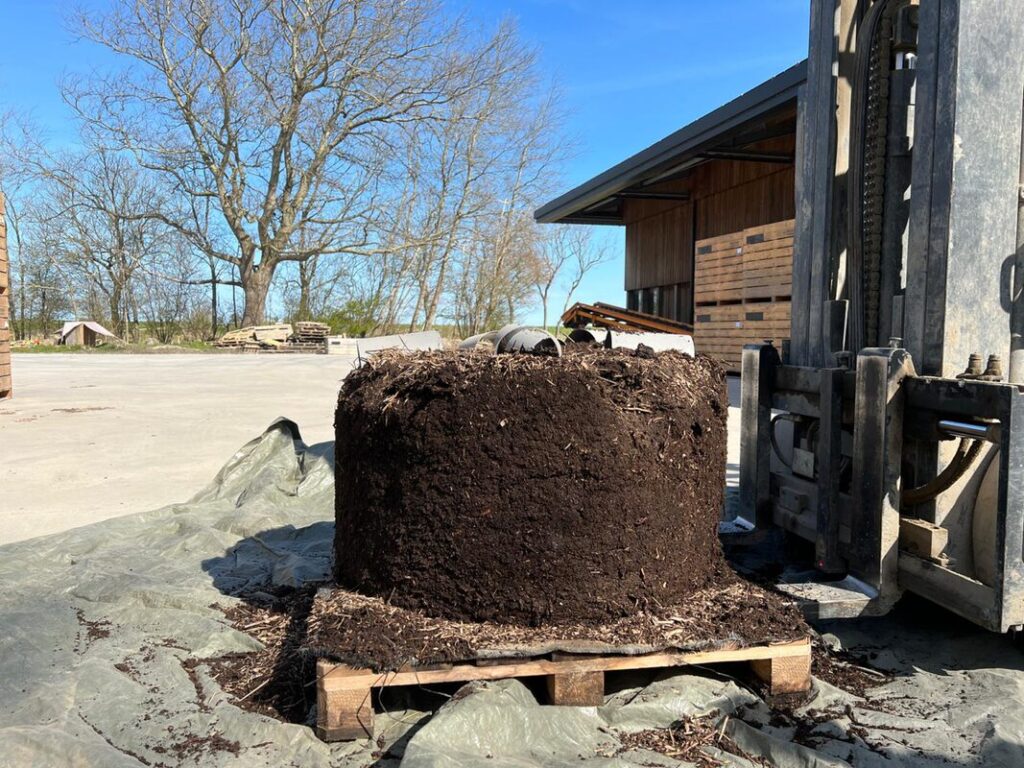
Westers. We plant the cover crop after harvest the previous fall. We let it stand over winter, this “undersowing,” which has like 20, 25 plant species. And then, the next spring, this crop wants to go into the reproductive phase. We use a technique called Flächenrotte. It’s a German term that translates to “soil surface decomposition.” It’s not really composting — it’s decomposition.
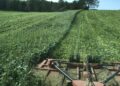
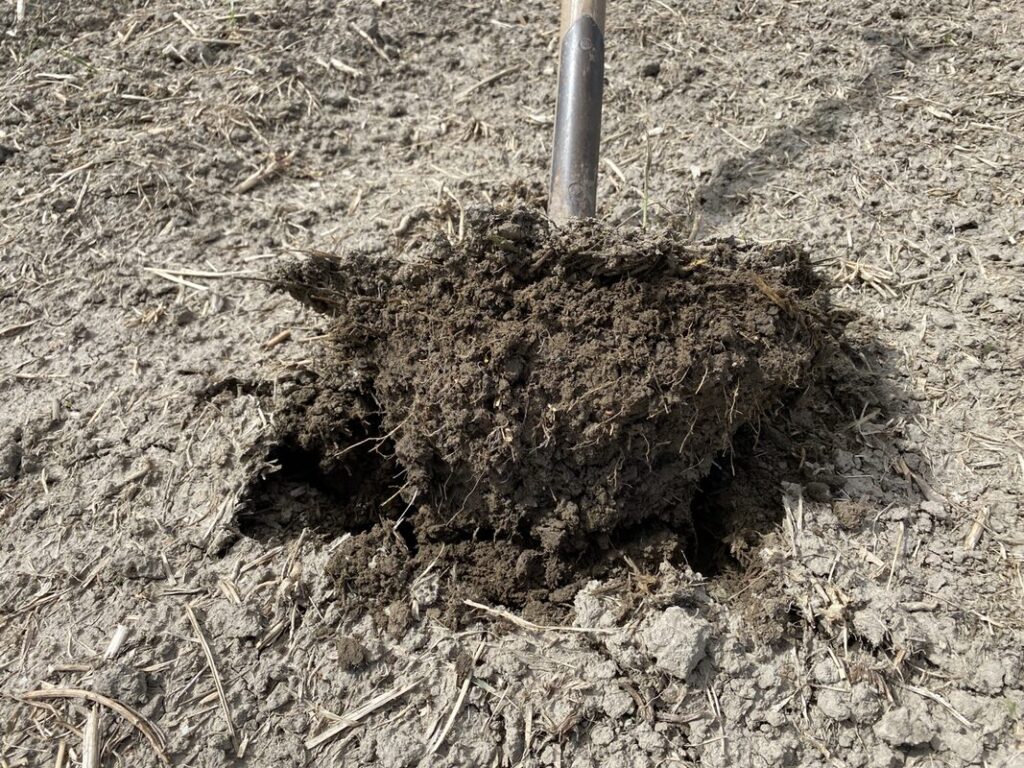
We have a very fast-turning rotovator, and we only go about one to two inches deep. It mixes into very fine soil because we have a high rotovating speed. We mulch in front of the tractor with a mulcher. By creating very high surface contact between these soil particles, which contain a clay compound, and the organic matter with very high microbial energy and fresh nutrients in them, we create the possibility for a clay-humus complex to form. It creates a very high amount of microbial breathing because of the energy you put in through the machine and what’s in the material. That means that you should not cover the soil tightly — there should not be a big roller behind it. There can be a very light roller or no roller behind it, so you have good gas exchange.
The other thing to better try to steer this process is a microbial inoculant. In our case it’s an herbal ferment, which is actually an antioxidant or reducing compound, which has a pH of less than 3.5. It’s mostly lactic acid bacteria, yeast, and photosynthetic bacteria; it’s sometimes called EM, but we make it ourselves. This material is sprayed on the plants before they are mulched, a couple of seconds before they are incorporated. We do that in one pass.
Kempf. You have the sprayer in front of the mulcher, in front of the tractor, and you’re incorporating the cover crop with the rotovator in the back.
Westers. Exactly. Using these ferments ensures a good direction this process. You have to work the soil and terminate the cover crop before your cash crop can be sown. It’s the same as making silage — dairy farmers also use these kinds of inoculants to make good silage. We want to steer the process in the same direction.
After you have done this pass, it takes about between two and three weeks, depending on temperature and moisture. You can observe the soil crumb structure and the color, and very distinctively the smell. In the first three days you have a slightly sour smell, then you have a week of almost no smell, and then at the end you have this sweet forest smell, and there are lots of actinomycetes. When you smell this, it’s ready. Then you see if you have emerging weed seeds, but there normally aren’t any because the nutrients are bound. Then it’s safe to sow your seed.
Kempf. I’m thinking about the implications this process has for developing a disease-suppressive soil. It’s a very deliberate process. It reminds me in some ways of ASD, anaerobic soil disinfestation, but it’s a much more natural process. ASD involves purchasing and bringing in all these various carbohydrates and feed stocks — potato starch and beet pulp and whatever else — whereas you are actually growing this with a crop and then incorporating it very shallowly.
Westers. What’s very important is that you have a lot of roots in the soil. This process will only work if you have gas exchange with the air, which is not hard, but also through the soil.
Kempf. That aspect is the opposite of ASD.
Westers. Yes. And what’s very important in this process is that you do not create a smear layer. That means that with a certain rotovating speed, you need a certain driving speed. The second part of not creating a smear layer and creating gas exchange to the soil under it is having enough roots. If you have grasses, clovers, and herbs in one mixture, you have enough roots. But if you only have a radish cover crop, for example, this process will not work. First, because what you are feeding the microbes is just a radish, which is very un-diverse in nutrition for soil life. And second, because you don’t have this perforation and this root zone — this appendage that you want to leave for reinoculation. When this process works, it’s amazing how much more soil crumb structure you create by just tilling a very small part.
Kempf. How deep do you see the soil crumb structure developing?

Westers. Twenty to 25 centimeters, which is like 10 inches. It’s amazing. It’s so nice what you can do with tillage, in combination with setting in motion a biological process and meeting all the conditions that need to be met.
We’ve talked about the machine, and we’ve talked about the microbes we put it, but we have not talked about the minerals. There must be, for instance, sulfur to form all the amino acids that all these microbes want to form, and so on. Those conditions have to be met, too. But if you have those conditions met, you have a process that uses a little diesel and a pass on the field but makes the soil so much looser because of microbial action. This is an incredible multiplication of microbes because you’re feeding them at a very specific way — high-intensity feeding.
Our organic matter has risen steeply. And since we have barely transported any manure or compost to our fields, that must have come from the microbial proliferation.
Kempf. So, when you are incorporating this cover crop shallowly and rapidly, with very fine particle size, and you have good gas exchange, you are developing a crumb structure to a depth of 10 to 12 inches, and that means that the microbial activity is not limited to that upper tillage layer. You also have this microbial fermentation process, this decomposition process, that is acting on the plant roots and decomposing the plant roots that you did not touch, and doing it very rapidly.
How long have you been using this practice of incorporating cover crops with these microbial inoculants, and what have you observed from a disease-resistance perspective?
Westers. In 2014, we went to the course in Germany, and they started calling it regenerative agriculture. The focus on the microbes and the minerals, and also the compost teas and so on, came with that. And about two years later, we were still using a lot of frost-killed cover crops with a lot of legumes, but we had all these thistles and bad emergence. That’s when Dietmar Näser told us about Flächenrotte and how we needed a lot of grasses. We said, “Yeah, but we sold our plow, and plowing is bad.” But in this case, it’s the how, not the plow.
With Flächenrotte, it’s okay to plow. If you do it like six inches, you can inject ferments behind the plowing blades if you drive slowly. You also take care that there are still enough roots in the soil — the deeper appendages from where the microbiology can be inoculated again. And with the incorporation of grasses again and the incorporation of specific tillage methods, we managed to finally get our crumb structure way down. In the first 10 years of not plowing and using a lot of cover crops, the crumb was only about a couple of centimeters. After we added these techniques, it really went down a lot.
And that also finally gave us good emergence and very good growth. We had had a lot of problems with caterpillars in brassicas. Brassicas are like nitrogen junkies — they take up a lot, and then they have too much, and they get attacked by everything. We saw that with a well-prepared Flächenrotte, together with a companion crop that also could buffer some of these nitrogen excesses, even in an organic system, even without manure, it’s possible. That has gone a long way for us. We have been able to produce germination rates that are above average — mostly above 95 percent, even for crops that are difficult, like nasturtium. For nasturtium, 80 percent is the minimum, but we get about 90 or 95 percent.
Kempf. Is the best translation of Flächenrotte “surface decomposition”? Decomposition — just on the surface. But decomposition almost doesn’t do justice to the process you’re describing. It’s almost like fermentation — like making a silage or a sauerkraut or a yogurt.
Westers. Yeah, but it’s still … not quite fermentation. Rotte in German is a good decomposition. It sounds like “rotting,” but that’s verrotend in German, and that’s a really different thing. It’s not just the decomposing of plant particles; it’s the rearranging and building up. As Dietmar Näser describes it, you have this U-curve. There’s a taking apart, which is going down, and then you have the reorganizing, which is the horizontal line, and then going up you have the rebuilding. And it’s at the end of that U-curve that it’s ready. If you sow seed in the going down part — in the taking apart — then it’s not a conducive environment. You have to wait until this process is done.
Kempf. You mentioned that in this building up process, you have the opportunity to form a humus-clay-mineral complex, which is the foundation of good soil aggregation. It’s the foundation of effective mineral nutritional delivery.
Westers. Yes. Because you’re feeding the soil life — it’s like feeding a salad of fresh, leafy greens to the soil. That combination, with these clay particles, is very effective. That also means that in a sandy soil, you have to till deeper, so you have more clay particles to buffer it with. And if you have no clay particles, you should add zeolite or another rock dust buffer material with high exchange capacity.
Kempf. You said that adequate sulphur levels are required. How are you managing the mineral nutrition aspect?
Westers. We start with an Albrecht soil analysis, but we do not follow it by the letter because it’s not the standard in the Netherlands — there are other standard soil analyses. Most of the soils are low in sulfur, and the advice from the lab was to spread like 110 kilos of elemental sulfur. But Dietmar told us we didn’t need to have a perfect mineral balance sheet and didn’t need to spread high amounts, but rather to combine lower amounts with biological measures.
So, for instance, with sulfur, we spread 25 kilograms of elemental sulfur yearly, and we mix that together with the seed, both in spring and with the cover crop in the fall. This provides elemental sulfur in the root zone with the highest activity of young growing plants, where you have this biogenic measure. And in that case, you need less.
It’s the same with magnesium. We have a calcium-saturated soil, so we should use magnesium. The advice from the lab was 1,000 kilos of magnesium sulfate in three years — that’s a lot. So, we do 100-125 kilos yearly, right before we do the Flächenrotte. You put it into this biological, active process where every part of that nutrient is being utilized by the biology and none is going to waste.
We see on our soil reports now that magnesium has gone up like 3 percent, which can’t be accounted for by the amount of magnesium we spread. Humus had climbed from 2 to 3.4 in a couple of years, which also couldn’t have happened by bringing carbon onto the farm on a truck, because we didn’t. Sulfur has gone from like 10 to 50 ppm with only 75 kilograms of sulfur added.
And then we’ve done plant sap analysis for almost 10 years now. In the beginning we had a lot of micronutrient deficiencies because of our high-pH, high-calcium soils, and even before we put on foliars, it’s much better on micronutrients. It’s also better on calcium, which people might find weird, since we have high-calcium soils.
Kempf. That’s very common.
Westers. It was even the case on soil that has lots of shells from the sea — 150 years ago this land was sea. We had very low calcium, and that’s a function of lack of fungi in the soil. These fungi are best promoted by grasses, because they love the carbohydrates. When we incorporated grasses again and stopped focusing purely on legumes, we saw a big increase in the standard calcium values on sap analysis. That translates to a lot of disease resistance, because in the young plant stage, you need these cell walls to be well supplied with the calcium, and then in a later stage you won’t get mildew.
Kempf. We started this fascinating conversation by me asking you about Canadian thistles, and you haven’t answered the question yet!
Westers. Yeah, sorry — got off track! Most of our Canadian thistles have gone away. I have one patch where there were carrots last year that were harvested in December under poor conditions, so that’s explainable. Most of our Canadian thistle is eaten by caterpillars. They are in the leaves and are curling and scraping the leaves, and you see all this caterpillar poop. I think they’re the same caterpillars that also eat nettles. It must be a special kind because those are not plants I would love to go to first if I were an insect. So, I’m not worried about those.
The same goes for quack grass, which on the lighter soil was an enormous problem, but through spraying compost tea, I think, and through the higher calcium, through more fungi, through more grasses in the soil, the quack grass has disappeared.
There’s only one perennial thistle that still causes us problems. I have not found the exact way to get rid of it. It has the same nutrient profile as a chicory. We did plant sap analysis on a lot of weeds, and this one is comparable to chicory in that it gathers potassium chloride and has no molybdenum and has pretty high nitrate. So I think we are going to sow more chicory.
Kempf. What do you attribute the reduction in the Canadian thistle to? When did things start to shift? Was there any particular practice?
Westers. I think one of the most important things is having the soil in a vegetative state and not tilling too often. Second, through that you get a nice crumb structure. That’s something thistle cannot stand, because they’re always growing in compaction, which creates a nitrate layer. Third, getting trifolium clovers out of the mixture. Not having only clovers or legumes in cover crops is very important. It’s a whole system. And I think the sprays with compost tea have an effect because they’re boosting the crop in photosynthetic capacity, and I think that for weeds it’s the other way around.
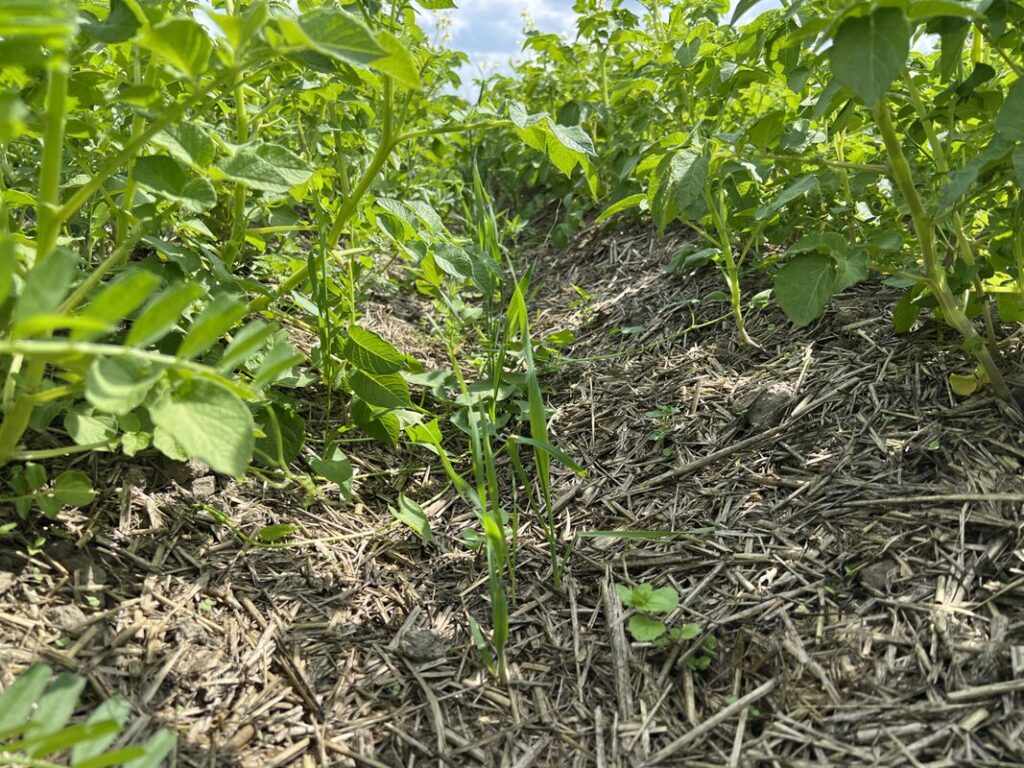
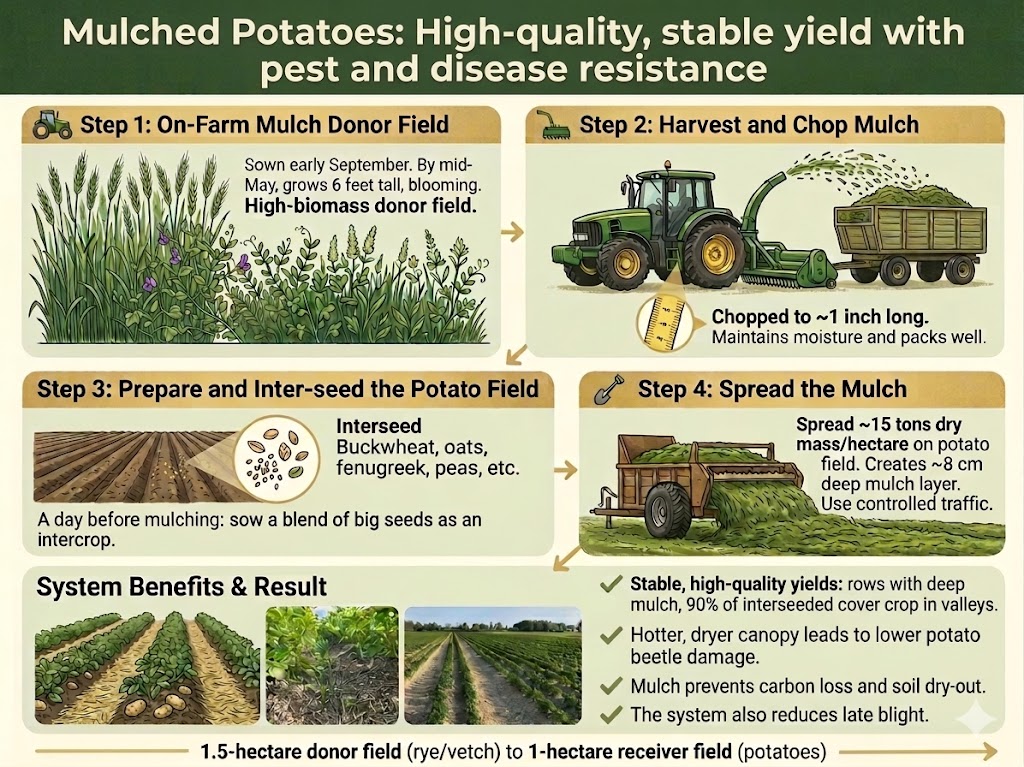
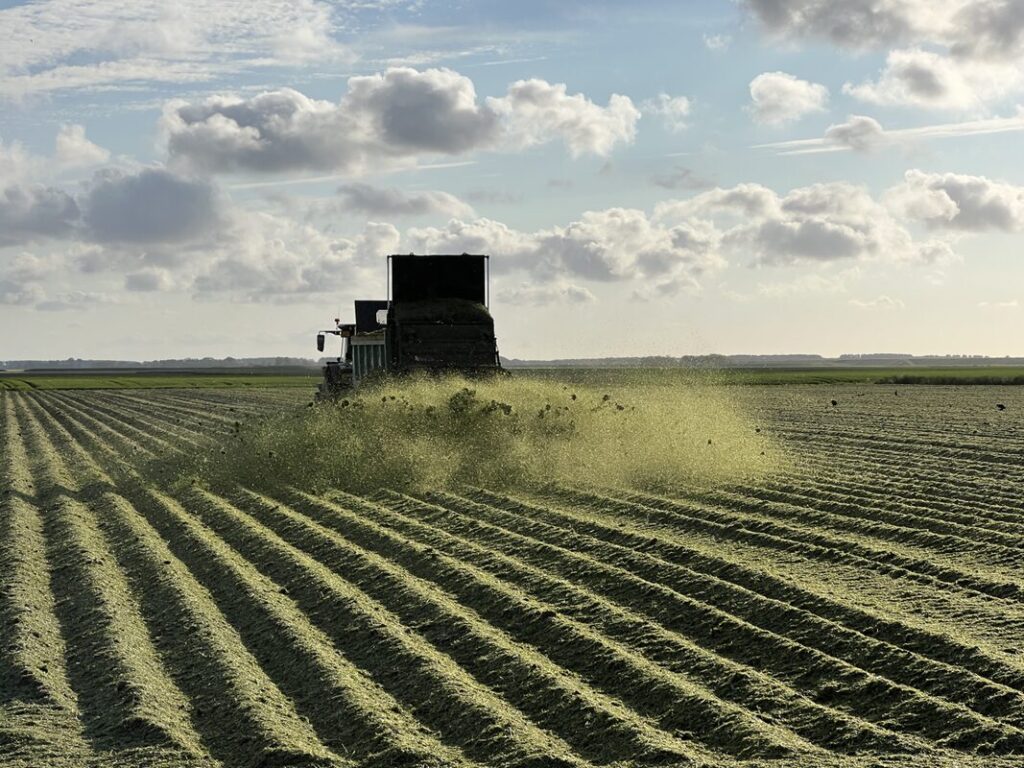
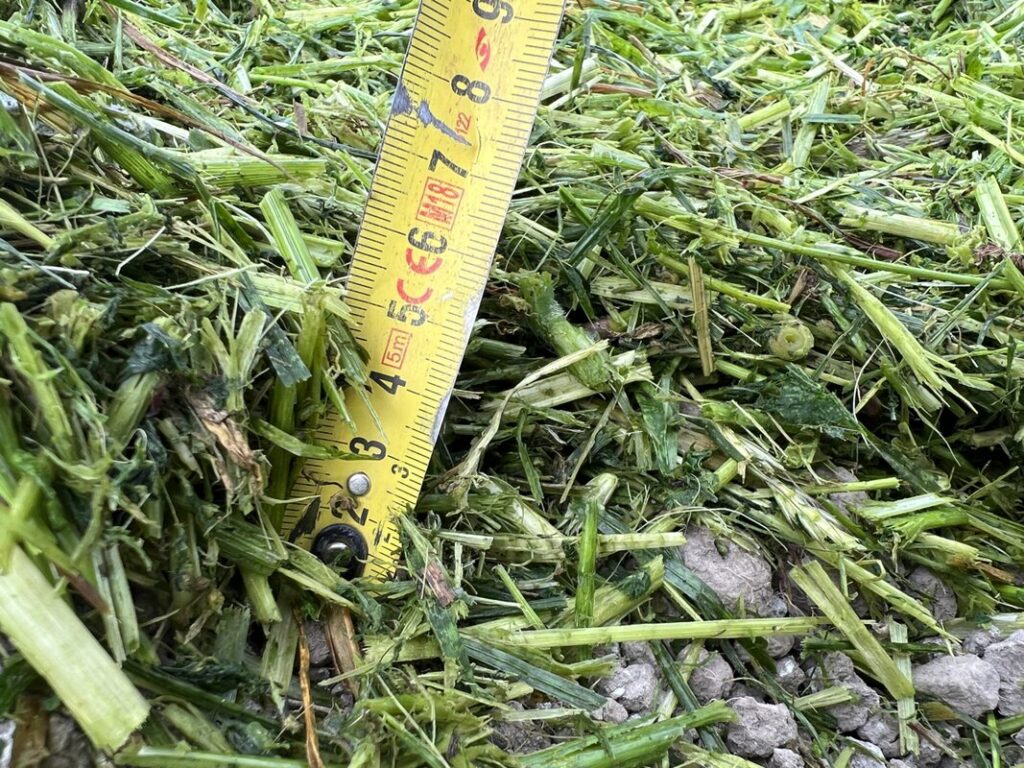
We should also talk about our mulching system for potatoes. For every hectare of potatoes, we have one and a half hectares of mulch growing. We do this within our own farm, so we do not import mulch. This mulch is sown in the first half of September, and it’s a rye and vetch mixture. By the middle of the following May, it will have bloomed and will be about six feet high and will produce about 10 tons of dry matter biomass per hectare. That translates to about 15 tons of dry mass per hectare on the potatoes, which creates a layer about eight centimeters deep of mulch material.
Kempf. How finely is that chopped?
Westers. About an inch long — which is important, because then you need less mulched material.
Kempf. It packs down more.
Westers. The field that has been harvested for mulch is the donor field. You have a donor field and a receiver field. That donor field has been dark all spring; every weed that emerges there grows in darkness because the rye and vetch are very dominant. Then you take it all off. We do a pretty aggressive tillage pass, we do a shallow plowing at 15 centimeters, and then we make ridges and grow carrots or peas. In this system, you can get rid of a lot of these perennial weeds in one or two years.
If you go to the normal organic advisors, they would say, in August, when you harvest the crop, till the soil bare and dry until there is no moisture left, and then the thistle will die. But in that process, you will burn the last tenths of a percent of carbon that you have because you will volatize and oxidize everything that’s still in there. And then the first thing that will come again the next year is the very thing that you tried to get rid of.
Kempf. Do you also interseed into the potatoes? Also, give us some context for the scale that we’re talking about.
Westers. We have 20 hectares of potatoes, plus 30 hectares of mulch. We mow the rye and vetch, chop it, and put it in a manure spreader. We try to keep as much moisture in the mulch as possible, not because we want moisture in the potato field but because we always have a lot of wind. As soon as we lose moisture, we cannot spread it. We use set tracks in the field because every track is a loss of potential potatoes that could be grown there.
The day before we spread the mulch, we sow a blend of buckwheat, oats, fenugreek, peas — all pretty big seeds. Then, a day later, the mulch goes on.
Kempf. Is the cover crop almost entirely in the valleys, or is there still a little bit on the ridge?
Westers. I would say 90 percent is in the valleys. But that is not a problem at all at harvest.
So, we have these nice strips of flowers between the potatoes. They help each other out, I think. And then we terminate at size because, as seed potatoes, they must not get too big. We have this special leaf puller with two rubber balls per row that pulls out the haulm and allows us to harvest one week later. When we harvest, we have this special harvester that goes on small tracks with a crate in the back, and it harvests directly into the crate, very gently.
Some potatoes are harvested at the beginning of August and some at the beginning of September. In September we sow the mulch for the next year’s potato crop in the same potato field, so we recycle those nutrients. That means that sometimes there is a gap in August for four or five weeks between the first-harvested variety and the last one. I want to regreen that; otherwise unwanted weeds will come. So, we made a seeder to sow buckwheat, oats, and camolina — three of the fastest-growing plants I could think of — right after harvest, and there is an almost-three-foot-high canopy of oats, buckwheat, and camolina in this four- or five-week period. We turn that in and sow the mulch crop of rye and vetch for the next year.
We still have a lot of wireworm. I call it a heritage pest, because when we were not doing things right, with a lot of focus on legumes and frost-killed cover crops, I think we introduced the possibility for the wireworm. They can survive five years — maybe I did something wrong five years ago and still have this problem. We started this mulching system three years ago, along with very intensive nutrient management at planting and via foliar, and we’ve had a reduction of about 90 percent of this wireworm problem. But we were at the brink of stopping with potatoes about six years back. This is one of the most remarkable things that has come out of these changes.
Kempf. How thick is the mulch when it’s fresh, and then when it’s compacted?
Westers. It’s about three inches when it’s fresh, and a couple days later, it shrinks about 30 percent. But those big seeds will grow through it.
Under all conditions, wet and dry, this system has given us very stable and qualitatively high yields. Last year, organic farmers in Holland had just 50 percent of normal yields, but we had 80 or 90 percent.
Kempf. What are the factors that contribute to less potato beetle pressure? Is it just because part of the plant is covered in mulch for a critical period?
Westers. No, actually, you spread the mulch right at emergence. The plant can be 10 centimeters tall when you spread the mulch, but it’s ideal to do it at emergence. A regenerative potato growing project in Germany found that the first flight of the potato beetle was the same with this system, but about 50 percent fewer larvae hatched. And the beetles aren’t the problem — it’s the larvae that eat the potato leaves. They have nice drone images where, on unmulched plots, 80 percent of foliage is gone, and on the mulched plots, only 20 percent of foliage is gone. Because of this mulching, the eggs are not able to hatch.
I think the mulch itself is important, but perhaps a more important part is that the plant health is higher. On the part of the field where there’s more compaction from the tractor, the root system is compromised, and there’s more pest pressure.
Kempf. If you have poorer egg hatching rate, and the larvae are not emerging from the egg in the mulched zone, what are the mechanisms behind that? Is it light reflection? Is it heat? Is it soil root development or plant root development and soil temperatures? There’s a lot to unwrap there.
Westers. The same goes for late blight. Late blight comes from a spore forming in the soil and infecting the potato plant. But if you create a layer that prevents soil particles from bouncing directly up to the leaf, you also create a barrier for late blight. That’s one part. The second part is you create lower humidity. We have measured the zone between the canopy and the mulch, and there’s about 10 to 15 percent lower relative humidity during the season compared to bare soil.
Those two factors are, I think, very important for delaying late blight. It’s about two weeks later. In the organic sector here in Netherlands we had very low yield last year, and that was blamed mainly on late blight.
| According to the German journal Lumbrico (2026, #23, pg. 24–27), “Within the crop canopy, the mulch material absorbs moisture. On the one hand, drier air warms more quickly; on the other hand, mulch is lighter in color than soil and therefore reflects more heat (albedo effect). As a result, conditions become not only hotter but also drier, which can inhibit the maturation and hatching of potato beetles (Weiler et al. 2025b). In 2022, a second generation of potato beetles occurred during the trials. In the unmulched control, the number of beetles in the second generation was ten times higher than in the mulched plots. This can be attributed, on the one hand, to the cooling of the soil by the mulch layer, which slows the development of the beetles in the soil, and on the other hand, to the fact that pupation of the larvae can be inhibited by higher temperature peaks (Weiler et al. 2025b).” |
Kempf. What other disease challenges or insect challenges have you observed shifting with your change in management practices?
Westers. There were a lot of insects in our brassica crops, which are our main seed crops. We have been able to conquer or prevent most of them, except the flea beetle, because we get seed from off the farm. A lot of the caterpillars turn up when the plant is bolting, which is a very vulnerable stage in the plant’s life. We have been able to prevent them with balanced nutrition from the Flächenrotte process and plant sap analysis. We’ve seen that our molybdenum levels are very high, and boron and sulfur are very high, but magnesium is still lacking. We’ve come a long way, but we have so much calcium that is prohibiting a lot of the magnesium. That’s the missing link; we can spray magnesium sulfate, but it’s not that easy to get it into the plant. We also don’t want to have burning. It has high EC in the spray mix. But a lot of the fungal diseases have pretty much disappeared, like the mildew in the carrots.
Kempf. How are you hoping to evolve? What further changes do you see for your cultural management approaches?
Westers. I would like to expand the mulching onto the seed crops too, because we see what a massive positive effect this has on potatoes, and also what a positive effect it has on the soil on the donor field.
It also enables us to produce a lot of biomass in our rotation. When you terminate rye and vetch in April, you’re missing out on so much biomass. By May, you can’t turn it into the soil on that field because you have like 10 tons of dry matter; Flächenrotte would take too long. The C:N ratio is too high, and the soil couldn’t make a cash crop that year.
| Learn more about Erwin at horaholm.weebly.com. |