
Acres U.S.A.® Magazine
  • Articles
    • News
    • Ecological farming
      • Climate
      • Environmental Issues
      • Farm management & planning
      • Human health
    • Livestock
    • Farm
    • Crop
      • Crop management practices
        • Ag technology
        • Cover crops
        • Crop nutrition
          • Crop protection
          • Diseases
        • Crops
        • Fruits
    • Soil
    • Opinion
  • Resources
    • Magazine
    • Online Learning
    • Newsletters
    • Free Articles
    • Blog
  • Magazine Issues
    • 2026
      • June 2026
      • May 2026
      • April 2026
      • March 2026
      • February 2026
      • January 2026
    • 2025
      • December 2025
      • November 2025
      • October 2025
      • September 2025
      • August 2025
      • July 2025
      • June 2025
      • May 2025
      • April 2025
      • March 2025
      • February 2025
      • January 2025
    • 2024
      • December 2024
      • November 2024
      • October 2024
      • September 2024
      • August 2024
      • July 2024
      • June 2024
      • May 2024
      • April 2024
      • March 2024
      • February 2024
      • January 2024
    • 2023
      • December 2023
      • November 2023
      • October 2023
      • August 2023
      • July 2023
      • June 2023
      • May 2023
      • April 2023
      • March 2023
      • February 2023
      • January 2023
    • 2022
      • December 2022
      • November 2022
      • October 2022
      • September 2022
      • August 2022
      • July 2022
      • June 2022
      • May 2022
      • April 2022
      • March 2022
      • February 2022
  • About Us
    • Our History
    • Our Staff
    • Contact Us
    • Community
      • Soil Health Primer Resources
  • Events
    • Eco-Ag Conference
    • Farm Weird Event
  • Subscribe
  • Login
  • Register
No Result
View All Result
  • Articles
    • News
    • Ecological farming
      • Climate
      • Environmental Issues
      • Farm management & planning
      • Human health
    • Livestock
    • Farm
    • Crop
      • Crop management practices
        • Ag technology
        • Cover crops
        • Crop nutrition
          • Crop protection
          • Diseases
        • Crops
        • Fruits
    • Soil
    • Opinion
  • Resources
    • Magazine
    • Online Learning
    • Newsletters
    • Free Articles
    • Blog
  • Magazine Issues
    • 2026
      • June 2026
      • May 2026
      • April 2026
      • March 2026
      • February 2026
      • January 2026
    • 2025
      • December 2025
      • November 2025
      • October 2025
      • September 2025
      • August 2025
      • July 2025
      • June 2025
      • May 2025
      • April 2025
      • March 2025
      • February 2025
      • January 2025
    • 2024
      • December 2024
      • November 2024
      • October 2024
      • September 2024
      • August 2024
      • July 2024
      • June 2024
      • May 2024
      • April 2024
      • March 2024
      • February 2024
      • January 2024
    • 2023
      • December 2023
      • November 2023
      • October 2023
      • August 2023
      • July 2023
      • June 2023
      • May 2023
      • April 2023
      • March 2023
      • February 2023
      • January 2023
    • 2022
      • December 2022
      • November 2022
      • October 2022
      • September 2022
      • August 2022
      • July 2022
      • June 2022
      • May 2022
      • April 2022
      • March 2022
      • February 2022
  • About Us
    • Our History
    • Our Staff
    • Contact Us
    • Community
      • Soil Health Primer Resources
  • Events
    • Eco-Ag Conference
    • Farm Weird Event
  • Subscribe
No Result
View All Result
Acres U.S.A.® Magazine
No Result
View All Result
Home Crop management practices Crop nutrition

Seedlings with Speed

John Kempf by John Kempf
March 5, 2024
0
Seedlings with Speed
0
SHARES
55
VIEWS
Share on FacebookShare on Twitter

Nutritional support is necessary for newly germinated seeds to take off and fulfill their potential

John Kempf

When seedlings emerge and are first exposed to light, how quickly do they fill with chlorophyll and turn dark green? How quickly should they?

It is common for seedlings to emerge and remain a pale yellow-green color for several days after emergence. In challenging weather conditions with overcast skies, I have observed light-green color in seedlings as late as two weeks after germination. Every day that goes by with the seedling not having enough chlorophyll is a day of photosynthesis and energy generation lost. 

Chlorophyll synthesis is triggered by exposure to light photons. When a seedling emerges, the cotyledons should turn dark green and be filled with chlorophyll within 24 hours of first being exposed to the light. As soon as chlorophyll is present, the seedling begins generating carbohydrate energy, the majority of which is transported to the root system, where it is utilized both to build root biomass and to build microbial populations in the rhizosphere. 

In my previous article (“Seeds with Speed” in the March 2023 issue of this magazine) I described how seedlings are particularly susceptible to infection by soilborne organisms such as pythium, phytophthora, rhizoctonia, fusarium, anthracnose and others in the first two weeks after germination. Sometimes these infections do not become visually observable until weeks or months afterward, when plants switch from rapid vegetative growth to reproduction. The visual expression is delayed for the infection, which occurred much earlier and only developed slowly until the plants came under stress. 

The two-week window after germination is the critical time to establish an abundant population of disease-suppressive organisms in the rhizosphere. Each day that colonization is delayed is an additional opportunity for potential pathogens to gain entry to the root system and produce a low-grade infection. 

Establishing an abundant population of disease-suppressive organisms around the rapidly growing root tips of a germinating seed requires the release of root exudates to provide a food source and a biostimulant for the organisms that came along for the ride on the seed surface, as well as any additional organisms that are recruited from the soil profile. 

However, a seed has limited energy reserves. As I understand it, very little root exudates are produced from the sugar reserves carried within the seed. The sugars within the seed are kept in reserve to maintain (not grow) the seedling in the case of challenging weather conditions. The seedling only begins moving a lot of sugars out through the root system as root exudates to feed biology once it can generate those sugars from photosynthesis. 

This is why a delay in photosynthesis is a problem. Every day photosynthesis is delayed or reduced is a day with fewer root exudates, a day with fewer disease-suppressive organisms, and a day for potential pathogens to gain entry. If we want to produce healthy, disease-resistant seedlings, a delay in photosynthesis is unacceptable.

Ideally, seedlings should emerge and immediately turn dark green — as dark green as when they are healthy and approaching their mature size, or right at the end of the framing stage, when they are building rapid vegetative growth. The idea that seedlings are naturally supposed to be a light-green color is monkey business. 

What has to happen for seedlings to emerge and immediately be dark green? They specifically need nutritional support with the nutrients that are required as enzyme cofactors for chlorophyll synthesis. Ideally, these minerals would have been provided in abundance to the seed parent and would already be stored inside the seed. Sadly, though, this is seldom the case. 
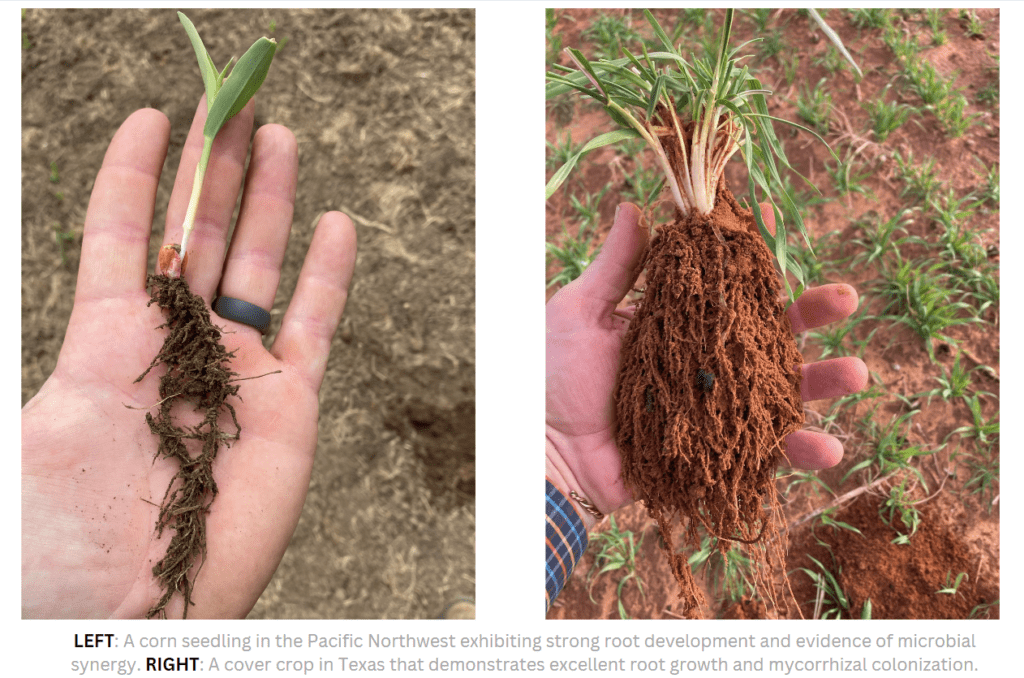
It is worth pointing out that the mineral deficiencies present within the seed cannot be corrected by a microbial inoculant alone. Well-designed seed treatments with microbial inoculants have demonstrated their economic and crop performance value, beyond question. But even when they are used, a great deal of opportunity remains untouched. 

If the seed’s parents are unlikely to have provided the nutrients that are necessary for strong photosynthetic activity in a newly emerged seedling, how can a grower fill that gap? Soil treatments and foliar sprays are possibilities, but they are not as likely to provide the nutrition directly where it’s needed as is another alternative: a nutrient-rich seed treatment.

Mineral nutrition treatments can be sprayed onto seeds at rates as low as a few quarts per ton of seed and as early as months ahead of planting. The treatment is absorbed into the seed at such low volumes that it doesn’t make the seed soft or moist, which means that the seed can run through any type of planter system without damage — as can occur with seed soaking. Growers can apply these treatments themselves with a single-spray nozzle as seeds travel down a conveyor, or they can often have their supplier treat the seed for them, since many are optimally equipped to do so.

We have developed a nutritional seed treatment product at AEA that contains the minerals needed as enzyme cofactors to rapidly build chlorophyll. Some of the nutrients needed to build chlorophyll are well known, such as iron, magnesium and nitrogen, but not all of these nutrients need to be added to seed in different settings. Many of the trace mineral metals are essential enzyme cofactors that are needed at this stage of seedling development and are often not present in the seed in adequate supply. 

We want seed to germinate quickly, and then we want the seedling to take off and go like a horse out of the gates. In our work at AEA, we find that nutritional and microbiome support at this critical seedling stage consistently produces visually observable results in root biomass and seedling development. This doesn’t necessarily mean larger seedling size. For continuous-fruiting reproductive crops like cotton and soybeans, we want the node spacing to remain compact, which may mean the seedlings themselves don’t appear to be larger, but the increased number of fruit is substantial. 

A consistent stand of dark-green seedlings right after emergence is a landscape of beauty, one that we too seldom get to see. A well-designed, synergistic combination of nutrient and microbial seed treatments can be the most impactful — and highest ROI — application you can make.


John Kempf is the founder of Advancing Eco Agriculture and the executive editor of Acres U.S.A. magazine.

← Previous What’s Inside? January 2024 • Issue #631 Next Eco-update →
Tags: ChlorophyllRootsSeedsSoil biology
John Kempf

John Kempf

John Kempf is an entrepreneur, speaker, podcast host, leading crop health consultant, and designer of innovative soil and plant management systems. He founded Advancing Eco Agriculture in 2006 and serves as Chief Vision Officer and Executive Board Chairman.

Next Post
Eco-update

Eco-update

  • Trending
  • Comments
  • Latest
The Most Important Livestock in Our Fields

The Most Important Livestock in Our Fields

July 1, 2024
Glyphosate Does What It’s Designed to Do — Kill

Glyphosate Does What It’s Designed to Do — Kill

February 19, 2025
USDA organic seal over American farm land

Losing Organic Farms

January 27, 2026
The Take-Half, Leave-Half Fallacy

The Take-Half, Leave-Half Fallacy

July 1, 2025
We Don’t Need Another Bridge — We Need an Off-Ramp

We Don’t Need Another Bridge — We Need an Off-Ramp

3
Under One Roof

Under One Roof

3
A Rose By Any Other Name

A Rose By Any Other Name

2
Terra Preta’s Biological Advantage

Terra Preta’s Biological Advantage

2
ECO-MEETINGS

ECO-MEETINGS

August 3, 2026
Shifting Gears

Shifting Gears

August 3, 2026
Left: Poa pratensis inoculated with bacteria obtained from leaves of a nitrogen-fixing line of corn (C-4-6) from Mexico. Right: Poa pratensis grown from seeds that were surface-disinfected for 50 minutes. Notice the difference in number of root hairs.

Multiplying Microbes

August 3, 2026
Community Quorum Sensing

Community Quorum Sensing

August 3, 2026

Recent News

ECO-MEETINGS

ECO-MEETINGS

August 3, 2026
Shifting Gears

Shifting Gears

August 3, 2026
Left: Poa pratensis inoculated with bacteria obtained from leaves of a nitrogen-fixing line of corn (C-4-6) from Mexico. Right: Poa pratensis grown from seeds that were surface-disinfected for 50 minutes. Notice the difference in number of root hairs.

Multiplying Microbes

August 3, 2026
Community Quorum Sensing

Community Quorum Sensing

August 3, 2026

About ACRES USA

Acres U.S.A.® Magazine

Acres U.S.A.® is North America’s oldest publisher on production-scale organic and regenerative farming. For more than 50 years, our mission has been to help farmers, ranchers and market gardeners grow food profitably and sustainably, with nature in mind.

Visit Our Advertisers

Magazine Issues

  • News
  • 2025
    • June 2025
    • May 2025
    • April 2025
    • March 2025
    • February 2025
    • January 2025
  • 2024 Articles
    • December 2024
    • November 2024
    • October 2024
    • September 2024
    • August 2024
    • July 2024
    • June 2024
    • May 2024
    • April 2024
    • March 2024
    • February 2024
    • January 2024
  • December 2023
    • December 2023
    • November 2023
    • October 2023
    • August 2023
    • July 2023
    • June 2023
    • May 2023
    • April 2023
    • March 2023
    • February 2023
    • January 2023
  • December 2022
    • November 2022
    • October 2022
    • September 2022
    • August 2022
    • July 2022
    • June 2022
    • May 2022
    • April 2022
    • March 2022

Contact Acres U.S.A

  • Contact Us
  • About Us
  • Advertise With Acres U.S.A.
  • My Subscription

Learn

  • Resources
  • Events
  • Magazine
  • Newsletters
  • Free Articles
  • Webinars
  • Online Courses
  • Bookstore

Our All Socials

Follow With Us...

  • My account
  • News
  • Ecological farming
  • Refund and Returns Policy
  • Privacy & Policy

© 2024 Acers USA Magazine

Welcome Back!

Login to your account below

Forgotten Password? Sign Up

Create New Account!

Fill the forms below to register

All fields are required. Log In

Retrieve your password

Please enter your username or email address to reset your password.

Log In
No Result
View All Result
  • HOME
  • ARTICLES
    • News
    • Farm
    • Ecological farming
    • Livestock
    • Crop
      • Crop management practices
      • Cover crops
      • Crop nutrition
      • Crop protection
      • Crops
      • Ag technology
    • Soil
    • Opinion
  • RESOURCES
    • Magazine
    • Online Learning
    • Newsletters
    • Blog
    • Free Articles
  • MAGAZINE ISSUES
    • 2026
      • June 2026
      • May 2026
      • April 2026
      • March 2026
      • February 2026
      • January 2026
    • 2025
      • December 2025
      • November 2025
      • October 2025
      • September 2025
      • August 2025
      • July 2025
      • June 2025
      • May 2025
      • April 2025
      • March 2025
      • February 2025
      • January 2025
    • 2024
      • December 2024
      • November 2024
      • October 2024
      • September 2024
      • August 2024
      • July 2024
      • June 2024
      • May 2024
      • April 2024
      • March 2024
      • February 2024
      • January 2024
    • 2023
      • December 2023
      • November 2023
      • October 2023
      • August 2023
      • July 2023
      • June 2023
      • May 2023
      • April 2023
      • March 2023
      • February 2023
      • January 2023
  • ABOUT US
    • Our History
    • Our Staff
    • Contact Us
    • Community
      • Soil Health Primer Resources
  • EVENTS
    • Eco-Ag Conference
    • Farm Weird
  • SUBSCRIBE
  • Login
  • Sign Up
  • Cart

© 2024 Acers USA Magazine

Lost Password?

Welcome Back!

Log in to your account below.

Lost Password?