

Acres U.S.A.® Magazine
  • Articles
    • News
    • Ecological farming
      • Climate
      • Environmental Issues
      • Farm management & planning
      • Human health
    • Livestock
    • Farm
    • Crop
      • Crop management practices
        • Ag technology
        • Cover crops
        • Crop nutrition
          • Crop protection
          • Diseases
        • Crops
        • Fruits
    • Soil
    • Opinion
  • Resources
    • Magazine
    • Online Learning
    • Newsletters
    • Free Articles
    • Blog
  • Magazine Issues
    • 2026
      • March 2026
      • February 2026
      • January 2026
    • 2025
      • December 2025
      • November 2025
      • October 2025
      • September 2025
      • August 2025
      • July 2025
      • June 2025
      • May 2025
      • April 2025
      • March 2025
      • February 2025
      • January 2025
    • 2024
      • December 2024
      • November 2024
      • October 2024
      • September 2024
      • August 2024
      • July 2024
      • June 2024
      • May 2024
      • April 2024
      • March 2024
      • February 2024
      • January 2024
    • 2023
      • December 2023
      • November 2023
      • October 2023
      • August 2023
      • July 2023
      • June 2023
      • May 2023
      • April 2023
      • March 2023
      • February 2023
      • January 2023
    • 2022
      • December 2022
      • November 2022
      • October 2022
      • September 2022
      • August 2022
      • July 2022
      • June 2022
      • May 2022
      • April 2022
      • March 2022
      • February 2022
  • About Us
    • Our History
    • Our Staff
    • Contact Us
    • Community
      • Soil Health Primer Resources
  • Events
    • Eco-Ag Conference
    • Farm Weird Event
    • Viroqua On Farm Event
  • Subscribe
  • Login
  • Register
No Result
View All Result
  • Articles
    • News
    • Ecological farming
      • Climate
      • Environmental Issues
      • Farm management & planning
      • Human health
    • Livestock
    • Farm
    • Crop
      • Crop management practices
        • Ag technology
        • Cover crops
        • Crop nutrition
          • Crop protection
          • Diseases
        • Crops
        • Fruits
    • Soil
    • Opinion
  • Resources
    • Magazine
    • Online Learning
    • Newsletters
    • Free Articles
    • Blog
  • Magazine Issues
    • 2026
      • March 2026
      • February 2026
      • January 2026
    • 2025
      • December 2025
      • November 2025
      • October 2025
      • September 2025
      • August 2025
      • July 2025
      • June 2025
      • May 2025
      • April 2025
      • March 2025
      • February 2025
      • January 2025
    • 2024
      • December 2024
      • November 2024
      • October 2024
      • September 2024
      • August 2024
      • July 2024
      • June 2024
      • May 2024
      • April 2024
      • March 2024
      • February 2024
      • January 2024
    • 2023
      • December 2023
      • November 2023
      • October 2023
      • August 2023
      • July 2023
      • June 2023
      • May 2023
      • April 2023
      • March 2023
      • February 2023
      • January 2023
    • 2022
      • December 2022
      • November 2022
      • October 2022
      • September 2022
      • August 2022
      • July 2022
      • June 2022
      • May 2022
      • April 2022
      • March 2022
      • February 2022
  • About Us
    • Our History
    • Our Staff
    • Contact Us
    • Community
      • Soil Health Primer Resources
  • Events
    • Eco-Ag Conference
    • Farm Weird Event
    • Viroqua On Farm Event
  • Subscribe
No Result
View All Result
Acres U.S.A.® Magazine
No Result
View All Result
Home Magazine issues April 2026

Rearranging the Deck Chairs on the Organic

Mark Kastel by Mark Kastel
April 1, 2026
in April 2026, Ecological farming, Opinion, Policy
0
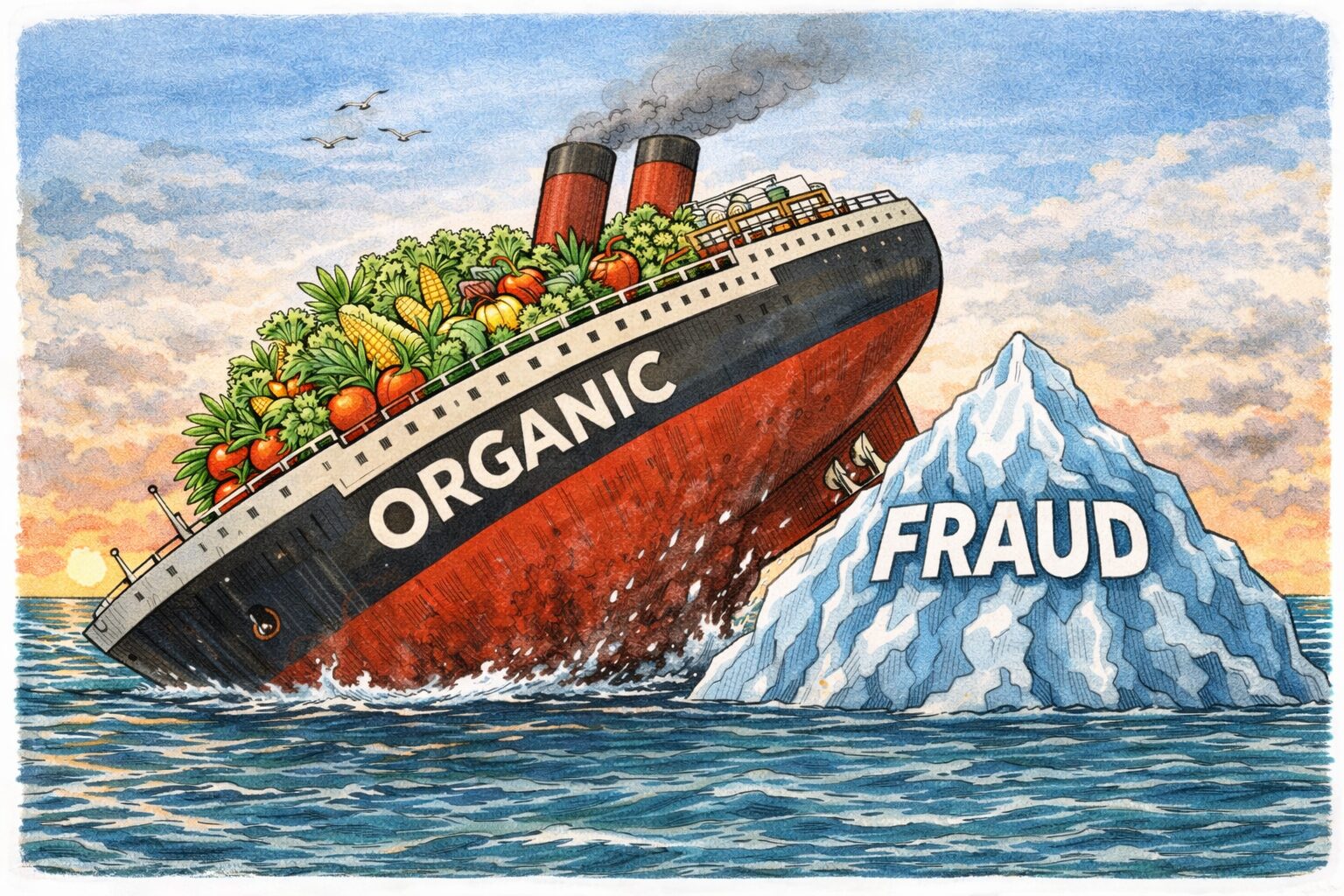
Sinking organic (Created with ChatGPT 5.2)

The days of simply attempting to tweak the existing organic regulatory structure has to end. We need to band together to make the necessary fundamental changes to the USDA Organic Program.

0
SHARES
13
VIEWS
Share on FacebookShare on Twitter

Without fundamental reform of the USDA Organic Program, family farms will continue to sink – while fraud flourishes

Mark Kastel

It pains me to see that so many organic certifiers and nonprofit leaders seem to have become nothing but cheerleaders for “organic,” the USDA organic program, and the certification scheme as it exists today.

The result? We have thrown family-scale organic farmers under the bus and are quickly morphing into an industry that has less to do with farming and more to do with returns for venture capitalists, private equity firms, and corporate agribusinesses controlling our food supply.

This is exactly what we were trying to get away from in the 1980s, when organics was commercializing in earnest. The movement started, in part, as a vehicle for family farmers seeking economic justice in the marketplace.

NOP Issues

After listening to 12 hours of the National Organic Standards Board (NOSB) meeting last week, including a report from USDA’s chief honcho at the National Organic Program (NOP), my initial takeaways are detailed below. My thoughts are also the result of a subsequent webinar, attended by a couple of hundred industry participants, that was sponsored by the National Organic Coalition (NOC) to address the reasons we are losing organic farmers in the U.S. — despite over $100 million spread around to NGOs by the USDA in an effort to recruit and train new entrants.


OrganicEye director Mark Kastel

Truncating public participation, as designed by Congress, in organic regulatory oversight

In the Q&A at the NOSB meeting, the chief at the NOP, Jennifer Tucker, said that due to lateral moves and shifts to efficient systems, they were doing perfectly fine after the administration cut over 30 percent of their staff. Does this mean they were highly inefficient prior to that? Most in the industry have always thought, based on the scope of the job to do and a market of over $70 billion, that they have been understaffed, and so we’ve supported additional funding for the program through Congress.

Paradoxically, Dr. Tucker then attributed the truncated, virtual NOSB meeting, without the normal time reserved for comments from the public, to the fact that there was not enough time and that it was too hard on the staff to schedule.

Perpetuating the certifier conflicts of interest in investigations of fraudulent activity

USDA’s National Organic Program has been focused on making sure all the paperwork is in order, dotting the i’s and crossing the t’s. Whether the farming operation or the food is actually organic seems to be secondary. Its delegation of investigations of fraudulent activity to the certifiers — generally for-profit business enterprises that appear to be either incompetent or potentially co-conspirators in the very incidents they are investigating — is wholly inappropriate.

Certifiers have an economic disincentive to ferret out fraud, especially involving their largest “clients.” Certifiers choosing the targets for unannounced inspections and testing leaves organic integrity subject to the inherent conflicts of interest.

Scheduled annual inspections result in millions of dollars spent on “busywork”

As an organic industry watchdog for the past 21 years, I can tell you that none of the large-scale frauds we have helped bust — collaborating with state agencies, the NOP, FBI, Justice Department, and investigative reporters at the Washington Post and New York Times — have ever stemmed from annual inspections. Our sources have been employees, former employees, or competitors ratting out unscrupulous industry participants. The annual inspections amount to “busywork” and, in aggregate, cost tens of millions of dollars a year. 

Our call to shift to less-frequent inspections for farms that have proven trustworthy and to refocus funding to aggressive, independent audits by senior inspectors and forensic accountants — which could truly bring the hammer down — has been ignored. Making this change would require congressional action.

Imported organic food is a shell game with the illusion of oversight

OrganicEye has also called for mandatory testing of all imported commodities. The cost would be a fraction of what organic farmers spend in the U.S. 
The incredibly Byzantine system USDA now uses — depending on paperwork to monitor foreign shipments — makes my eyes roll back in my head. I have little doubt that the most sophisticated fraudsters can figure out how to game the system.

Illegal imports from non-certified and uninspected farms

Even worse, while U.S. farmers are required to go through the annual inspection process, foreign farmers can be gathered together, coordinated by the very agribusinesses that are purchasing their production, to form “producer groups,” where individual operations don’t need to be inspected. That places U.S. farmers at a distinct competitive disadvantage and opens up consumers to be victims of fraud.

Let me make this perfectly clear: the Organic Foods Production Act, passed by Congress to empower USDA to protect the American public against fraud in the organic marketplace, clearly requires “organic” food to come exclusively from farms that are certified. And that, statutorily, requires annual inspections.

Many of us thought group certification was a good idea when it was first formally floated over 25 years ago, but the vision presented to us was small indigenous communities or cooperatives using “peer” certification, by elders, to compel compliance from very small landholders. Today, though, these groups are likely to have participants spread over thousands of miles and no restriction on the scale of the farming operations. This sets the stage for a free-for-all by international corporate interests that are undermining the USDA organic program. 

Equivalency agreements

Equivalency agreements with foreign countries, like Canada, were originally envisioned to enable similar and trustworthy organic regulatory schemes to supervise their own farmers so they wouldn’t have to have dual certification in two countries. 

In reality, a tremendous amount of foreign imports are coming into the U.S., certified by Canada, that are grown in Africa, Asia, and Central America. The shipments don’t even go through Canada. Only the paperwork does. It’s an egregious loophole that needs to be closed.

Saving the U.S. Organic Farmer

We have lost thousands of family-scale farmers around the country in recent years, and there are untold other families that would’ve liked to convert their operations to organic management, but the market demand was not there. Many of these conventional farms have gone out of business, especially dairy farms.

USDA has recently spent over $100 million trying to train and recruit farmers in an attempt to increase the abysmal percentage of organic crops produced in the U.S. This has amounted to a slush fund funneled through existing certifiers and nonprofits. Many of the subcontractors in the Transition to Organic Partnership Program (TOPP) — certifiers and nonprofits — have admitted that, despite the farmer training, they are having challenges getting farmers to actually follow through with certification.

A much better investment by the USDA would be an aggressive and effective enforcement program, resulting in the creation of marketplace incentives to increase domestic production. U.S. farmers cannot compete with fraud — either “organic alchemy” that magically converts conventional crops to organic or the USDA allowing massive livestock factories producing “organic” milk, meat, and eggs that do not meet the spirit nor the letter of the laws governing organics.

Fundamental Changes

We need to band together to make the necessary fundamental changes to the USDA Organic Program. The days of simply cheerleading and attempting to tweak the existing regulatory structure (tantamount to rearranging the deck chairs on the Titanic) has to end. For years, OrganicEye’s board secretary-treasurer, Will Fantle, has paraphrased USDA’s messaging to us: “Sit down, shut up, and clap louder!”

As long as the cash registers keep ringing, with millions of dollars contributed from the corporate sector to nonprofits and hundreds of millions of dollars being invested in certification, I’m afraid there isn’t much incentive to lobby for fundamental change. As Upton Sinclair said, “It’s very hard to convince a man of something when his salary depends on him not understanding it.” 

My call here is a very speculative attempt to turn things around. I care deeply about the integrity of organics, and it pains me when others just pay lip service to it.

As always, I welcome inquiries, held in confidence, from leaders in the organic movement who share these concerns and would like to collaborate on real-world solutions.

← Previous April 2026 • Issue #658 Next Roundup Pie →
Tags: Organic certificationOrganics
Mark Kastel

Mark Kastel

Mark Kastel is the executive director of OrganicEye (organiceye.org). This article was originally published on the OrganicEye website and is used with permission.

Next Post
Worms (DNB Stock)

Composting with Boron

  • Trending
  • Comments
  • Latest
The Most Important Livestock in Our Fields

The Most Important Livestock in Our Fields

July 1, 2024
Glyphosate Does What It’s Designed to Do — Kill

Glyphosate Does What It’s Designed to Do — Kill

February 19, 2025
USDA organic seal over American farm land

Losing Organic Farms

January 27, 2026
The Take-Half, Leave-Half Fallacy

The Take-Half, Leave-Half Fallacy

July 1, 2025
We Don’t Need Another Bridge — We Need an Off-Ramp

We Don’t Need Another Bridge — We Need an Off-Ramp

3
Under One Roof

Under One Roof

3
A Rose By Any Other Name

A Rose By Any Other Name

2
Terra Preta’s Biological Advantage

Terra Preta’s Biological Advantage

2
Weapons Over Research

Weapons Over Research

April 14, 2026
Real Food in Hospitals?

Real Food in Hospitals?

April 7, 2026
Closing the Beef Loophole

Closing the Beef Loophole

April 1, 2026
Worms (DNB Stock)

Composting with Boron

April 1, 2026

Recent News

Weapons Over Research

Weapons Over Research

April 14, 2026
Real Food in Hospitals?

Real Food in Hospitals?

April 7, 2026
Closing the Beef Loophole

Closing the Beef Loophole

April 1, 2026
Worms (DNB Stock)

Composting with Boron

April 1, 2026

About ACRES USA

Acres U.S.A.® Magazine

Acres U.S.A.® is North America’s oldest publisher on production-scale organic and regenerative farming. For more than 50 years, our mission has been to help farmers, ranchers and market gardeners grow food profitably and sustainably, with nature in mind.

Visit Our Advertisers

Magazine Issues

  • News
  • 2025
    • June 2025
    • May 2025
    • April 2025
    • March 2025
    • February 2025
    • January 2025
  • 2024 Articles
    • December 2024
    • November 2024
    • October 2024
    • September 2024
    • August 2024
    • July 2024
    • June 2024
    • May 2024
    • April 2024
    • March 2024
    • February 2024
    • January 2024
  • December 2023
    • December 2023
    • November 2023
    • October 2023
    • August 2023
    • July 2023
    • June 2023
    • May 2023
    • April 2023
    • March 2023
    • February 2023
    • January 2023
  • December 2022
    • November 2022
    • October 2022
    • September 2022
    • August 2022
    • July 2022
    • June 2022
    • May 2022
    • April 2022
    • March 2022

Contact Acres U.S.A

  • Contact Us
  • About Us
  • Advertise With Acres U.S.A.
  • My Subscription

Learn

  • Resources
  • Events
  • Magazine
  • Newsletters
  • Free Articles
  • Webinars
  • Online Courses
  • Bookstore

Our All Socials

Follow With Us...

  • My account
  • News
  • Ecological farming
  • Refund and Returns Policy
  • Privacy & Policy

© 2024 Acers USA Magazine

Welcome Back!

Login to your account below

Forgotten Password? Sign Up

Create New Account!

Fill the forms below to register

All fields are required. Log In

Retrieve your password

Please enter your username or email address to reset your password.

Log In
No Result
View All Result
  • HOME
  • ARTICLES
    • News
    • Farm
    • Ecological farming
    • Livestock
    • Crop
      • Crop management practices
      • Cover crops
      • Crop nutrition
      • Crop protection
      • Crops
      • Ag technology
    • Soil
    • Opinion
  • RESOURCES
    • Magazine
    • Online Learning
    • Newsletters
    • Blog
    • Free Articles
  • MAGAZINE ISSUES
    • 2025
      • June 2025
      • May 2025
      • April 2025
      • March 2025
      • February 2025
      • January 2025
    • 2024
      • December 2024
      • November 2024
      • October 2024
      • September 2024
      • August 2024
      • July 2024
      • June 2024
      • May 2024
      • April 2024
      • March 2024
      • February 2024
      • January 2024
    • 2023
      • December 2023
      • November 2023
      • October 2023
      • August 2023
      • July 2023
      • June 2023
      • May 2023
      • April 2023
      • March 2023
      • February 2023
      • January 2023
  • ABOUT US
    • Our History
    • Our Staff
    • Contact Us
    • Community
      • Soil Health Primer Resources
  • EVENTS
    • Eco-Ag Conference
    • On-Farm Viroqua Event
    • Farm Weird
  • SUBSCRIBE
  • Login
  • Sign Up
  • Cart

© 2024 Acers USA Magazine

Are you sure want to unlock this post?
Unlock left : 0
Are you sure want to cancel subscription?