

A photographic tour of a well-managed farm: Pinnacle Organically Grown Produce
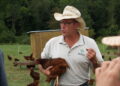
On August 23, 2023, a busload of farmers, researchers, agronomists and eco-ag enthusiasts arrived at Phil and Katherine Foster’s Pinnacle Organically Grown Produce in central California. The Fosters have grown a wide variety of vegetables on 250-plus acres for more than 30 years, planting and harvesting every week of the year.
This photo essay details just a small portion of everything Phil Foster showed the group. Pinnacle is an excellent example of a well-managed organic farm that has prospered for several decades.
All photos courtesy of Acres U.S.A.
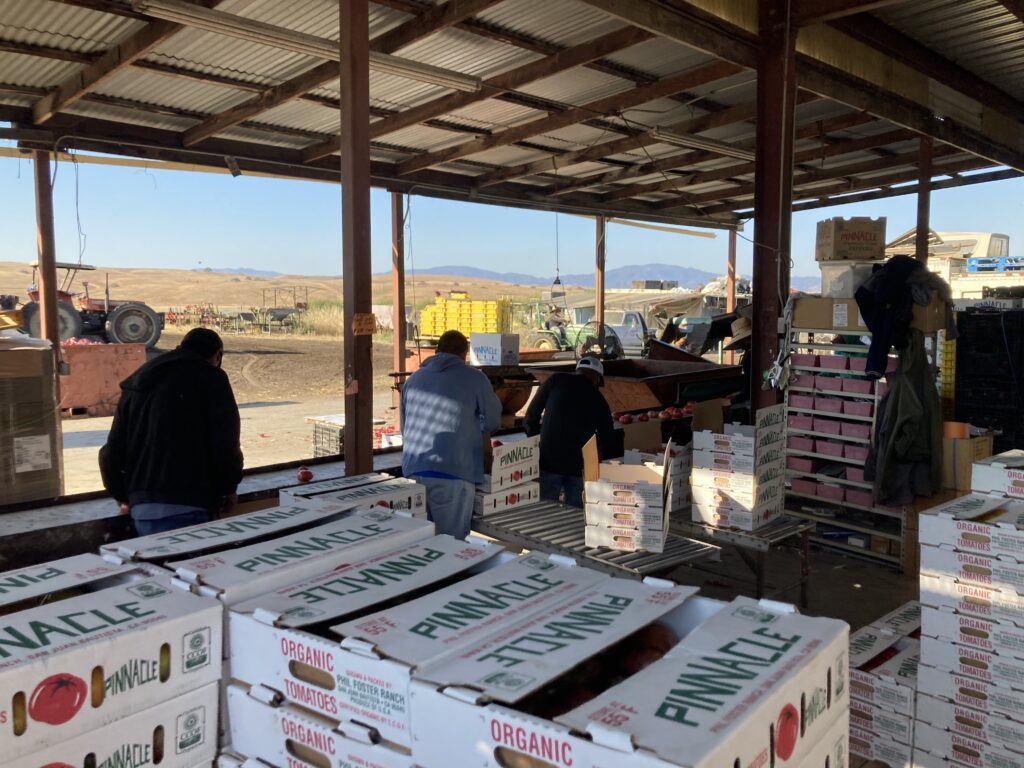
We manage most of our sales ourselves. Probably 75 percent of what we grow is marketed within 100 miles of the farm. We’ve really tapped into the Bay Area. We do ten farmers markets, we do a farmstand at our other farm location every Saturday morning for people in the community, and we have a couple of refrigerated trucks and about 25 stores we deliver to, including some Whole Foods that we backdoor. We also get product into their distribution facility and another produce distributor in the San Francisco area, so we have access to a greater national wholesale market. If we have extra products, we move some to them. So, we handle almost everything ourselves.
In order to do that, we have some infrastructure — we have some cold storage on this ranch and we have cold storage on the other ranch. Right now there’s about 70 of us working on the farm. We are a pretty labor-intensive farm with fresh vegetables. The people who work on the farm are the reason the farm has been successful over the years. Efrain Contreras, who manages this ranch and knows this ranch better than I do — we’ve worked together for over 30 years. We have a number of employees who’ve been here 25-plus years. We have a lot of employees with 10 or more years experience. That is really invaluable to the farm operating well, and it just makes farming a lot more fun when you help people who are really talented and can work seamlessly from job to job. That’s been an important component of the farm.
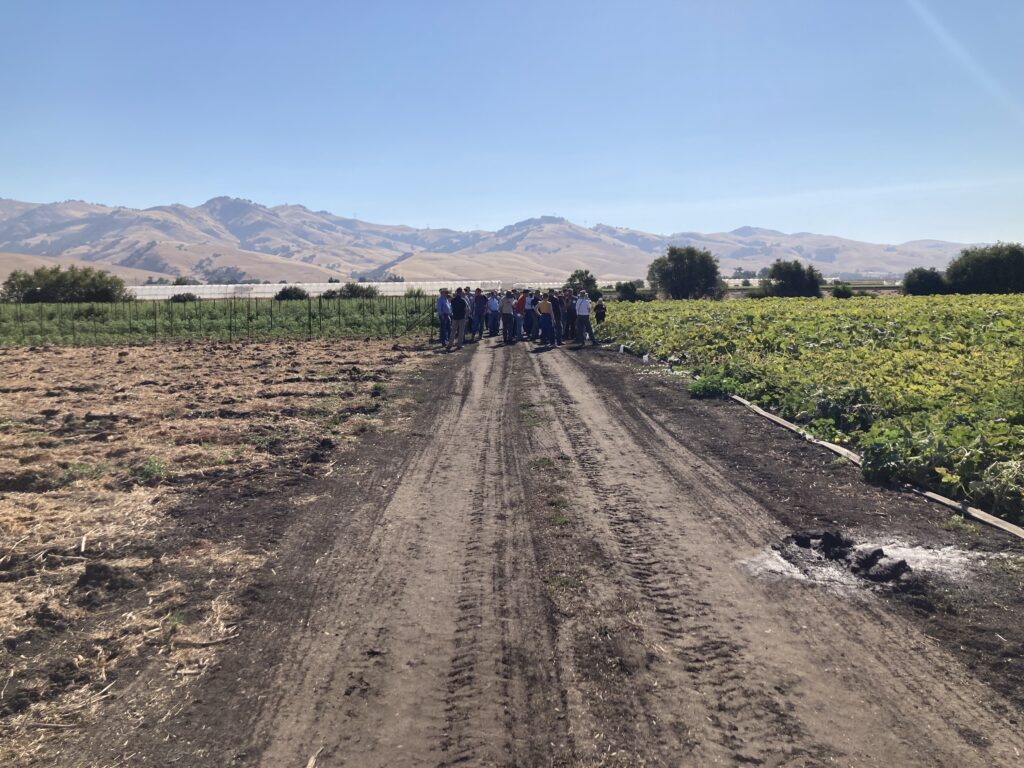
I won’t be able to give you really good figures on up-to-date water costs, but it’s all groundwater. Our two farm locations have wells. This farm location has five small wells on it. Coming out of the winter, we have about 500 gallons a minute combined. This time of year [August] we’re about 350 gallons minutes. The water table in this area is very fragile, so we’ve really protected it. $20 an acre-inch is an old figure; it’s probably changed a little bit since then. We do have solar systems that offset some of the power use.
We use some hand-moved sprinklers, but we do a lot of drip. We do recycle the tape a few times. The water quality is decent; it’s not superb. A little bit of boron; the total dissolved solids are probably 600-700, so there’s a little bit of sodium. Our soils are serpentine soils, so they’re high in magnesium; there’s levels of magnesium in the water, so we’ve always been fighting to get more calcium into our soils.
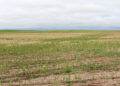
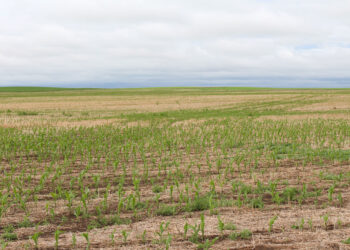
We’ve been in a dry cycle the last seven or eight years. Last year was a real bonus —we doubled our annual rainfall this last rainfall season, but we haven’t had a winter like that in quite a while. We’ve been on a downward cycle in terms of the amount of ground we can farm on this ranch. We used to grow on 175-180 acres a year, and now we’re really better off doing 120. We’re up to about 130 acres this year.

We first got certified by California Certified Organic Farmers in 1990. We’ve been through a lot of inspection cycles. It’s still a little bit of a challenge, each one, but for the most part it’s pretty simple for us to go through. We keep really good records; we don’t use a lot of inputs; we’re doing the diversity component that they’re looking for. It’s relatively easy for us, but we’ve had a lot of years of experience — we should be able to handle it pretty well.

Pat Herbert was a pioneer in composting in our area. He was an early adopter in the early ’90s, and he became associated with the Luebke family out of Austria, who were really skilled at training farmers to do on-farm composting. Fascinating, some of the ideas they had. We have basically followed that methodology. It helped us get grounded in learning how to make compost. We’ve adapted a little bit, but basically that’s the system we’re using.
The Luebkes gave us an idea of how to set up a composting yard. Ours is nice because it’s close to our shop. The slope in this spot is also pretty good. There are three little cross-falls across the yard, and they’re about 2 or 3 percent down. So, in the winter, when we get a little bit of rainfall, we have covers on the piles, and there’s drainage off the field without a lot of water standing against the compost.
We started producing compost in 1995 with a little self-propelled eight-foot windrow turner made by an Amish machine shop in Pennsylvania. This turner here is the one we’ve been using for more than 20 years. It’s a 10-foot pull-type turner made by Sandberger. It’s been rebuilt three or four times over the years. It’s been a real valuable piece of equipment over the years.
Manuel is the compost meister for the farm. He builds the windrows and does the temperature and CO2 testing and recording of all our data for our composting operation. We’ve produced over 2,500 tons of compost a year in the past. Now we’re more like 1,500 or 1,600 tons. It’s only used on our two farm locations — we don’t sell it. When you start selling it, there’s more oversight that you have to go through. But if you’re using it yourselves, the oversight is pretty easy to manage.
We have applied rates of eight or 10 tons — not dry weight; it’s 40 or 45 percent moisture. On this ranch we’ve dropped back the rate a bit — we’re more like six tons to the acre. So that’s three-and-a-half tons dry weight. We mix gypsum with it so we can apply that at the same time. We add a little bit of lime with it. We’ve used rock dust in with it.
Feedstocks haven’t changed much over the years. We get the clean green material out of the urban areas. We’ve always looked for material that was handled pretty well and had very little trash material mixed in with it. Different times of the year it’ll have a higher grass component. In the fall it might have a higher carbon ratio, but generally it’s 25 to 40 to one. There used to be a dairy in our county; that’s closed down, but we still get dairy manure from over in the Los Banos area. We used to get turkey manure, but that’s been closed down for a while. But some of their houses are within four or five miles of us and they now raise ducks, so we get duck manure from ducks that have been in open houses with shavings for bedding. They clean those houses out every so often, and we can pick that material up; that’s a pretty nice feedstock. Some of that duck is for egg laying, so they’re supplementing with calcium, so the calcium levels in the manure we get are at a nice level. We’ve gotten horse manure in the past — lots of horse operations in the area. I don’t go collect it, but I can get a trucking company to bring the material to us. All our cull vegetables work back in. If I can ever buy cheap wheat hay or wheat straw, that’s a nice quick carbon source. We like to lay that bedding down first and then build our windows up.
It’s all built with the loader. Manuel’s pretty talented at mixing. We’re usually starting at 25 or 30:1 C:N ratio, and when we finish we’re maybe at 12 or 14:1.

Five years ago we got interested in reduced till. Prior to that we were using judicious tillage practices — whatever we needed for our farm. We really focused on reduced till, thinking that might be the next step for improving organic matter. We haven’t seen a bump yet. We haven’t really been able to determine how much it’s improved the farm yet.
Our yields in general reduced where we did highly reduced tillage practices. And part of that is, you’re transitioning to a different system. You’re learning. We had 30 years of learning practices that worked well for us. Then, changing your practices dramatically — you have to start over on a learning curve. I think it takes you a number of years. The first couple of years we stubbed our toes.

This piece of equipment is for vertical tillage. We have the straight blades; we have wavy blades in the back; we have a place in the middle where we can put chisels if we need to, if we want to loosen the soil up a little bit. We very rarely run chisels anymore, because if we’re following a nice cover crop, that cover crop mix has some species in it with good tap roots, and we’re finding that there isn’t much compaction following a cover crop; the chisel’s not going to do me any good.
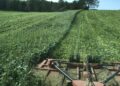
What we really run a lot is this undercutting knife, if we have a cover crop and want to terminate it, and we haven’t had much luck with the roller crimper. If you mow it, sometimes you’ll get regrowth, especially earlier in the spring. But the undercutting knife for terminating a cover crop works pretty well. It also works well if we’re coming out of a crop into another crop, or a crop to a cover crop; we might want to get the crop that we’ve mowed loosened from the soil.
We’re also having much more severe perennial morning glory problems the last few years — maybe related to some of our reduced-tillage practices. If we have beds that are coming out of cover crop, and we left the material on the beds, we may go through periodically and undercut it and try to starve it, while leaving the residue on the surface.

Another tool we’ve been using a lot more is the power harrow. With all the residue we leave on the soil surface, when we transition from the residue to planting a crop, we want to get that residue moved around. It’s been pretty valuable, to go along with the vertical tillage tool.

We make permanent beds, so when these tomatoes come out they’ll be planted to a cover crop. We have drills for 80-inch beds for the small cover crop seeds. Then these beds could go into peppers next year; but it’s probably going to go into fallow because it’s had pretty severe morning glory, and we probably need to address that.