
A seed is the beginning, and the end, of a plant’s life
The ages-old question, “What came first, the chicken or the egg?” summarizes my dilemma when it comes to writing about seeds! I suppose that the dilemma really isn’t one — it’s merely a result of me attempting to perceive a moment-in-time phase of those things we call plants.
In fact, the seed is just about the only time when time does stand still for the plant. At all other life phases, a plant is undergoing constant change as it systematically goes through metamorphosis. The seed is almost like a resting stage somewhere in the middle of a plant’s life.
Most of us are trained and conditioned to look at seeds as the beginning of a plant’s life: the plant emerges from the seed, it passes through the seedling stage (which looks radically different than the mature plant), it elongates, its leaves change shape throughout its life, the plant flowers, the flower is pollinated, and it sets seed. The seed is the beginning of the plant. Or is the seed the end of the plant? Or is it simply the goal of the plant? In a linear view of the world, all of these perspectives can make sense.
The seed could be considered more like a momentary pause in time. The idea that “life creates time” has been discussed for over a century (by ecological/biodynamic farming pioneer Rudolf Steiner, among others). That time and the structure of the universe itself is a “byproduct” of life is a new idea to most people, but it actually makes a whole lot of sense, especially when you think of seeds.
This idea was most recently described and promoted by Robert Lanza, a biologist and the author of Biocentrism: How Life and Consciousness are the Keys to Understanding the Universe. Lanza’s argument is that life and consciousness is necessary for the perception of time. Without life, time wouldn’t exist as we understand it. (If you ever wonder how I got to be so weird, you’ve only got to remember that Robert Lanza is not that much older than me, and I grew up down the road from him. Lanza was one of the earliest pioneers of cloning, and the rumor was that he cloned genetically modified chickens in his basement as a teenager. We’ve literally drunk the same water most of our lives … No joke!)
Creating Seed Conditions
The seed is a plant that has been put on pause. How can this hard black bead that resembles a granule of Idaho rock phosphate somehow turn into a hairy vetch plant, while the phosphate merely dissolves and becomes smaller and smaller molecules of Ca3(PO4)2? How is it that this seed can sit dormant for months, years, and in some cases, millennia, before a new, genetically unique plant emerges from it?
If we’ve done our work well, we farmers and ranchers have created the ideal conditions to receive this young plant from the seed. We have prepared a welcoming seed bed, we’ve balanced the minerals in the soil, and we’ve ensured that the seed is in contact with it. In many respects, the plant communicates through the sense of touch. By touching the soil where it finds itself, it receives the information that it needs to activate certain genetic pathways and silence others.
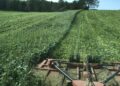
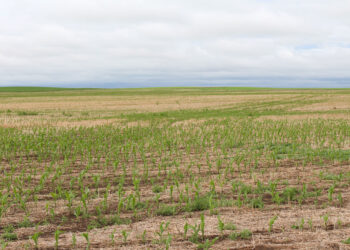
Making sure the seed has adequately balanced soil minerals immediately around it when it germinates is one of the biggest crop-producing bangs for your buck. As soon as the radicle (the initial root) of a seed makes contact with the soil, we want it to receive signals that tell it that it is in a welcoming place and will have plenty of nutrients to grow well, and therefore that it can activate the genetic pathways that allow it to yield up to its genetic potential. If we are not able to amend our soil on every acre, then we can “trigger” the young plant into early vigor by band-applying mineral nutrients and crop fertilizer in-row at planting. Decades of band applications of mineral amendments at New Forest Farm have created an interesting tiger-striped pattern of darker green and more vigorous growth in many fields (I was not always able to afford enough mineral amendments to correct everything uniformly all at once).
Once the plant has made it past the critical seedling stage with everything it needs, it will be bigger and more vigorous than other plants that didn’t have an early advantage, and it is more likely to be able to scavenge for nutrients that might be in short supply elsewhere in the surrounding soil. Custom application of soil minerals and fertilizer is becoming easier and easier these days with the rapid advancements in drone technology and precision farming techniques, so this is not difficult at all.
In addition to adequate minerals, the right blend of soil biology is needed. Soil biology has the ability to dissolve soil minerals, chelate them, and otherwise take small rocks (Ca3(PO4)2 in my earlier example) and combine them with other elements to make them bioavailable for the plant as food. Compost, vermicompost, compost teas, liquid compost extracts, biodynamic preparations, and biologically active seed coatings all provide biology that interacts with the minerals that will now become available for the plant so it will grow and bear more vigorously. Dripped, spread, sprayed or injected, soil biology “covers over a multitude of sins,” as a mentor once told me.
Adequate levels of soil organic matter act as both a sponge — holding water-soluble nutrients — and as a source of nutrients. The complexed carbon compounds in organic matter decompose in the process of mineralization. A longer-lasting nutrient sponge is biochar. Extremely resistant to decomposition and mechanical breakdown, the hollow cells and lattice structure of biochar hold nutrients in place while roots develop and come looking for dinner.
Time Stops
The seed has awakened into time, and it touches the world around it. The signals it receives have switched its genetics on and off in response to its surroundings. These epigenetic changes (changes in gene activity, not necessarily the genetic sequence) inform the plant as to how to interact with its environment and can affect its flavor, immunity to disease, resistance to pests, and nutritional value. All of these sensory inputs then affect how the egg cells and sperm cells divide in meiosis.
All of the information this plant has received, from when it first reached out and “touched” the soil around it, has been recorded within itself. Then, through wind or the activity of insects or the action of the paintbrush in your hand, a pollen grain from one anther makes contact with the stigma of a flower, and one half of it begins to generate a pollen tube that elongates through the style. The sperm cell travels through this pollen tube and touches the embryo.
Once this happens, time stops.
LOOK!… a seed!
Mark Shepard is a land designer and consultant and is the author of Restoration Agriculture, Water for Any Farm and the Water for Any Farm Technical Manual.