
Ecological farmers owe a debt of gratitude to the man who kept organic methods alive at the outset of the synthetic input age
“GENIUS? Or FRAUD?”
That was the screaming red headline on the back of J.I. Rodale: Apostle of Nonconformity — the first-ever biography of J.I. Rodale, written by Carlton Jackson in 1974.
Despite the sensationalist cover, Jackson tried to give a balanced portrayal of Rodale. But J.I. Rodale remains a controversial and misunderstood figure to this day. I wrote a less-than-charitable assessment of his writings myself back in June 2019, in which I focused heavily on some inaccurate information in his book Pay Dirt. And there were some errors — his claims that the sulfur in chemical fertilizers caused cancer, for example, were never validated.
I’ve learned much more in the past four years, and I’ve gained a lot of respect for J.I. Rodale and what he did. He wasn’t a genius — he rarely came up with any original ideas. But he wasn’t a fraud, either, because he believed wholeheartedly in everything he promoted. And he played a critical role in bringing organic farming to the United States and helping it survive the tumultuous years of the 1950s and 1960s.
It’s time to revisit Rodale and give him the credit he deserves.
Against the Grain
Like most of the early leaders of organic farming, J.I. Rodale cared little what people thought of him. He wanted to do and write what he thought was best, even if that went against the tide of public opinion. Carlton Jackson’s carefully chosen title, Apostle of Nonconformity, indeed sums up Rodale’s two personality traits that made him the leading advocate of organic farming in the United States. He was an apostle in the sense that he passionately preached healthy farming and lifestyles, and he was a nonconformist in that he did not hesitate to disagree with the agricultural and medical consensus of his day.
Born Jerome Irving Cohen, J.I. Rodale (1891-1971) was the son of Eastern European Jewish immigrants who had settled in New York City. His overbearing father, Michael, wanted him to become a rabbi. While his father was still alive, J.I. dutifully attended religious instruction after his regular school classes. But once his father died, J.I. dropped out of rabbinical training and pursued a career as an accountant instead.
J.I. quickly discovered that being Jewish was a handicap in the 1920s. He had difficulty finding a good accounting job because of his surname of Cohen. Despite this antisemitism, he finally landed a job with the Internal Revenue Service. To help reduce future discrimination, J.I. took the drastic step of changing his last name to the much less Jewish-sounding Rodale. His older brother, Joe, followed suit, and the two of them started an electrical components business called the Rodale Manufacturing Company. They moved the headquarters from New York to Emmaus, Pennsylvania, in 1930. J.I. broke further with cultural norms by marrying a Catholic woman, Anna Andrews, in 1927.
Instead of becoming bitter at having to work so hard to surmount prejudice, Rodale seems to have always approached life with a sense of humor. Later in life, he would attribute this good-natured approach to life to his healthy diet of organic foods. Even before he found out about organic farming, he was always trying to make people laugh. His lifelong dream was to produce comic plays. The fact that they were always flops — if they even made it to the first performance — never discouraged him. He just tried again.
Rodale’s other dream was to be a publisher. As soon as he had a little extra capital from his manufacturing business, he immediately invested it in a series of unsuccessful publishing ventures. He launched magazines with titles like The Humorous Scrapbook, The Clown, American Humorist and Fact Digest. They were all digest-style magazines, with articles reprinted from other publications, and most of them had a comic bent. They also all lost him money.
From an early age, Rodale was also interested in health and fitness. Most of his immediate family died in their fifties or sixties from heart attacks, and he wanted to stay as healthy as possible in hopes of living a little longer. Health magazines figured prominently in the immense amount of reading material that he sifted through to clip for his digest magazines. And as he flipped open a small British health magazine called Health for All, sometime in 1940 or 1941, he had no idea that an advertisement for a new book by Sir Albert Howard would change the course of his entire life.
Organic Farming Comes to America
In his later reminiscences, Rodale usually attributed the beginning of his interest in organic farming to reading Sir Albert Howard’s An Agricultural Testament in 1940 or 1941. Howard, a British botanist, developed what he called the Indore method of composting during his work in India in the 1920s. An Agricultural Testament gave practical instructions on how to build compost piles. But what really attracted Rodale to Howard’s work was his philosophy of the connection between soil and health.
Howard warned that Western agriculture was at a time of crisis. Despite the huge amount of scientific research done on agriculture, yields were dropping or merely remaining steady. Soil was eroding. Diseases and pests were becoming more and more of a problem. The cause? Modern agriculture had broken a fundamental natural law — the Law of Return. In nature, all plant and animal wastes were returned to the soil, recycling mineral elements and organic matter. But chemical fertilizers bypassed that process completely.
Based on decades of observation and experimentation in India, Howard discovered that when he followed the Law of Return and grew plants in soils high in organic matter, they suffered little from pests or diseases. Similarly, animals that were properly nourished on plants grown in healthy soil were also healthy. Most importantly, there was a growing amount of evidence that humans who ate a healthy diet of food grown on good soil were also healthier than the average British population at the time.
“If the physique and health of a nation ultimately depends on the fresh produce of well-farmed land, if bad farming is a factor in the problem of poor physique and bad health, we must set about improving our agriculture without delay,” Howard urged.
When J.I. Rodale read that, a lightbulb went on in his mind. For years he had been interested in health and diets. He blamed his poor health as a child in part on the stale white bread and outdated canned meat that his frugal father had brought home from his store. But suddenly he realized that nutrition wasn’t strictly a matter of diet. Maybe it went all the way back to the soil.
Ever since he was a teenager, Rodale had dreamed of owning his own farm. Howard’s book was the trigger that turned that dream into a reality. “No longer could I enjoy eating store-bought vegetables and meat,” he wrote in a 1952 recollection in Organic Gardening magazine. “A powerful impetus surged over us, and within a few weeks my wife and I became the proud owners of one of the worst pieces of land in our county; sixty acres of the most refractory clay you would want to sink a disc into. But we were not aware of it at the time. We were more desirous of getting a good location, having a secure feeling that farming by the organic method would take care of everything else.”
Too busy with his manufacturing and publishing business to turn compost piles himself, Rodale hired an incompetent farm worker whose performance left much to be desired. “If there was any type of mistake that a person could commit in making compost, this well-meaning but unfortunate individual made them,” Rodale recalled. Still, the work of soil restoration was begun, and the experiment was successful enough that Rodale was committed to organic farming for the rest of his life.
Just farming organically himself wasn’t enough for Rodale. “I felt that I had to share this information with the rest of the country,” he explained. “It would not be fair to know this and to say nothing about it, considering that I owned printing presses and was a publisher.” Rodale corresponded with Sir Albert Howard, who gave him advice and agreed to become the associate editor of a new magazine about organic farming.
Rodale usually made it sound like Howard was the only person he corresponded with before launching his magazine. But to his credit, Rodale also toured existing organic farms in eastern Pennsylvania and New York, “trying to squeeze into days what should have gone into years.”
One place that Rodale visited was the School of Living in Suffolk, New York, operated by Ralph Borsodi. Borsodi had gone back to the land in the 1920s, and his books This Ugly Civilization and Flight from the City were read by thousands of homesteaders in the 1930s and 1940s. He had begun using organic farming methods in 1938 and was happy to give J.I. and his young son Robert a full tour of his farm in the spring of 1940 or 1941.
“Rodale was especially interested in the nearby compost heaps and the early garden nearly laid out,” Mildred Loomis later recalled in her 1992 book Ralph Borsodi: Reshaping Modern Culture. The Rodales were also very appreciative of the delicious organic lunch Borsodi served them, which included baked potatoes, a fresh cabbage-celery salad, and frozen green beans. After the meal, J.I. Rodale “spent the whole afternoon in the library” looking at organic farming books.
At some point Rodale also stopped by the Kimberton Farms School in Pennsylvania and met Ehrenfried Pfeiffer, who was the leading advocate of biodynamic farming in the United States. Rodale relied heavily on Pfeiffer’s book Bio-Dynamic Farming and Gardening as he developed his own organic farming and composting methods.
Borsodi and Pfeiffer were part of the nascent community of biodynamic and organic farmers that already existed in the northeastern United States in 1940. But until Rodale came along, there was no American magazine devoted to promoting organic farming. And that’s where his experience as a publisher came in handy.
Organic Gardening is Born
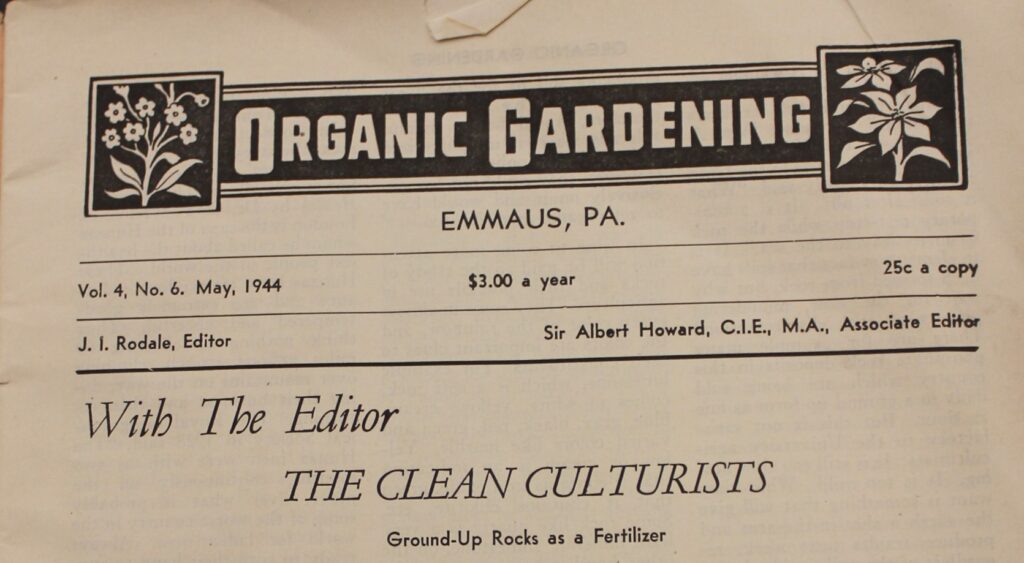
Rodale was so excited about the potential of organic farming that he printed 14,000 copies of his first magazine issue, titled Organic Farming and Gardening. He sent them out free with order forms in May 1942 but only received 12 subscribers. Noting that these were mostly gardeners, not farmers, Rodale launched a direct marketing campaign targeted at home gardeners and changed the magazine’s title to Organic Gardening in January 1943.
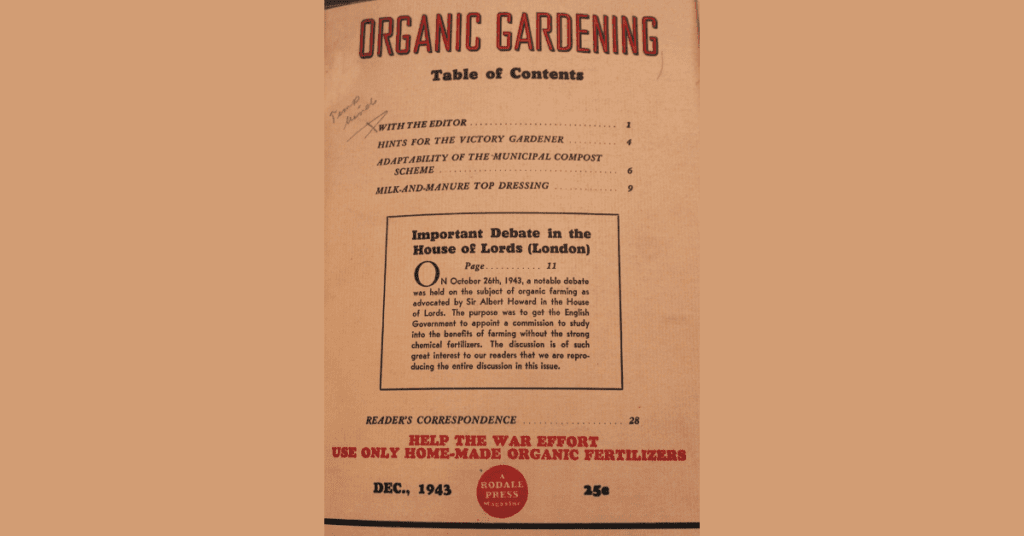
It was an inopportune time to start a magazine. Wartime paper rationing restricted Organic Gardening’s circulation, and Rodale apologized to his readers that the magazine was printed on low-quality paper. As a savvy marketing tactic, Rodale pointed out that organic gardening was patriotic because it freed up fertilizer raw materials for defense industries. “Help the war effort: Use only home-made organic fertilizers” was the magazine’s slogan in the early 1940s. He ran a multi-year series of vegetable production articles by Roger W. Smith titled “Hints for the Victory Gardener.” Planting and growing an organic victory garden was patriotic, and the magazine faced little opposition during the war years.
Like his previous magazines, the early issues of Organic Gardening were digest-style, composed mostly of reprints from other periodicals. Most issues featured articles both by Sir Albert Howard and Ehrenfried Pfeiffer, who were the magazine’s main contributors. Ralph Borsodi wrote a series of articles about the economics of organic fertilizers in 1944. The reprinted articles were mainly from British publications, alerting American readers to organic news like the debate about organic farming in the House of Lords in 1943.
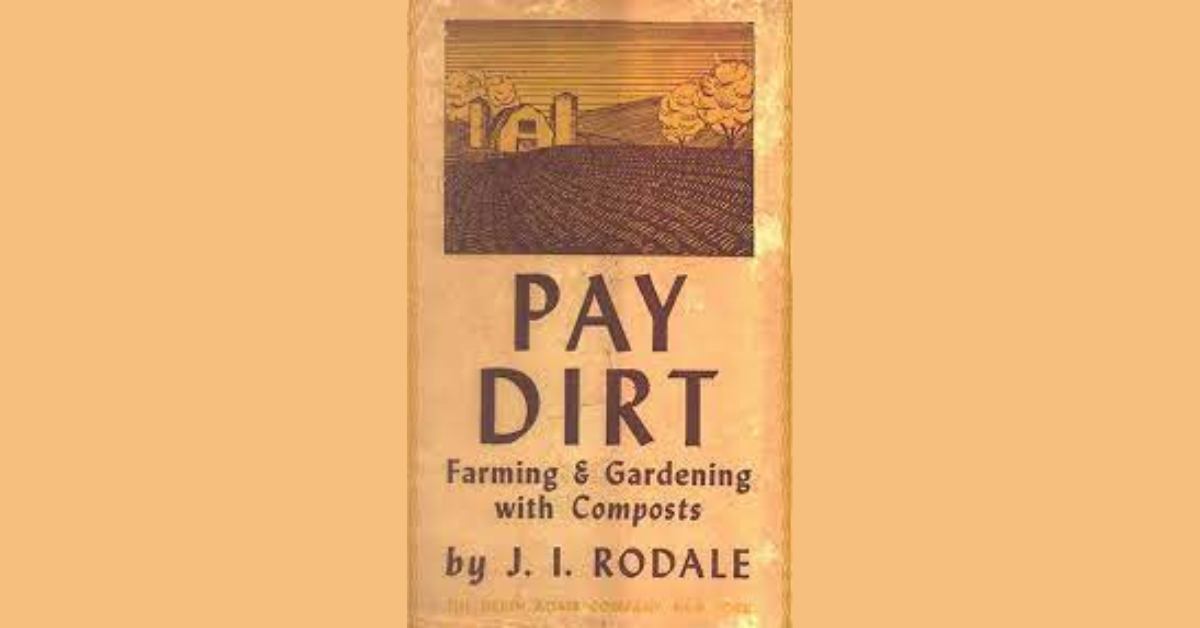
By 1945, Rodale’s subscription base had risen enough that he decided to publish his first book about organic gardening, Pay Dirt. He was able to get a contract with Devin-Adair in New York, making Pay Dirt also the first book Rodale had written that was not published by his own press. Going with an established commercial publisher got Pay Dirt into the public view, especially after the influential conservation freelancer Russell Lord wrote a mostly favorable review for it in the Sunday New York Times. Lord also published a symposium of comments about Pay Dirt in his own magazine, The Land.
“Much of the stuff he cites seems to me the outcome of a flaming will-to-believe, and a bit screwy; but most of it makes sense, plainly,” Lord wrote in his review of Pay Dirt. “And there can be no doubt that in plugging for humus, as opposed to mineral powders, Rodale is a needed makeweight.”
The first half of Pay Dirt was a practical guide to composting, combining the methods used by Sir Albert Howard and Ehrenfried Pfeiffer. No one really found fault with that section. It was the second half of the book that caused some reviewers to raise their eyebrows. Rodale devoted a lengthy section to “The Dangers of Chemical Fertilizers,” which was a compilation of fertilizer or pesticide poisoning accounts he had clipped from various publications.
Next, Rodale wrote about “Health or Disease from Food,” relying heavily on Howard’s work and Lady Eve Balfour’s The Living Soil. “Sufficient proof, it seems to me, has been gathered to show that the low status of American health is directly related to the condition of the soil in which we raise our foods,” Rodale concluded.
British organic farmers had been saying similar things for five or six years. But their books were not widely read in the United States. Pay Dirt was the first time most Americans heard about the organic philosophy that healthy soils grow healthy plants, animals and people. Rodale didn’t criticize agricultural science quite as harshly as Howard did. But agronomists and soil scientists were quick to realize that his theories, if taken to the extreme, could jeopardize the entire system of chemical-dependent farming that they were painstakingly working to build.
“I did not dream at that time that I was touching off a powder keg,” Rodale wrote in 1952. The fuse burned slowly, but by 1950 the debate about organic farming would explode at a national level. And because Rodale’s Organic Gardening magazine was the main way American organic farmers and gardeners connected with each other, J.I. Rodale and his publishing company would become the main target of the anti-organic rhetoric of chemical industry and agricultural scientists.
Others might have buckled under the strain. But Rodale was as strong-willed as he was good-natured. He didn’t make any money off Organic Gardening magazine in the 1940s or 1950s. But he kept publishing it because he truly believed that organically grown food was the key to health and happiness.
All organic, ecological and regenerative farmers in the United States today owe him a great debt for keeping organic farmers and gardeners connected until organic gardening could once again flower in the late 1960s.
Anneliese Abbott has a B.S. in agronomy and an M.S. in agroecology and is the author of Malabar Farm. She runs a small CSA in Michigan and can be contacted through her website, historyoforganic.com.