

Integrating livestock back into cropland systems restores microbial life, improves carbon cycling, and strengthens soil health through managed grazing practices
Editor’s note: This is the fifth in a series of five explanations of the principles of soil health, as described by Jay Fuhrer, who was one of the first to define these principles as a whole. Each article will include a description of the principle along with a profile of a farm that is successfully implementing it.
If only we could invent a way to distribute aerobic and anaerobic microbes effectively and economically across our agricultural landscapes. Something mobile and capable of processing plant material into nutritional protein that humans can eat. The invention should also come in various sizes suitable for specific needs, like playing a close role with plants, soils, and the carbon cycle. Yes, I mean this tongue-in-cheek!
The fossil record tells us that our planet has a long association with animals. Plants, animals, and soils have coexisted and supported each other over geological time. Modern agriculture owes its existence to this cooperation. One of my favorite quotes that explains the magnitude of impact animals can have on the landscape comes from The Journals of Lewis and Clark: “This scenery already rich, pleasing, and beautiful was further heightened by immense herds of buffalo, deer, elk, and antelope which we saw in every direction feeding on the hills and plains. I do not think I exaggerate when I estimate the number of buffalo which could be comprehended at one view to amount to 3,000.” The journal entry is dated Monday, September 17, 1804, near present-day Chamberlain, South Dakota.

What role does animal integration play in today’s agriculture? Diverse grazing ruminant animals use fermentation, saliva, microbes, and the carbon cycle to complete their life functions. The ruminant is always warm and wet, providing the ideal microbial environment, even in a drought. Landscapes with livestock integration can process crop residues through the ruminant. The soil food web benefits from a readily available food supply. Fungi break down the residues into simpler chains, which are eventually finished by bacteria. Livestock distribute microbes across the landscape. As grazing ruminants enter a new paddock, they make food available for the soil food web on day one.
Biological carbon capture and maintenance is always challenging, as many present-day cropping systems are not capable of sequestering and maintaining carbon. Livestock integration returns another soil health principle to the landscape, allowing the soil food web to digest the organic materials through the living, dead, and very dead (humus) soil organic matter portions.
In spite of all these benefits, farmers remain skeptical. Are there challenges to returning animals to the landscape? Animal husbandry concerns are at the top of the list. Our grandparents were good at encouraging trust and minimizing stress when working with grazing ruminants. This is an art and science we need to relearn and reapply. Physical components are needed too: water sources, fencing (physical or virtual), handling facilities, a rotational grazing system, etc. Remember, though: you don’t need to own livestock — you just need to know someone who does.
How do we return animals to the landscape? Fall and winter grazing of cover crops and/or crop residues is a good start. Remember to always leave adequate soil armor. For a larger biological impact, consider a full-season cover crop managed by grazing, and then return the field to the crop rotation the following year. Hay fields are also capable of sequestering carbon with winter feeding locations and by rolling out bales or bale grazing, continually moving the feeding site. Lastly, rotational perennials, managed and rotated through our cropping systems, is another option.
Cowboy up!
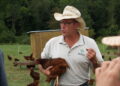
| Featured Farm: Carpenter Ranch Moffit, North Dakota Dave and Vicki Carpenter Carpenter Ranch is located just west of Moffit, North Dakota. By 2010, Dave had finished a 23-year career with the U.S. Marshals, while his wife Vicki worked in the medical field. Dave was aware of the value of goalsetting and moving toward an objective, and as he switched careers to full-time ranching, it became time to apply this knowledge to a degraded grassland, with an initial goal of increasing the carrying capacity. Dave credits his maternal grandparents and his father-in-law for early livestock interest and foundational information. He began talking with the Burleigh County Soil Conservation District (BCSCD) about soil health, livestock integration, grazing management, and carbon in the late ’90s, attending soil health tours and workshops. He actively participated on the BCSCD board of supervisors. Over the years a shift in thinking started to occur — from the original goal of increasing carrying capacity to the importance of reading the landscape, increasing plant diversity, and keeping the soil covered. From winter feeding cattle at the headquarters to knowing where on this ranch to improve the soil’s food source, Dave’s focus became broader. The cow/calf operation evolved into an all-perennial operation with a once-over grazing system. Dave began to utilize daily moves, faster in the early grazing season and slower in the later grazing season. Winter feed is now purchased and fed on carbon-deficient areas such as old hay-land. Paddocks are walked and observed for adequate leaf length to continue harvesting sunlight and carbon dioxide. As Dave says, “Sometimes you think you have enough litter and leaf length, and later when you walk a paddock you just finished grazing, you realize you took too much. It’s always a matter of reading the landscape and adjusting when needed.” All of the soil health principles are applied on Carpenter Ranch. Dave explains, “My thinking changed from the first time I stepped onto the ranch in 1999 compared to today. Initially I started with monocultures and amendments, as I didn’t totally understand soil function and soil health principles. Livestock integration got me started, and soon I was adding soil armor, plant diversity, minimal disturbance, and a continual live plant. For our ranch, plant diversity was an especially important “aha” moment, as it brought noticeable soil and water resiliency. Along with livestock integration came multiple income streams as we kept connecting the principles. “The soil health principles help chart a path forward. It’s not a straight path, but ultimately they move you in the right direction. Operations should consider moving in the direction of applying all the soil health principles for the entire operation. Without cover and carbon, you can’t build life.” |