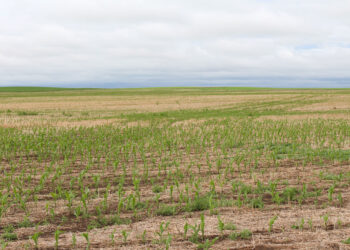

A study appearing in Nature Communications based on field and greenhouse experiments at the University of Kansas shows how a boost in agricultural yield comes from planting diverse crops rather than just one plant species: soil pathogens harmful to plants have a harder time thriving.
“It’s commonly observed that diverse plant communities can be more productive and stable over time,” said corresponding author James Bever. “Rangelands with numerous species can show increased productivity. But the reason for this has been a bit of a mystery.”
While crop rotation and other farming practices long have reflected benefits of a mix of plants, the new research puts hard data to one important mechanism underpinning the observation: the numbers of microorganisms in the soil that eat plants.
“Diverse agricultural communities have the potential to keep pathogens at bay, resulting in greater yields,” Bever said.
“What we show is that a major driver is the specialization of pathogens, particularly those specific to different plant species. These pathogens suppress yields in low-diversity communities. A significant advantage of rangeland diversity is that less biomass is consumed by pathogens, allowing more biomass for other uses, such as cattle. The same process is crucial for agricultural production.”
The new data was developed at the University of Kansas using field experiments at the KU Field Station, along with greenhouse assays and feedback modeling using computers.
“We conducted an experiment manipulating the number of plants in a plot and varying precipitation levels — we had from one up to six species in a plot,” Bever said.
“Then, we evaluated the composition of the soil-pathogen microbiome. What we found is that the variation in pathogen composition in monocultures significantly predicted the yield when combined. When there are distinct pathogen communities, mixing them leads to a greater release of pathogens from your neighbors. The worst scenario is when a neighboring crop has the same pathogens. In that case, you’re experiencing double density — your crop pathogens and those from your neighbor crop.”
According to Bever, the research argues against the industrial-agricultural practice of planting a single food crop over many acres of land. “Regarding monoculture practices, the philosophy of promoting plant diversity seems to counter prevailing practices.”
“It’s definitely to your advantage to mix your crops — to plant them in heterogeneous mixes in the plot. For convenience, we might plant alternating rows of different crops. That’s going to do a better job of controlling pathogens than if you just had many rows of the same crop next to each other.”
Metallic Micronutrients Associated with Structure and Function of Soil Microbiome

(Courtesy of Nature Communications) — Micronutrients are highly correlated to the structure and function of soil microbiomes and are comparable to the effects of soil macronutrients and pH. Micronutrients positively contributed to ecosystem productivity by direct effect (nutrient supply for plants) rather than indirect effect (associated microbiome).
A study from Zhejiang University, published in Nature Communications, has found that metallic micronutrients in the soil are highly correlated with the abundance, diversity and function of the soil microbiome.
The researchers specifically looked at iron, manganese, copper, zinc, molybdenum and nickel in a survey across 180 sites in China, covering a wide range of soil conditions and controlling for pH. They found that iron especially, followed by manganese, copper and zinc, is important in the function and structure of the soil microbiome.
An incubation experiment with iron and zinc additions to five different soil types also showed that increased micronutrient concentration affects microbial community composition and functional genes.
In addition, the researchers ran structural equation models that indicated that micronutrients positively contribute to the ecosystem productivity, both directly (their availability to plants) and, to a lesser extent, indirectly (via affecting the microbiome).
Altering Plant Microbiome Protects Crops against Disease
Scientists from the University of Southampton, China and Austria have altered the microbiome of plants, boosting the prevalence of “good” bacteria that protect the plant from disease.
The findings, published in Nature Communications, could substantially reduce the need for environmentally destructive pesticides.
There is growing public awareness about the significance of our microbiome — the myriad of microorganisms that live in and around our bodies, most notably in our guts. Our gut microbiomes influence our metabolism, our likelihood of getting ill, our immune system, and even our mood.
Plants too host a huge variety of bacteria, fungi, viruses and other microorganisms that live in their roots, stems and leaves.
For the past decade, scientists have been intensively researching plant microbiomes to understand how they affect a plant’s health and its vulnerability to disease.
“For the first time, we’ve been able to change the makeup of a plant’s microbiome in a targeted way, boosting the numbers of beneficial bacteria that can protect the plant from other, harmful bacteria,” said Dr. Tomislav Cernava of the University of Southampton.
“This breakthrough could reduce reliance on pesticides, which are harmful to the environment. We’ve achieved this in rice crops, but the framework we’ve created could be applied to other plants and unlock other opportunities to improve their microbiome. For example, microbes that increase nutrient provision to crops could reduce the need for synthetic fertilizers.”
The international research team discovered that one specific gene found in the lignin biosynthesis cluster of the rice plant is involved in shaping its microbiome. Lignin is a complex polymer found in the cell walls of plants — the biomass of some plant species consists of more than 30 percent lignin.
First, the researchers observed that when this gene was deactivated, there was a decrease in the population of certain beneficial bacteria, confirming its importance in the makeup of the microbiome community.
The researchers then did the opposite, over-expressing the gene so it produced more of one specific type of metabolite — a small molecule produced by the host plant during its metabolic processes. This increased the proportion of beneficial bacteria in the plant microbiome.
When these engineered plants were exposed to Xanthomonas oryzae — a pathogen that causes bacterial blight in rice crops — they were substantially more resistant to it than wild-type rice.
Bacterial blight is common in Asia and can lead to substantial loss of rice yields. It’s usually controlled by deploying polluting pesticides, so producing a crop with a protective microbiome could help bolster food security and help the environment.
The research team are now exploring how they can influence the presence of other beneficial microbes to unlock various plant health benefits.
Genetics of Host Plants Determine What Microorganisms They Attract
Plants often develop communities with microorganisms in their roots, which influences plant health and development. Although the recruitment of these microbes is dictated by several factors, it is unclear whether the genetic variation in the host plants plays a role.
“Previously, researchers have only looked at what kind of microbes are present in association with plants, but not what might be driving the formation of these communities and how we might be able to control these drivers through plant breeding,” said Angela Kent of the University of Illinois Urbana-Champaign.
Microbes form complex communities called microbiomes in and around the roots of plants. The host plants can dictate which microbes are invited into their roots — known as endophytes — using chemical signals. They can also alter the soil properties around the roots to influence which microbes can grow around the root surface, or rhizosphere.

However, in order to breed plants based on what microbes they associate with, researchers first need to understand the extent to which plant genomes can influence the rhizosphere microbiome.
To answer this question, the researchers studied two native silver grass species — Miscanthus sinensis and Miscanthus floridulus. These plants are considered potential bioenergy crops because they require lower nutrient concentrations to achieve more growth compared to traditional crops.
The study was conducted in 16 sites across Taiwan and included a range of environmental conditions, such as hot springs, mountain peaks and valleys, to represent all possible environmental extremes.
The researchers collected 236 rhizosphere soil samples from randomly selected Miscanthus plants and also isolated the microbiome inside the roots. The microbiomes in and around the roots were identified using the DNA sequence of bacterial and fungal rRNA genes, focusing on the part of the genome that is unique to each species. The variation in the plant genome was measured using microsatellites, which are small pieces of repeating DNA that can distinguish even closely related plant populations.
“The samples were collected 15 years ago, when the project was too large for the sequencing capabilities at the time. As the cost of sequencing came down, it allowed us to revisit the data and take a closer look at the microbiome. During sample processing, we also inadvertently extracted plant DNA and we were able to use that as a resource for genotyping our Miscanthus populations,” Kent said.
“We screened the host genome sequences for insights into how they can affect the microbiome,” said Niuniu Ji, a postdoctoral researcher in the Kent lab. “I discovered that the plants affect the core microbiome, which was exciting.”
Although plant microbiomes are very diverse, the core microbiome is a collection of microbes that are found in most samples of a particular set of plants. These microbes are considered to play an important role in organizing which other microbes are associated with the plant and helping with host growth.
The core microbiome that the researchers found in Miscanthus included nitrogen-fixing bacteria that have been found in rice and barley in other studies. All these microbes play a role in helping the plants acquire nitrogen, which is a vital nutrient for plant growth.
Recruiting nitrogen-fixing microbes may help the plants adapt to different environments, but importantly, this capability contributes to the sustainability of this grass as a potential bioenergy crop.
On the other hand, the influence of the genetic variation among the plants had a lower effect on the rhizosphere microbiome, which was more strongly affected by the soil environment. Even so, the plants placed a greater emphasis on recruiting fungi compared to other microbes.
Recycled Phosphorus Fertilizer Reduces Nutrient Leaching, Maintains Yield
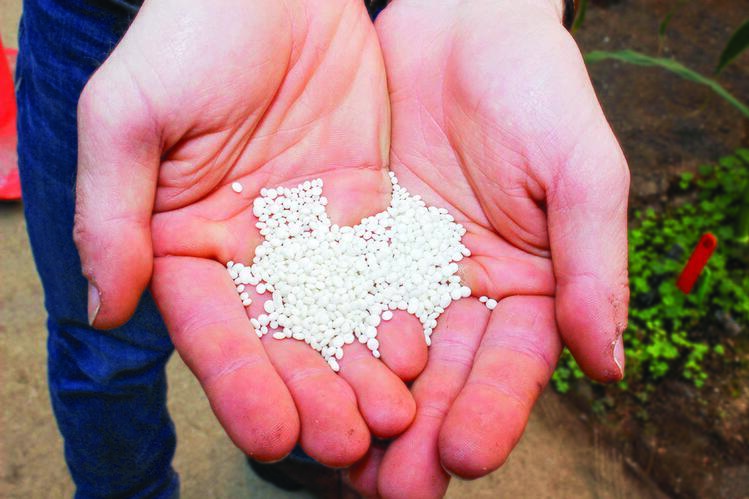
(Courtesy of University of Illinois) — Struvite granules
A promising new form of ammonium phosphate fertilizer has been field-tested by University of Illinois Urbana-Champaign researchers. The fertilizer, struvite, offers a triple win for sustainability and crop production, as it recycles nutrients from wastewater streams, reduces leaching of phosphorus and nitrogen in agricultural soils, and maintains or improves soybean yield compared to conventional phosphorus fertilizers.
“There have been some lab and greenhouse projects showing the potential of struvite, but this is the first field-scale assessment of nutrient loss and yield benefits together,” said principal investigator Andrew Margenot. “We found that struvite can be a full substitute for monoammonium phosphate [MAP] or diammonium phosphate [DAP] for soybeans yield-wise, and it reduces nonpoint source nutrient losses relative to conventional fertilizer options.”
The team’s results are published in the Journal of Environmental Quality.
Applying MAP or DAP in the fall as a source of phosphorus for crops is common practice for corn and soybean production in much of the Midwest. But because the phosphorus in MAP and DAP is highly water soluble, much of the nutrient is lost during the ensuing winter and early spring months. Not only can this contribute to downstream nutrient pollution; it also means there may be less phosphorus available in the soil by the time crops are planted in spring.
Importantly, MAP and DAP also contain soluble forms of nitrogen, an overlooked fact that Margenot says is contributing to the problem of nitrate loss across the Midwest.
“There is a major blind spot in the nitrogen cycle,” Margenot said. “In the U.S. and the Midwest specifically, the overwhelming majority of our phosphorus fertilizers are ammoniated. When farmers buy a phosphorus source to apply in the fall, their options are generally limited to MAP or DAP, so they can’t avoid co-applying nitrogen.”
He did the math in a companion paper and found DAP applied at the typical rate (200 pounds per acre) adds 36 pounds of nitrogen per acre that most farmers — and land-grant recommendations — don’t account for. Adding it up across Illinois, Margenot estimated that 198 million pounds of nitrogen are added every fall in the form of MAP or DAP.
“That number is 11 percent more than our statewide nitrate loss reduction target of 178 million pounds,” he said. “Managing this overlooked fall-applied nitrogen is low-hanging fruit that could make a large dent in nitrate losses in Illinois and other Mississippi River Basin states, and we could do it without changing phosphorus application rates.”
Struvite also contains nitrogen, but struvite is less water soluble than MAP. That explains why Margenot’s team found phosphorus and nitrogen leaching were significantly lower under struvite than MAP — comparable to natural leaching measured in unfertilized soils.
But if the nutrients are less soluble, does that mean plants have a harder time accessing them? Not according to the study. Soybean yields weren’t significantly different under either fertilizer. And in the study’s southern Illinois site, struvite — but not MAP — actually increased soybean yield compared to no-fertilizer control plots. Margenot thinks the yield bump could have resulted from the magnesium in struvite.
Struvite (magnesium ammonium phosphate, a 5-28-0 [10 Mg] source) forms when magnesium is added to wastewater, where it reacts with phosphorus and nitrogen and pulls those nutrients out of the waste stream. Chicago and St. Louis have leased portions of their wastewater streams to a company to manufacture the recycled fertilizer, but Margenot says the struvite manufacturing industry is currently too small to satisfy the phosphorus needs of the entire Corn Belt.
“Struvite isn’t scalable right now, but we’re proving the efficacy of a solution that will be on the shelf one day. Our results point to the benefits of scaling up struvite production and use on the farm,” he said.
Although struvite decreased nutrient losses relative to MAP, Margenot notes that nutrient loss happens even without added fertilizer, and he recommends cover crops to mitigate these “background” losses that occur regardless of fertilization.
“When we added no fertilizer, be it MAP or struvite, we still saw substantial losses, especially in the higher organic matter Mollisols [black prairie soils] of our Central Illinois site,” he said. “Our soils are so rich; they hold a lot of organic nitrogen and phosphorus. If it’s warm enough, these nutrients will mineralize and become nitrate and phosphate. If there’s no crop there to grab it, like a cover crop or wheat, then those nutrients will be leached.”
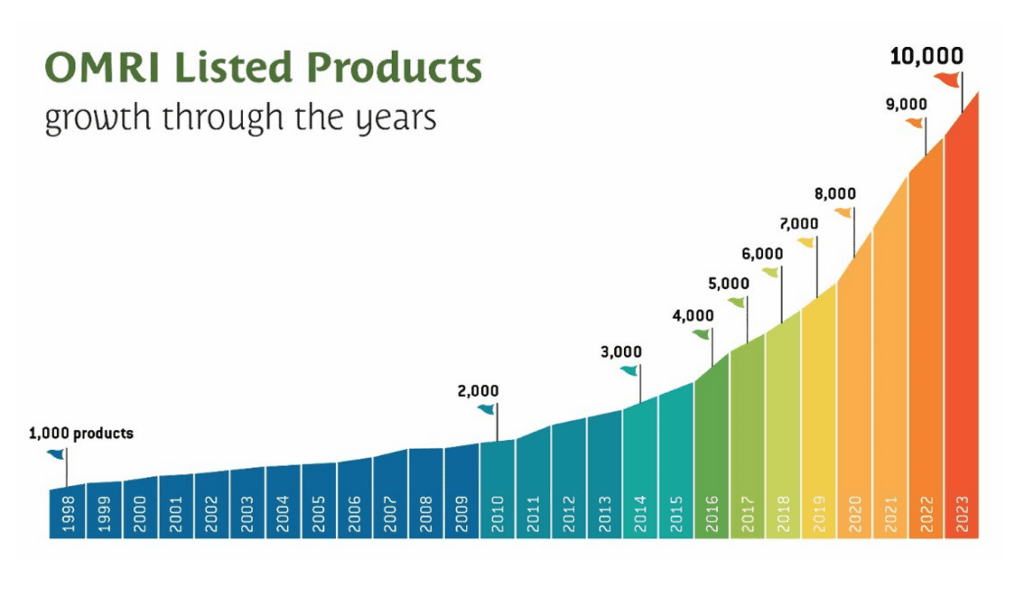
OMRI Reaches 10,000 Listed Input Products for Organic Use
(Courtesy of OMRI)
The Organic Materials Review Institute recently reviewed and verified its 10,000th product for organic use.
OMRI was founded in 1997 by organic certifiers and stakeholders. It provides an independent review of input products for the U.S. National Organic Program standards, the Canada Organic Regime standards, and the Mexico Organic Products Law. The median review time for a new product is currently just two months.
The growth in inputs that are acceptable for organic production is encouraging — reducing synthetic, toxic inputs should be a major goal for all ecologically minded farmers, and new products are offering the hope of moving away from the conventional mindset of the past 75 years. At the same time, 10,000 options may seem overwhelming for farmers seeking to make the transition to better methods.