

Trump Announces $8 Billion in Farm Relief to Offset High Diesel Prices
On October 19, 2026, President Donald Trump and Secretary of Agriculture Brooke Rollins announced the Harvest Fuel Relief Program, which “will make $8 billion available for one-time payments to American farmers this harvest season to provide relief during temporary market disruptions and increased input costs.”
According to the US Energy Information Administration, highway diesel prices reached a record high of $6.30 a gallon in September 2026. When adjusted for inflation, this is slightly lower than the diesel price of $4.86 a gallon in July 2008 ($7.78 in 2026 dollars) or the most recent price spike, in November 2022, which was $5.96 a gallon ($6.79 in 2026 dollars).
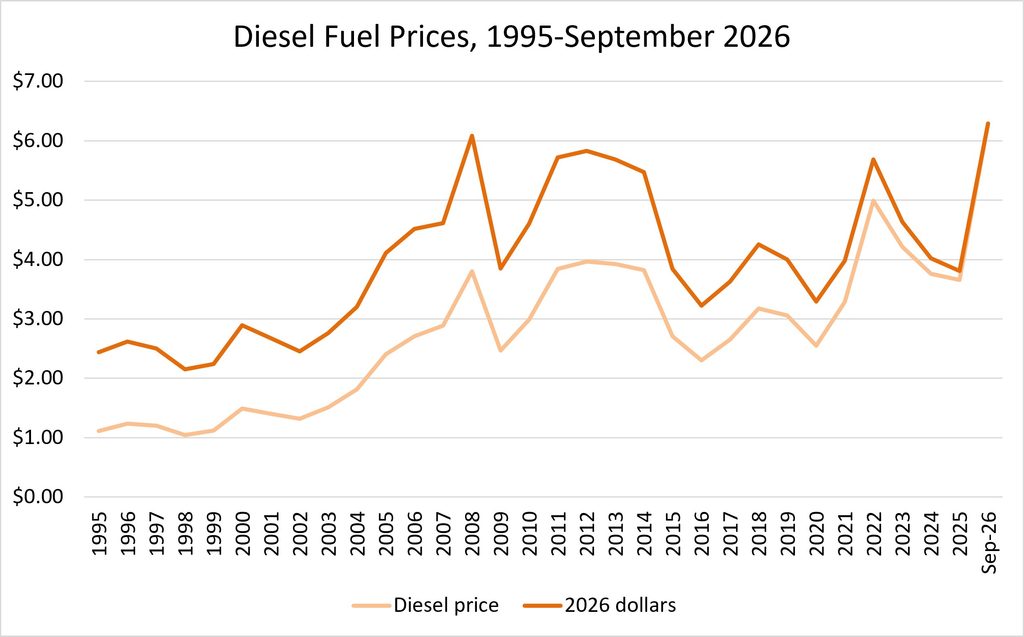
(Data from US EIA) – Diesel fuel prices are at a record high, but not when adjusted for inflation.
Farm diesel prices are about 60 cents per gallon lower than highway diesel because offroad diesel is exempt from road taxes. But according to the University of Illinois Urbana-Champaign, the agricultural diesel price of $5.76 on October 16, 2026 was also the highest on record—although, adjusted for inflation, real prices were higher in 2008.
Added to the $47 billion in government payments already allocated to American farmers for 2026, the Harvest Fuel Relief program will bring the total government payments to farmers for 2026 up to $55.4 billion. That’s the highest amount of annual government aid to farmers since the previous record of $45 billion in 2020 ($58 billion in 2026 dollars).

The announcement was applauded by agricultural industry groups like the American Farm Bureau Federation, National Association of Wheat Growers, National Corn Growers Association, and National Sorghum Producers. But the National Farmers Union said, “The need for repeated emergency aid is a clear sign that the farm safety net is failing family farmers.”
While high fuel prices are certainly contributing to rising farm input costs, they’re not the only factor. Agricultural economists at the University of Illinois calculate that fuel costs are only 2.8 percent of total non-land production costs for corn and 4.2 percent for soybeans, meaning that even the huge jump in diesel prices since last year averages out to $6 per acre for corn. With an estimated average corn yield of 180 bushels per acre in 2026, that’s only 3.33 cents per bushel—and corn prices in August 2026 were 49 cents higher than in August 2025.
So why are farmers in such dire straits that they need more “emergency” money from the government? The problem is that the cost of all inputs (not just fuel) is so high that many farmers have to take out loans every spring just to buy seed and fertilizer for the cropping season. Fuel prices contribute to input costs, but those costs were high even when gas prices were low.
That’s where organic farmers have a huge advantage. Though they still use diesel fuel, they purchase significantly less of other expensive inputs—synthetic fertilizers, pesticides, and patent-protected GMO seeds. That makes them more resilient to fluctuations in fuel prices—and less dependent on taxpayer-funded government bailouts.