• Home
  • Events

    Upcoming Events

    • Menoken Farm Field Day
    • Eco-Ag Conference
    • View all events →

    Recent Webinars

    • Kyle Richardville
    • David Montgomery
    • Gary Zimmer
    • Taylor Henry
    • Fernando Falomir
    • Megan Neubauer
    • David Knaus
    • View more webinar replays →
  • Bookstore

    Books by Category

    • Soil Health
    • Livestock & Animals
    • Gardening & Homesteading
    • Farm Business
    • Health & Food

    Books by Collection

    • New Releases
    • The Albrecht Volumes
    • Acres U.S.A. Published
    • Eco-Ag Speakers
    • Soil Health Educators

    Books by Level

    • Beginner
    • Intermediate
    • Advanced
    • Kids

    Featured

    • Explore Jon Stika's New Book →
  • Resources

    Continue Learning

    • White Papers
    • Online Courses

    Where to Find Us

    • Acres U.S.A. Podcast
    • YouTube Channel
    Facebook Instagram X-twitter Linkedin
    • Join our Newsletter →
  • Articles

    Articles by Topic

    • News
    • Ecological Farming
    • Livestock
    • Soil Health
    • Opinion

    Articles on Crops

    • Cover Crops
    • Crop Nutrition
    • Disease & Pests
    • Fruits & Nuts
    • Ag Technology

    Magazine Issues

    2026
    • January
    • February
    • March
    • April
    • May
    • June
    • July
    • August
    2025
    • January
    • February
    • March
    • April
    • May
    • June
    • July
    • August
    • September
    • October
    • November
    • December
    2024
    • January
    • February
    • March
    • April
    • May
    • June
    • July
    • August
    • September
    • October
    • November
    • December
    • Explore the archives →
    • Subscribe to the magazine →
  • About

    About Us

    • About Acres U.S.A.
    • Meet Our Team
    • Our History
    • Eco-Ag Achievement Award

    Contact Us

    • 970-392-4464
    • support@acresusa.com

    Acres U.S.A. LLC
    PO Box 351
    Viroqua, WI 54665

    • A New Era of Eco-Ag →
Subscribe
HOME
Events
  • Upcoming Events
  • Menoken Farm Field Day
  • Eco-Ag Conference
View all events
  • Webinars
  • Kyle Richardville
  • David Montgomery
  • Gary Zimmer
  • Taylor Henry
  • Fernando Falomir
  • Megan Neubauer
  • David Knaus
Bookstore
  • Books by Category
  • Soil Health
  • Livestock & Animals
  • Gardening & Homesteading
  • Farm Business
  • Health & Food
  • Books by Collection
  • New Releases
  • The Albrecht Volumes
  • Acres U.S.A. Published
  • Eco-Ag Speakers
  • Soil Health Educators
  • Books by Level
  • Beginner
  • Intermediate
  • Advanced
  • Kids
Resources
  • Continue Learning
  • White Papers
  • Online Courses
  • Where to Find Us
  • Acres U.S.A. Podcast
  • YouTube Channel
Facebook Instagram X-twitter Linkedin
Join our Newsletter
Articles
  • Articles by Topic
  • News
  • Ecological Farming
  • Livestock
  • Soil Health
  • Opinion
  • Articles on Crops
  • Cover Crops
  • Crop Nutrition
  • Disease & Pests
  • Fruits & Nuts
  • Ag Technology
  • Magazine Issues
2026
  • January
  • February
  • March
  • April
  • May
  • June
  • July
  • August
2025
  • January
  • February
  • March
  • April
  • May
  • June
  • July
  • August
  • September
  • October
  • November
  • December
2024
  • January
  • February
  • March
  • April
  • May
  • June
  • July
  • August
  • September
  • October
  • November
  • December
Explore the archives
Subscribe to the magazine
About
  • About Acres U.S.A.
  • Meet Our Team
  • Our History
  • Eco-Ag Achievement Award
SUBSCRIBE

Bog to Basics

Cass Gilmore by Cass Gilmore
June 5, 2026
0
Home Magazine issues June 2026
2
SHARES
425
VIEWS
Share on FacebookShare on Twitter

Turning on-farm plants into fermented inputs helps reduce chemical dependence while improving cranberry health and ecosystem balance

Cass Gilmore

I am fortunate to have traveled throughout North America observing conventional farming operations as well as alternative operations. On the surface, these farms may seem disorganized, lacking technology, or misguided. However, this is not the case. The reality is that farming was successful before the introduction of better life though chemistry — otherwise none of us would be here. 

I have also realized that the world around us is filled with nutrition and answers to many of the pest and pathogen problems we have on the farm. Finding solutions using these resources, rather than buying products at the store, has been a fascinating conversion for our 80-acre cranberry farm in South Middleboro, Massachusetts.

Making Fermented Plant Juices
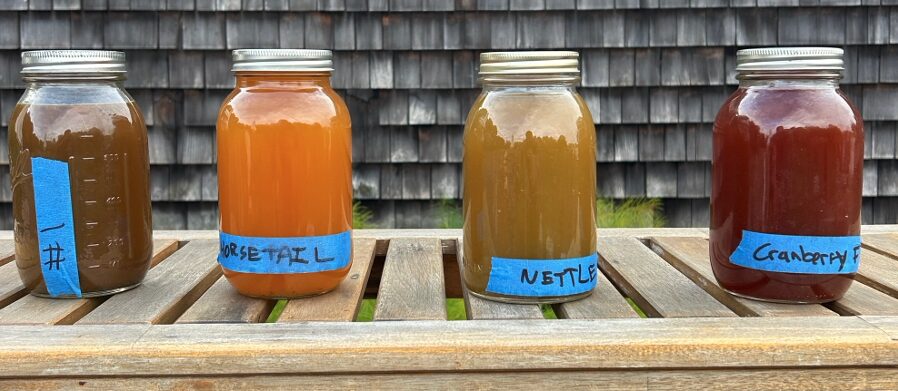
Fermented plant juices have reduced dependence on purchased inputs and have brought life back to the farm.

I have had many influences over the years, but Nigel Palmer’s book The Regenerative Grower’s Guide to Garden Amendments has one of the best first chapters on how plants interact with the world around them and how they actually consume, or create nutrition, from their surrounding environments. Remember — plants can’t walk away, so they must make the environment around them work. 

Nigel visited me one day at the farm. It was a quick tour, but he suggested that I not use a smorgasbord of weeds to create fermented plant juices (FPJ), like I had done with my first batch, but instead focus on one plant per batch to better understand what each plant is producing for fertility. Different plants are associated with different soil mineral deficiencies. He also mentioned to be aware of what stage the plant is in when harvesting — vegetative, early growth, flowering or maturing — as plant hormones will differ as they’re transferred into the ferment; depending on what I am aiming for, I may want different plant stages. This was great advice — things I had not considered.

I began to make single fermented plant juices with plants around the farm. Horsetail grows naturally in patches on the cranberry bogs. It is known to be good for plant health and disease pressure. My poor father spent his life spraying and trying to kill horsetail — with success … until the next year, when it would reappear. Now here I am taking this “weed” and making batches of it to ferment and reapply back to the bogs!
Horsetail fermented plant juice

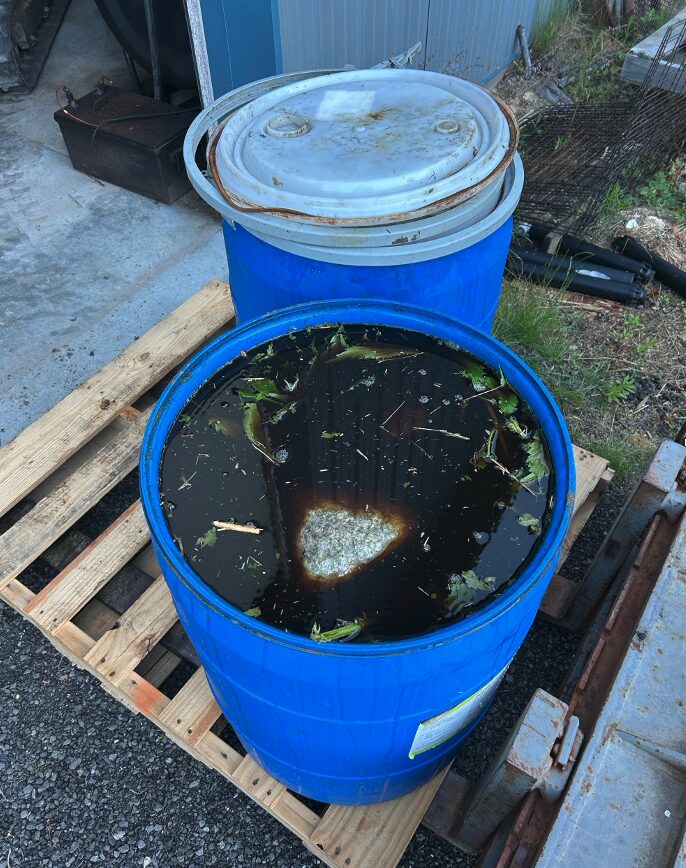
The next plant for my FPJ collection was stinging nettle. It doesn’t grow on or near the cranberry bogs. In fact, I had never heard of it. But stinging nettle does seem to love to grow around grazing beef. Back at the house we had some pretty impressive patches of it. I would harvest it when the nettle is in its growth stage — not too small, but not beyond ripe. I usually fill a 55-gallon barrel of nettle material — roots, shoots, and leaves — and top it off with water and a biological inoculant. I have been using EM-1, but you can also gather fungi from the environment, ferment it a month or so, and decant. This process is quite impressive. Only a little over a bucket of plant material is left after decanting — it’s quite surprising how much of this plant is dissolved into the FPJ.

There is a commercially available bio-fungicide that is extracted from Japanese knotweed. Maybe I could recreate this product myself, I thought, to apply during cranberry bloom. I filled two totes with blooming knotweed — roots, shoots and leaves — plus my biological inoculant, and topped it off with water. I let it ferment all winter for use the following year. After decanting, I had a little over 150 gallons per tote of liquid FPJ. While I do not lab-test the bio-fungicide properties of this FPJ, I do get a nutritional analysis.
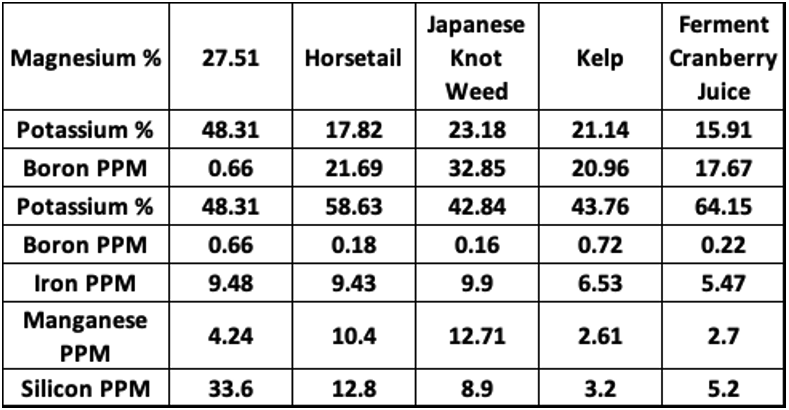
Fermented plant juice mineral content.

I also recently made a fermented juice with kelp and got both mineral and biological lab analyses. A fellow farmer wanted to aerate kelp using a commercial product called Rise and Thrive, from Fishbrew, to act as an inoculant. I was hesitant — I had tried aerating FPJ and it didn’t seem to work well, but perhaps that was because I used land plants, not water plants. So, we put 40 pounds of kelp into 100 gallons of water with 1 quart of Rise and Thrive. After two weeks, I didn’t see much activity; by the third week, I could see the kelp starting to break down; after four weeks, the only thing left was the thick kelp stock — everything else had dissolved. I used the kelp extract as a pre-flower nutrition additive.

Finally, I got into fermented fruit juice (FFJ). My farm does agriculture tourism; being an hour south of Boston with a picturesque cranberry bog, we’ve become a popular destination for tours and events. We sell limited fresh fruit, but during cleaning, any discards or poor-quality fruits get removed. We usually throw them into the woods or supplement the beef. I was able to fill two totes of discarded fruit to make a fermented fruit juice. 
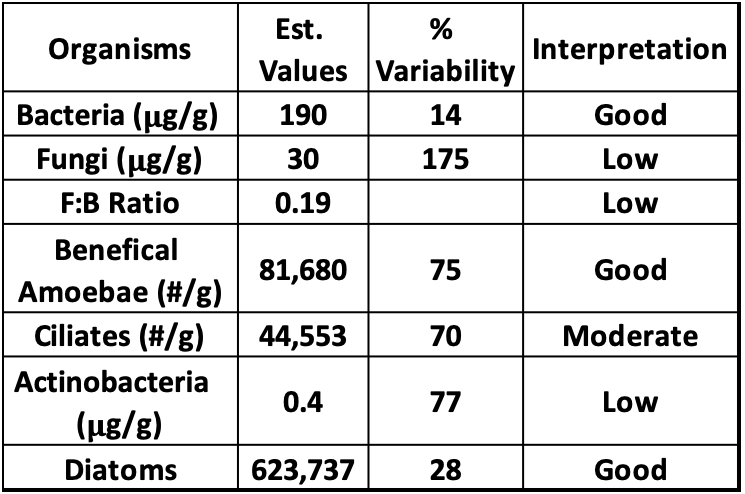
Biological report for kelp fermented plant juice

I let this FFJ cook for about eight or nine months before decanting, and I was worried that using discarded fruit may potentially create a pathogen haven. I had the local cranberry station and my cranberry handler scientists test it. They looked at the FFJ under the microscope to try to determine if I was creating a potential disaster. They reported there were some bad pathogens, however they were a small proportion of the overall biological life. They felt confident that it shouldn’t be an issue. I was still a bit nervous, so I used the FFJ as fruit-fill nutrition. It provided some great overall nutrition and did not create a fruit rot issue. 

Something to note regarding FFJ is that the fruit being fermented must be reapplied to the same fruit — apples to apples, oranges to oranges, and cranberries to cranberries. 

Benefits

The farm ecosystem began to change as I’ve incorporated more on-farm amendments. I began to eliminate all nasty broad-spectrum pesticides — knowing what a lot of these do to all living creatures — and to reduce salt-based fertilizers. Overall, I have so far reduced chemical inputs to a half to two-thirds of what was applied in the past. 

I have begun to see more life on the farm. The birds chirp more, there are bats at night, and I’m even beginning to see worms! This is something that is certainly not common on a chemical farm. Even more interesting is that the cranberry bogs get flooded for harvest in the fall and for winter protection. How do these worms survive? I’m not sure they either hold their breath or come back on the beds once the water is drained. 

During harvest flooding, we use a floating corralling boom to collect the fruit for pumping off and cleaning. I have noticed over the years that this is a great time to see what pests were missed during the year. Usually, I would find cranberry weevils and flea beetles. Now I am seeing ladybugs, fireflies, spiders, and praying mantises.

The cranberry health is also noticeably better. My farm does run on the wetter side and would be a good candidate for phytophthora. However, this is not an issue. While my neighbors deal with outbreaks, I have none on-site. The cranberry roots have beautiful nodules, and the soil sticks to the roots when shaken. The weeds that do live within the canopy have bare roots, indicating that the soil is not helping them. 

All transitioning farms have to pay for their past sins. The trick is to slowly pull the rug out over a few years rather than all at once — unless you can handle falling on your face. It’s taken me five to six years to really see a difference in the balance of life on the farm. Yes, I do get pests, they tend to be more manageable. 

Farming practices are like driving a car: sometimes you need to use the brake, and sometimes you need to use the gas. If you use just one or the other, things will go poorly!

← Previous ECO-UPDATE Next Reduce to Produce →
Tags: Fermented plant juice
Cass Gilmore

Cass Gilmore

Cass Gilmore is a third-generation cranberry farmer at Benson’s Pond in South Middleboro, Massachusetts (bensonspond.com). He grows 80 acres of cranberries and offers tours to the public, and, of course, other farmers get the special treatment.

Next Post
N efficiency chart (Please cover over “Panel A”) (National Agriculture Statistics Service; farmdoc estimates) — Average N applied per bushel, 2002–2024.

Fertilizer for Thought

  • Trending
  • Comments
  • Latest
The Most Important Livestock in Our Fields

The Most Important Livestock in Our Fields

July 1, 2024
Glyphosate Does What It’s Designed to Do — Kill

Glyphosate Does What It’s Designed to Do — Kill

February 19, 2025
USDA organic seal over American farm land

Losing Organic Farms

September 18, 2026
The Take-Half, Leave-Half Fallacy

The Take-Half, Leave-Half Fallacy

July 1, 2025
Author photo (Wikimedia)

A Food Emancipation Proclamation

3
We Don’t Need Another Bridge — We Need an Off-Ramp

We Don’t Need Another Bridge — We Need an Off-Ramp

3
Under One Roof

Under One Roof

3
A Rose By Any Other Name

A Rose By Any Other Name

2
October 2026 • Issue #664

October 2026 • Issue #664

October 2, 2026
Regenerating Mycorrhizae

Regenerating Mycorrhizae

October 2, 2026
ECO-GRAPHIC

ECO-GRAPHIC

October 2, 2026
ECO-MEETINGS

ECO-MEETINGS

October 2, 2026

Recent News

October 2026 • Issue #664

October 2026 • Issue #664

October 2, 2026
Regenerating Mycorrhizae

Regenerating Mycorrhizae

October 2, 2026
ECO-GRAPHIC

ECO-GRAPHIC

October 2, 2026
ECO-MEETINGS

ECO-MEETINGS

October 2, 2026

Don't miss an update!

Stay informed on what's new in the Acres U.S.A. community: new articles, upcoming events and resources for regenerative farmers.

Acres U.S.A. is North America’s oldest publisher on production-scale organic and regenerative farming. For more than 50 years, our mission has been to help farmers, ranchers and market gardeners grow food profitably, regeneratively, and with nature in mind.

Facebook Instagram X-twitter Youtube Linkedin Spotify

SHOP

  • Bookstore
  • Online Courses
  • Giftcards

ABOUT

  • About Acres U.S.A.
  • Our Team
  • Eco-Ag Acheivement

LEARN

  • Events
  • Magazine
  • Newsletter
  • Webinars
  • Free Articles
  • Online Courses

Contact Us

Acres U.S.A. LLC
PO Box 351
Viroqua, WI 54665​
info@acresusa.com
970-392-4464
  • Manage My Subscription
  • Advertise with Us
No Result
View All Result
  • HOME
  • ARTICLES
    • News
    • Farm
    • Ecological farming
    • Livestock
    • Crop
      • Crop management practices
      • Cover crops
      • Crop nutrition
      • Crop protection
      • Crops
      • Ag technology
    • Soil
    • Opinion
  • RESOURCES
    • Magazine
    • Online Learning
    • Newsletters
    • Blog
    • Free Articles
  • MAGAZINE ISSUES
    • 2026
      • June 2026
      • May 2026
      • April 2026
      • March 2026
      • February 2026
      • January 2026
    • 2025
      • December 2025
      • November 2025
      • October 2025
      • September 2025
      • August 2025
      • July 2025
      • June 2025
      • May 2025
      • April 2025
      • March 2025
      • February 2025
      • January 2025
    • 2024
      • December 2024
      • November 2024
      • October 2024
      • September 2024
      • August 2024
      • July 2024
      • June 2024
      • May 2024
      • April 2024
      • March 2024
      • February 2024
      • January 2024
    • 2023
      • December 2023
      • November 2023
      • October 2023
      • August 2023
      • July 2023
      • June 2023
      • May 2023
      • April 2023
      • March 2023
      • February 2023
      • January 2023
  • ABOUT US
    • Our History
    • Our Staff
    • Contact Us
    • Community
      • Soil Health Primer Resources
  • EVENTS
    • Eco-Ag Conference
    • Farm Weird
  • SUBSCRIBE
  • Login
  • Sign Up
  • Cart

© 2024 Acers USA Magazine

Lost Password?