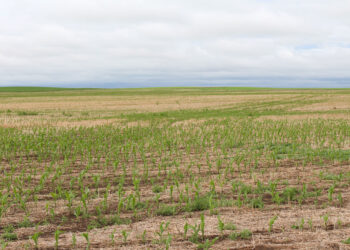


Soil health lessons — compliments of regenerative lawncare
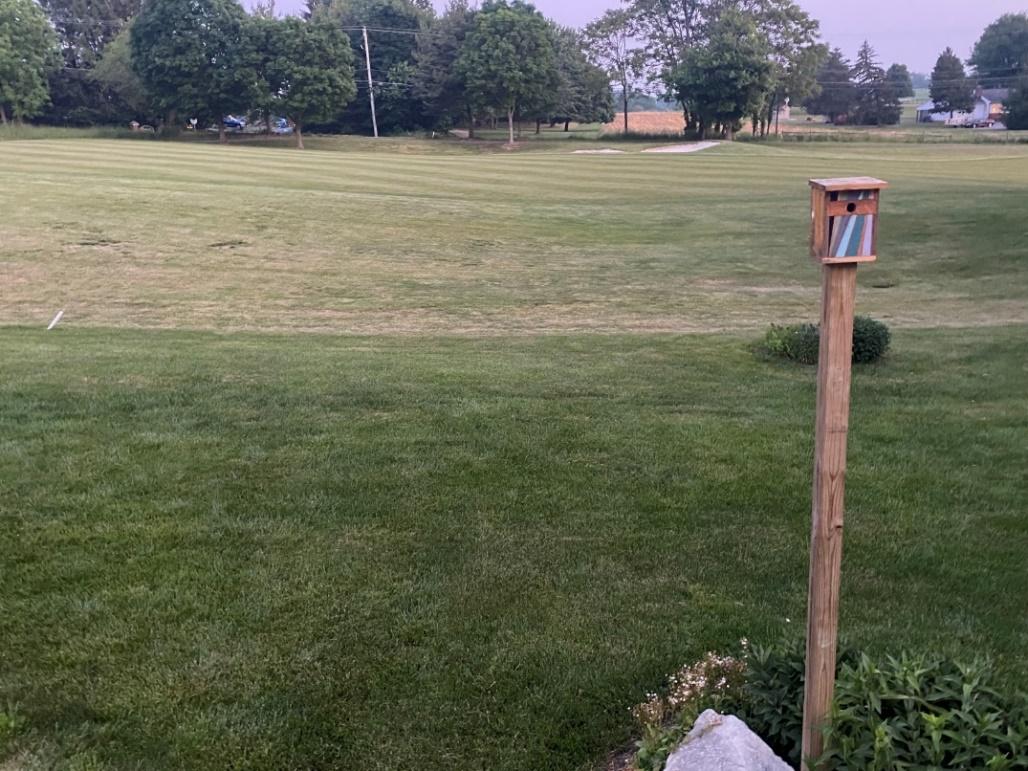
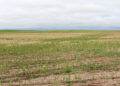
1 — My lawn and the neighboring golf course during a drought. The golf course is being watered routinely while my lawn is not being watered. My lawn also has not received any herbicides or fertilizer in over five years, yet it’s thriving in a drought because I’ve invested in leaf mold and compost topdressings to build healthy soil.
I hate lawns. I know that’s not a subtle statement, but I feel this is an important disclosure to make right up front: I never intended to have a perfect lawn. I’ll briefly share how I ended up here, then jump into lessons for everyone who has their hands in the soil.
It all started in the landscaped areas that lie between my home and the lawn. I fell in love with native plants and all the life they support above- and belowground. I believe in balance, so I researched the good and the bad plants. I learned I could prevent unwanted plants from germinating simply by changing soil conditions. I worked to improve the soil in my landscape by topdressing with leaf mold and compost. Over time, the unwanted plants subsided, and the native plants filled in.
Moving to the lawn was a natural progression. My theory was that the same principles to build healthy soil in the landscape would also work in the lawn — and they did!

2 — 2024 spring picture of landscaped areas, loaded with native plants.

3 — Compost topdressing on the lawn, half complete.
As I look back on my journey building healthy soil in the lawn, I want to share four lessons that will benefit anyone who works with the soil.
Goals and Values
First, ensure your goals do not conflict with your values. This is easier said than done. I value health, and my new year’s resolution was to lose 10 pounds; yet I also like milkshakes and hamburgers. This is a simple example of goals conflicting with values — something that happens countless times daily. Value-based decision making is a great concept, but it’s easy to get wrong.
Here my top three values when it comes to soil:
- I believe all organisms play an important role in nature — both those commonly considered “good” and those we mostly deem “bad” (even mosquitos!).
- I value healthy soil. There is overlap between #1 and #2, and that’s okay. Considering nearly two-thirds of all species live in the ground, and soil’s ability to grow plants that start the food chain, soil easily makes #2 on my list.
- I value Earth’s atmosphere. I believe climate change is real, and I believe there is a correlation between carbon in the atmosphere and human activities. Therefore, I value solutions that store carbon in the ground and do not release carbon into the atmosphere. This means everyone that owns land (not just farmers) has the potential to impact climate change.
Using these three values, here are all the processes used in lawncare to meet my three lawncare goals.
- Reduce inputs
- Pre-emergent herbicides
- Fertilizers
- Chemicals
- Lime
- Water
- Reduce processes
- Core aeration
- Dethatching
- Sprinkler systems
- Build healthy soil
At this point, I came to an interesting revelation: the traditional lawncare model attempts to replace processes that nature has perfected. Take dethatching, for example. Nature uses countless organisms to break organic matter into smaller and smaller pieces. Meanwhile, humans attempt to replicate this process with gas-powered dethatching machines that remove organic material from the ground. As a general rule, it’s best to allow nature to handle all the decomposition of organic matter.
The Golden Rule of Soil
Second, live by the Golden Rule. This is my favorite lesson — to treat living organisms the way you want to be treated. I’m not referring to your neighbors, suppliers, employees or customers. I’m referring to the countless living organisms who are doing all the heavy lifting for you — the ones in the soil breaking down organic matter, making nutrients available to plants, holding carbon, etc.

So, how do you treat unseen organisms in the soil? Simple: you treat them the way you want to be treated. I’ll share three examples:
- Provide protection. You don’t want your home destroyed by a giant rototiller, do you? Neither do the organisms in the soil. Protect organisms by limiting soil disturbances and not drenching them with chemicals.
- Provide shelter. Organisms in the soil work best in temperatures between 70 and 80 degrees. Uncovered soil can reach temperatures of over 135 degrees. Using a year-round cover crop is important to regulate temperatures and to prevent erosion and nutrient leaching.
- Provide jobs. Modern fertilizers bypass the soil to feed the plant directly, taking jobs away from hardworking organisms in the soil. Feed the soil, not the plant. Continue to add organic matter to feed your employees, and keep them working hard.
I focus on the organisms in the soil, but I value all living organisms. This includes the unwanted plants, referred to as “weeds,” that I am passionate about helping. I’m the guy who feels bad removing a weed because I realize I’m killing a living organism — a living organism that is improving the soil!
I don’t love the “w” word because of its negative connotation, so I intentionally use the phrase “unwanted plants.” Unwanted plants have an important role to play in balancing the soil. So, if you are removing an unwanted plant, be sure you understand the role it is playing and take measures to remedy the adverse condition. Otherwise, history will repeat itself and another unwanted plant will quickly germinate.
Define Success
Third, figure out how to measure success. At the end of the day, how do you know if you met your goals? If the answer having is the best-looking crop around, then you may want to revisit step 2. If you want to grow the most nutrient-dense crop around by having the healthiest soil in town, then you’re on the right track. This should be an easy step if you have clearly defined goals and values. I recommend completing this step upfront because there is a good chance you will want to establish a baseline prior to starting.
I focus on three areas that involve a mix of quantitative and qualitative data.
- Soil organic matter. My goal is to increase soil organic matter, as measured with a soil test. Every home is different, but I estimate the average in my area is between 2.0 to 3.0 percent SOM. The most recent test I completed last fall measured 5.0 percent.
- Visual test. My home neighbors a golf course. Most lawncare fanatics consider golf courses to be the “green standard.” Therefore, I visually compare my lawn with the golf course through the seasons. I’ve learned that my lawn starts to green up earlier in the spring when soil temperatures start to reach around 45 degrees in March, while the golf course greens up in April, after its first treatment. Mine also stays green longer in a drought because of its ability to hold more water.
- Chemicals. To be truly regenerative, I need to use no chemicals. Over the years, as I’ve stopped using herbicides and fertilizers while increasing soil organic matter, the amount of chemicals has dramatically decreased. I anticipate using less than 1 quart of liquid spray over the course of an entire year on a half-acre of lawn. This is well below the estimated 10 gallons used when I started.

4 — March 13, 2023. My lawn is starting to come alive as temperatures reach 45, while the golf course at top is still dormant.
The Juice Is Worth the Squeeze
Finally, by managing your soil regeneratively, you’ll discover many long-term benefits. All that up-front investment is worth it because your regenerative benefits to the soil are not lost when you stop — in comparison with traditional practices, which are only as good as your last treatment. Once you stop, nature will step in with unwanted plants tasked with fixing the damage. Here are three long-term benefits I’ve noticed:
- Nutrient density. My grass is growing in better soil than most vegetables and fruits. That’s a crazy statement and should concern everyone.
- Water holding capacity. Prior to starting regenerative practices, water would rush across my backyard. Now, the worst rains are absorbed deeply into our backyard without flooding, pooling or running off.
- Reduced carbon footprint. I have a smaller carbon footprint because I reduced inputs like herbicides and fertilizers that travel great distances to be made and distributed. My carbon footprint is further improved by the amount of carbon stored in the soil.
Conclusion
These lessons apply to anyone with their hands in the soil. I believe they prove that regenerative practices, and its benefits, are possible in any type of landscape or crop. Do not listen to the naysayers. Regenerative lawn care is not only possible but is also easier to maintain than a traditional lawn, which requires multiple treatments of fertilizer and chemicals throughout the year, year-after-year, for the rest of your life. Don’t get me wrong — applying compost annually is no easy task — but it’s completed once a year, with no lifetime commitment.
Most farmers and lawncare professionals leverage traditional practices. They’ve invested heavily in equipment and processes that support this model. Therefore, they are quick to share their opinion and tell you that you are wrong. Believe in the science of regenerative practices, and believe what you are seeing.
Tim Sheppard is the owner of Soil Shepherds Regenerative Landscaping in Avondale, Pennsylvania.

5 — October 2023 — close-up view, with leaves starting to fall.