• Home
  • Events

    Upcoming Events

    • Menoken Farm Field Day
    • Eco-Ag Conference
    • View all events →

    Recent Webinars

    • Kyle Richardville
    • David Montgomery
    • Gary Zimmer
    • Taylor Henry
    • Fernando Falomir
    • Megan Neubauer
    • David Knaus
    • View more webinar replays →
  • Bookstore

    Books by Category

    • Soil Health
    • Livestock & Animals
    • Gardening & Homesteading
    • Farm Business
    • Health & Food

    Books by Collection

    • New Releases
    • The Albrecht Volumes
    • Acres U.S.A. Published
    • Eco-Ag Speakers
    • Soil Health Educators

    Books by Level

    • Beginner
    • Intermediate
    • Advanced
    • Kids

    Featured

    • Explore Jon Stika's New Book →
  • Resources

    Continue Learning

    • White Papers
    • Online Courses

    Where to Find Us

    • Acres U.S.A. Podcast
    • YouTube Channel
    Facebook Instagram X-twitter Linkedin
    • Join our Newsletter →
  • Articles

    Articles by Topic

    • News
    • Ecological Farming
    • Livestock
    • Soil Health
    • Opinion

    Articles on Crops

    • Cover Crops
    • Crop Nutrition
    • Disease & Pests
    • Fruits & Nuts
    • Ag Technology

    Magazine Issues

    2026
    • January
    • February
    • March
    • April
    • May
    • June
    • July
    • August
    2025
    • January
    • February
    • March
    • April
    • May
    • June
    • July
    • August
    • September
    • October
    • November
    • December
    2024
    • January
    • February
    • March
    • April
    • May
    • June
    • July
    • August
    • September
    • October
    • November
    • December
    • Explore the archives →
    • Subscribe to the magazine →
  • About

    About Us

    • About Acres U.S.A.
    • Meet Our Team
    • Our History
    • Eco-Ag Achievement Award

    Contact Us

    • 970-392-4464
    • support@acresusa.com

    Acres U.S.A. LLC
    PO Box 351
    Viroqua, WI 54665

    • A New Era of Eco-Ag →
Subscribe
HOME
Events
  • Upcoming Events
  • Menoken Farm Field Day
  • Eco-Ag Conference
View all events
  • Webinars
  • Kyle Richardville
  • David Montgomery
  • Gary Zimmer
  • Taylor Henry
  • Fernando Falomir
  • Megan Neubauer
  • David Knaus
Bookstore
  • Books by Category
  • Soil Health
  • Livestock & Animals
  • Gardening & Homesteading
  • Farm Business
  • Health & Food
  • Books by Collection
  • New Releases
  • The Albrecht Volumes
  • Acres U.S.A. Published
  • Eco-Ag Speakers
  • Soil Health Educators
  • Books by Level
  • Beginner
  • Intermediate
  • Advanced
  • Kids
Resources
  • Continue Learning
  • White Papers
  • Online Courses
  • Where to Find Us
  • Acres U.S.A. Podcast
  • YouTube Channel
Facebook Instagram X-twitter Linkedin
Join our Newsletter
Articles
  • Articles by Topic
  • News
  • Ecological Farming
  • Livestock
  • Soil Health
  • Opinion
  • Articles on Crops
  • Cover Crops
  • Crop Nutrition
  • Disease & Pests
  • Fruits & Nuts
  • Ag Technology
  • Magazine Issues
2026
  • January
  • February
  • March
  • April
  • May
  • June
  • July
  • August
2025
  • January
  • February
  • March
  • April
  • May
  • June
  • July
  • August
  • September
  • October
  • November
  • December
2024
  • January
  • February
  • March
  • April
  • May
  • June
  • July
  • August
  • September
  • October
  • November
  • December
Explore the archives
Subscribe to the magazine
About
  • About Acres U.S.A.
  • Meet Our Team
  • Our History
  • Eco-Ag Achievement Award
SUBSCRIBE

B4 You Buy

Steve Campbell by Steve Campbell
March 1, 2026
0
Home Livestock
0
SHARES
528
VIEWS
Share on FacebookShare on Twitter

Cows with big bellies, big butts, bare backs and bald udders will, on average, produce better-quality calves

Steve Campbell

I was recently talking to a group of land stewards who were touring the ranch in Australia where I was a guest. The end of the tour found the group across the fence from a herd of 2,000 cows with calves. The landowners asked me if I would spend a few minutes going over a few of the concepts that we had been talking about the previous two days.

I did not have much time; however, I wanted to touch on phenotype and hormonal activity and how they positively or negatively impacted fertility in the herd. 

Starting off with phenotype (or shape) was easy, with so many examples just across the fence. A “wedge” shaped cow is the most fertile for many reasons. Starting with the shoulders (small part of the wedge), she should be shorter here on the topside than at the hook bones. Why? Because sex hormones shut off long-bone growth. The earlier in life and the more estrogen a heifer calf is producing, the more she should look like she is walking downhill while travelling on level ground. From the side view, this would create the top part of the wedge.
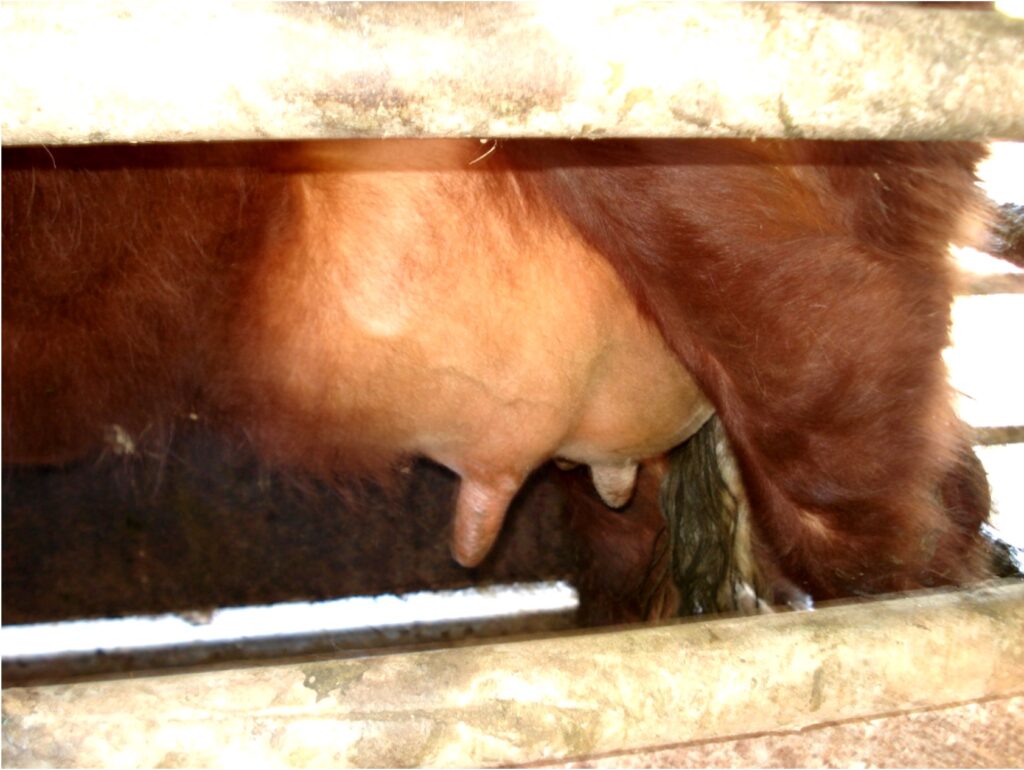
A good bald udder

On the bottom side, the heart girth (taken around the smallest circumference behind the front leg) should be equal to the topline (measured from pin bone to poll). To give the cow (or heifer) a wedge look, her flank circumference needs to be larger than the girth measurement by a minimum of two inches, but a plus-four-inch, -six-inch or -eight-inch flank is even better. Kenneth Redman of Sydney, Montana, found in his analysis that old cows typically had larger flanks than the herd average, meaning that they could “digest enough for three” even during the poor, dry years. This larger flank gives the look of an ever-increasing wedge toward the rear of the cow, from a side view.

Moving to the back of the cow, she needs to have a rump at least two and a half inches wider than it is long. The length is measured from the back of the pin bones to the front of the hook bones. The width is measured at the widest part of the rump area (usually the stifle muscle on each side). Michael McDonald of Nebraska found that the best indicator of fertility in a cow or heifer was how much wider the rump was than its length. Kenneth Redman found that old cows that had given ten calves in a row had a wider rump than the average cow in the herd. With this wide rump, a view from the top of the cow is also going to give us a wedge-shaped look.

At that point, the group had an idea of the shape of a replacement heifer that is in the ballpark with her phenotype. Next, my explanation turned to hormonal activity and butterfat. That short leg up front was created by high production of estrogen. Two other places we would see early estrogen expression is in hairs standing up in the adrenal whorl and the stifle muscle developing early. In most cases, higher hormonal activity is expressed in an early-shedding animal with a uniform haircoat. If your heifers all shed late and have hair sticking every which way, it is time to take a serious look at the feed and mineral quality you provide.

Bare backs allude to early shedding. Dr. Jan Bonsma said that if he could use only one of all of the indicators he knew for selecting which animal he would eat that year, he would select the animal that shed its winter haircoat the earliest. That animal had the best glandular function in her environment and would be the most healthful for him to eat. 

We can use this to our advantage if we start observing what we look at. That early-shedding heifer will typically have fewer flies than her herd-mates. She will maintain body condition easier/better. One of the big keys to heifers and cows getting pregnant is the ability to gain weight between calving and breeding. That bred replacement heifer must be able to eat enough for two. Late-shedding first-calf heifers typically are the ones who breed back late or come up open in the fall. Part of this is glandular function, but in a number of cases it is related to a phenotype that hinders the heifer’s ability to gain weight during lactation before joining her with the bull.
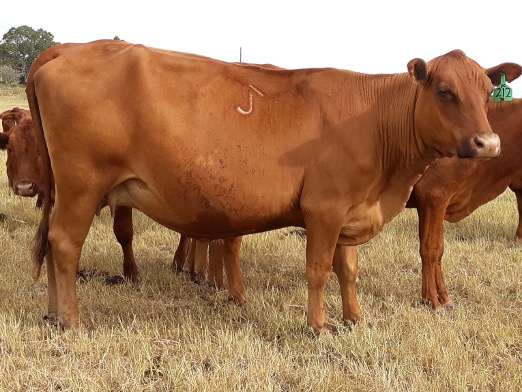
This cow has a healthy glandular system

Butterfat in the heifer can be observed in a number of ways — even on the day she is born. These include (not in order of importance) 1) an adrenal hair whorl located in the shoulder blade area or further forward; 2) extra teats; 3) an area around the teats that has shorter, nappy, lighter hair color than the rest of her body (this is a precursor to a bald udder later in life); 4) the correct outline of her escutcheon showing high butterfat when she is milking; 5) the presence of vertical folds in the hide; and 6) a small-diameter cannon bone and a pointed poll. In the mature cow, a bald udder is the number one indicator of butterfat. The more of the previously enumerated characteristics we see, the more likely we are to have a high-butterfat-producing cow. 

I summarized my talk by saying, “you need a cow with a big belly, a wide butt, a bald udder and a bare back.”

Any one animal might “prove” these comments incorrect. However, one hundred cows with all of these traits will give you more and better-quality calves than one hundred cows that have few or none of these traits. 

← Previous Ground Truth Next Eat Real Food →
Tags: CattleLinear measurement
Steve Campbell

Steve Campbell

​Steve Campbell is a lifelong cattleman and regenerative livestock consultant based in Idaho.

Next Post
The just-replaced MyPlate graphic was fairly similar to the old Basic Four food groups.

Eat Real Food

  • Trending
  • Comments
  • Latest
The Most Important Livestock in Our Fields

The Most Important Livestock in Our Fields

July 1, 2024
Glyphosate Does What It’s Designed to Do — Kill

Glyphosate Does What It’s Designed to Do — Kill

February 19, 2025
USDA organic seal over American farm land

Losing Organic Farms

September 18, 2026
The Take-Half, Leave-Half Fallacy

The Take-Half, Leave-Half Fallacy

July 1, 2025
Author photo (Wikimedia)

A Food Emancipation Proclamation

3
We Don’t Need Another Bridge — We Need an Off-Ramp

We Don’t Need Another Bridge — We Need an Off-Ramp

3
Under One Roof

Under One Roof

3
A Rose By Any Other Name

A Rose By Any Other Name

2
October 2026 • Issue #664

October 2026 • Issue #664

October 2, 2026
Regenerating Mycorrhizae

Regenerating Mycorrhizae

October 2, 2026
ECO-GRAPHIC

ECO-GRAPHIC

October 2, 2026
ECO-MEETINGS

ECO-MEETINGS

October 2, 2026

Recent News

October 2026 • Issue #664

October 2026 • Issue #664

October 2, 2026
Regenerating Mycorrhizae

Regenerating Mycorrhizae

October 2, 2026
ECO-GRAPHIC

ECO-GRAPHIC

October 2, 2026
ECO-MEETINGS

ECO-MEETINGS

October 2, 2026

Don't miss an update!

Stay informed on what's new in the Acres U.S.A. community: new articles, upcoming events and resources for regenerative farmers.

Acres U.S.A. is North America’s oldest publisher on production-scale organic and regenerative farming. For more than 50 years, our mission has been to help farmers, ranchers and market gardeners grow food profitably, regeneratively, and with nature in mind.

Facebook Instagram X-twitter Youtube Linkedin Spotify

SHOP

  • Bookstore
  • Online Courses
  • Giftcards

ABOUT

  • About Acres U.S.A.
  • Our Team
  • Eco-Ag Acheivement

LEARN

  • Events
  • Magazine
  • Newsletter
  • Webinars
  • Free Articles
  • Online Courses

Contact Us

Acres U.S.A. LLC
PO Box 351
Viroqua, WI 54665​
info@acresusa.com
970-392-4464
  • Manage My Subscription
  • Advertise with Us
No Result
View All Result
  • HOME
  • ARTICLES
    • News
    • Farm
    • Ecological farming
    • Livestock
    • Crop
      • Crop management practices
      • Cover crops
      • Crop nutrition
      • Crop protection
      • Crops
      • Ag technology
    • Soil
    • Opinion
  • RESOURCES
    • Magazine
    • Online Learning
    • Newsletters
    • Blog
    • Free Articles
  • MAGAZINE ISSUES
    • 2026
      • June 2026
      • May 2026
      • April 2026
      • March 2026
      • February 2026
      • January 2026
    • 2025
      • December 2025
      • November 2025
      • October 2025
      • September 2025
      • August 2025
      • July 2025
      • June 2025
      • May 2025
      • April 2025
      • March 2025
      • February 2025
      • January 2025
    • 2024
      • December 2024
      • November 2024
      • October 2024
      • September 2024
      • August 2024
      • July 2024
      • June 2024
      • May 2024
      • April 2024
      • March 2024
      • February 2024
      • January 2024
    • 2023
      • December 2023
      • November 2023
      • October 2023
      • August 2023
      • July 2023
      • June 2023
      • May 2023
      • April 2023
      • March 2023
      • February 2023
      • January 2023
  • ABOUT US
    • Our History
    • Our Staff
    • Contact Us
    • Community
      • Soil Health Primer Resources
  • EVENTS
    • Eco-Ag Conference
    • Farm Weird
  • SUBSCRIBE
  • Login
  • Sign Up
  • Cart

© 2024 Acers USA Magazine

Lost Password?