
Acres U.S.A.® Magazine
  • Articles
    • News
    • Ecological farming
      • Climate
      • Environmental Issues
      • Farm management & planning
      • Human health
    • Livestock
    • Farm
    • Crop
      • Crop management practices
        • Ag technology
        • Cover crops
        • Crop nutrition
          • Crop protection
          • Diseases
        • Crops
        • Fruits
    • Soil
    • Opinion
  • Resources
    • Magazine
    • Online Learning
    • Newsletters
    • Free Articles
    • Blog
  • Magazine Issues
    • 2026
      • June 2026
      • May 2026
      • April 2026
      • March 2026
      • February 2026
      • January 2026
    • 2025
      • December 2025
      • November 2025
      • October 2025
      • September 2025
      • August 2025
      • July 2025
      • June 2025
      • May 2025
      • April 2025
      • March 2025
      • February 2025
      • January 2025
    • 2024
      • December 2024
      • November 2024
      • October 2024
      • September 2024
      • August 2024
      • July 2024
      • June 2024
      • May 2024
      • April 2024
      • March 2024
      • February 2024
      • January 2024
    • 2023
      • December 2023
      • November 2023
      • October 2023
      • August 2023
      • July 2023
      • June 2023
      • May 2023
      • April 2023
      • March 2023
      • February 2023
      • January 2023
    • 2022
      • December 2022
      • November 2022
      • October 2022
      • September 2022
      • August 2022
      • July 2022
      • June 2022
      • May 2022
      • April 2022
      • March 2022
      • February 2022
  • About Us
    • Our History
    • Our Staff
    • Contact Us
    • Community
      • Soil Health Primer Resources
  • Events
    • Eco-Ag Conference
    • Farm Weird Event
  • Subscribe
  • Login
  • Register
No Result
View All Result
  • Articles
    • News
    • Ecological farming
      • Climate
      • Environmental Issues
      • Farm management & planning
      • Human health
    • Livestock
    • Farm
    • Crop
      • Crop management practices
        • Ag technology
        • Cover crops
        • Crop nutrition
          • Crop protection
          • Diseases
        • Crops
        • Fruits
    • Soil
    • Opinion
  • Resources
    • Magazine
    • Online Learning
    • Newsletters
    • Free Articles
    • Blog
  • Magazine Issues
    • 2026
      • June 2026
      • May 2026
      • April 2026
      • March 2026
      • February 2026
      • January 2026
    • 2025
      • December 2025
      • November 2025
      • October 2025
      • September 2025
      • August 2025
      • July 2025
      • June 2025
      • May 2025
      • April 2025
      • March 2025
      • February 2025
      • January 2025
    • 2024
      • December 2024
      • November 2024
      • October 2024
      • September 2024
      • August 2024
      • July 2024
      • June 2024
      • May 2024
      • April 2024
      • March 2024
      • February 2024
      • January 2024
    • 2023
      • December 2023
      • November 2023
      • October 2023
      • August 2023
      • July 2023
      • June 2023
      • May 2023
      • April 2023
      • March 2023
      • February 2023
      • January 2023
    • 2022
      • December 2022
      • November 2022
      • October 2022
      • September 2022
      • August 2022
      • July 2022
      • June 2022
      • May 2022
      • April 2022
      • March 2022
      • February 2022
  • About Us
    • Our History
    • Our Staff
    • Contact Us
    • Community
      • Soil Health Primer Resources
  • Events
    • Eco-Ag Conference
    • Farm Weird Event
  • Subscribe
No Result
View All Result
Acres U.S.A.® Magazine
No Result
View All Result
Home Crop management practices Cover crops

Bean There, Covered That

Joe Ailts by Joe Ailts
February 1, 2026
0
Agronomist Joe Ailts

Agronomist Joe Ailts

0
SHARES
46
VIEWS
Share on FacebookShare on Twitter

Early-relative-maturity soybeans, planted early in the northern Corn Belt, offer great yields — and the possibility of establishing better cover crops after harvest

Joe Ailts

As an independent agronomist who straddles the intersection of traditional row-crop agronomy and the principles of soil health, I am constantly on the hunt for “system hacks” that integrate these two philosophical camps in ways that ultimately increase productivity and profitability. That’s a big ask, given that many believe the integration of soil health principles — notably reduced tillage and cover crops — comes with significant cost and a yield penalty.

But what if we can have our cake and eat it too? What if there are ways to integrate soil health practices that do not compromise yield and profitability, but instead enhance them? These are the system hacks that I relentlessly pursue, under the belief that there is indeed synergy when combining traditional agronomic principles with soil health practices.

Covering Up North

The best example of a system hack I’ve discovered is the concept of early-planted, early relative maturity (RM) beans. Early-RM beans can deliver similar yield compared to later-RM beans while offering farmers a significantly earlier harvest window, enabling them to then establish a cover crop prior to winter.

I own an agronomy consulting business in northwest Wisconsin, and most of the farms I work with are north of the 45th parallel. We are closer to the North Pole than the equator. As such, our growing season is far more condensed than most acres in the Corn Belt. Every day above the freezing point must be taken advantage of to grow profitable crops.

Many farmers in this part of the world, and many ag industry “experts,” proclaim that covers and no-till can’t work here. It’s too wet. It’s too cold. This is pure hogwash. Years of experience have shown that we can quite successfully employ cover crop and no-till practices while preserving yield potential. In fact, when Mother Nature throws us extremely dry or wet growing seasons, I have often observed the superior functionality of soil health-focused cropping systems, as the soils underneath these crops tend to buffer the extremes.

I have collected 9,064 unique, weighed soybean-yield data points across the last seven growing seasons from farms across east-central Minnesota and northern Wisconsin. From this information-rich database, three important relationships stand out.

Early-RM Beans and Yield

First, let’s explore the relationship between soybean RM and yield. Like corn, there is a positive relationship between RM and yield: longer-day varieties tend to yield more than shorter-day varieties. Figure 1 shows that there is a 0.9 bu./acre increase for every 0.1 increase in RM. To use a practical example, there is a 4.7 bu./acre yield gain when comparing a 1.0 RM soybean with a 1.5 RM soybean.
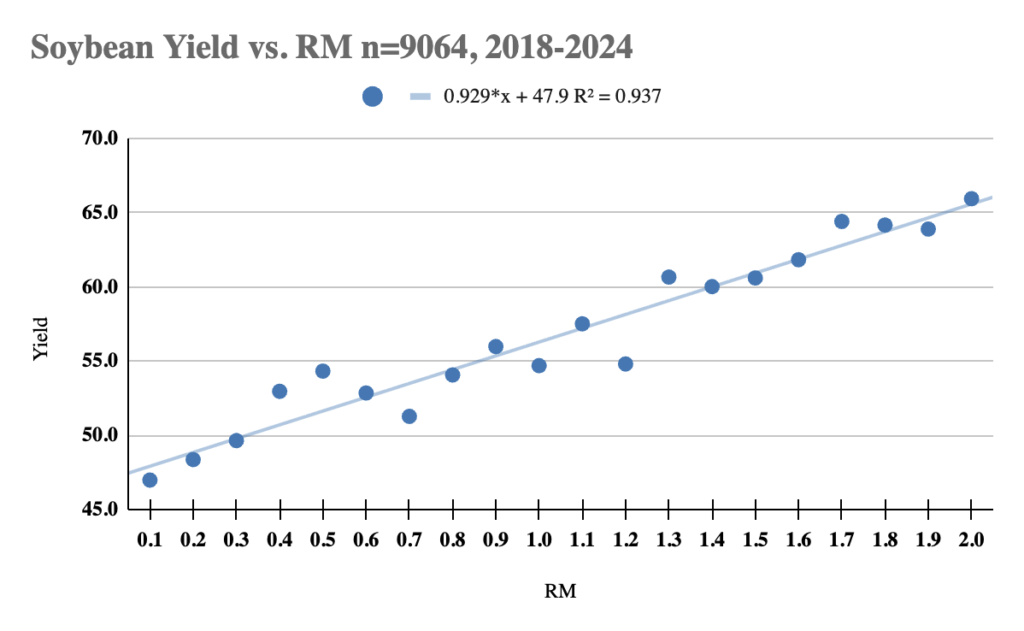
Figure 1. Agronomic practices matter a lot, but, in general, longer-day varieties tend to yield more than shorter-day varieties.

There are a number of important caveats when interpreting this aggregate data. This 0.9 bu./acre RM value cannot be applied to specific circumstances in the field. No farmer, agronomist or university researcher can claim that shifting from a 1.0 RM bean to a 1.5 RM bean will deliver a 4.7 bu./acre advantage. Soybean variety agronomic characteristics will always be the primary driver of relative performance. A 1.0 RM bean variety with superior white mold tolerance will likely stomp a 1.5 RM variety with weak white mold tolerance in fields with white mold pressure. 

Agronomics matter — a lot. I ask readers to consider this data from a bird’s-eye-view perspective. These are big-picture trends and should be interpreted as such.

The Planting Date Effect

Figure 2 demonstrates the relationship between yield and planting date. University of Wisconsin soybean specialist Shawn Conley has performed a mountain of research on this topic. His data, on a much larger geographic scale, matches the observations I’ve pulled out of the same dataset referenced above: early-planted soybeans yield more. In fact, some, including Dr. Conley, have stated that soybean planting date may be the single biggest driver of soybean yield that farmers can control. I tend to agree.
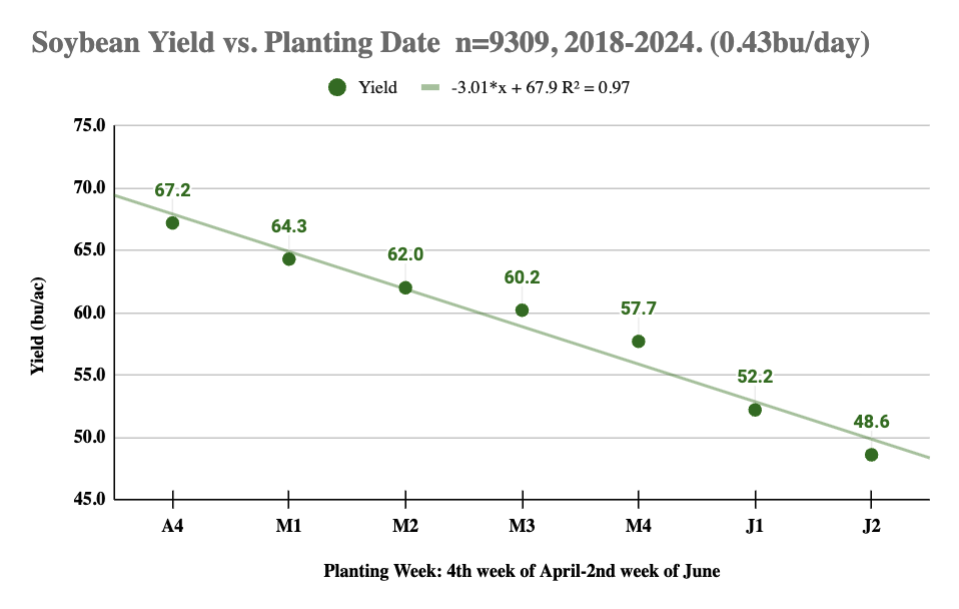
Figure 2. Planting date may be the single biggest driver of soybean yield that farmers can control. (A4 = fourth week of April, M1 = first week of May, and so on through the second week of June.)

The data in Figure 2 shows that there is a 0.43 bu./day loss in soybean yield for every day that soybeans do not get into the ground. Planting date matters — big time. I respectfully ask those of you committed to planting your corn before your beans to consider this data carefully. Bonus thought: beans can germinate at 46 degrees, whereas corn prefers 50.

Early RM + Early Planting: A System Hack

The data I’ve presented so far is building up to the big reveal: early RM soybeans planted early can hang with longer-RM beans. But wait — didn’t the data show a strong positive relationship between RM and yield? It did, and now it’s time to take this analysis a step further by combining planting date, RM, and yield into a single analysis that reveals a unique and unexpected anomaly.

Figure 3 shows yield by planting date, similar to the data in Figure 2. However, this time soybean RM is broken into three distinct groups: early RM (blue line), mid-group RM (red line), and late RM (green line). I would like to draw your attention to the blue line at the A4 and M1 planting weeks. These are the two most important data points; they imply that there is no meaningful yield loss when early RM beans are planted in the first two weeks of our historical planting window here in the northern Corn Belt. This breaks all the rules, doesn’t it?
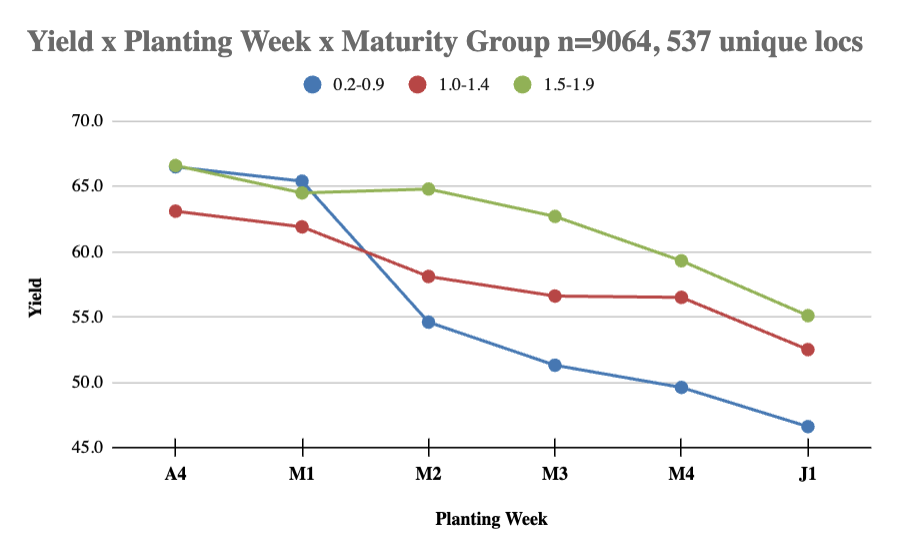
Figure 3. Early RM (blue line), mid-group RM (red line), and late RM (green line). There is no meaningful yield loss when early-RM beans are planted in the first two weeks of our historical planting window here in the northern Corn Belt.

I’ve ground-truthed this concept over a couple of growing seasons on the farms I consult with. Having identified a 0.4 RM bean with superior agronomic characteristics, I can cite numerous circumstances in which this bean, planted in the first week of May, yielded 60-plus bushels/acre in a county where the average is 42 bushels.

Take note of how the blue line appears to fall off a cliff when you get into the second week of May. The data implies that planting date is key to making this system hack work. Figure 2 shows the importance of planting date on yield; why is that effect magnified for the success of early RM beans? I believe it is due to sunlight and moisture availability, which offer key advantages to early beans. With a condensed life cycle, early-RM beans are going to enter the flowering and pod-fill stages earlier than later-RM beans. Doing so gives them the advantage of more sunlight and (usually) more moisture in the earlier parts of summer. There are likely other factors, but these stand out as logical considerations.

The Covered Advantage

What is the real advantage of these early-RM beans if they yield on par with later-RM beans? Time — that most precious of resources, which all of us wish we had more of. 

A rule of thumb states that each 0.1 RM of soybean translates to roughly one day at harvest. Using a practical example, the RM difference between an 0.4 soybean and a 1.4 soybean is one full maturity group, or ten 0.1 increments, which is about 10 days at harvest. What could you do with 10 days after harvest? A lot, I say.

These early-RM beans allow you to get started sooner. That means you finish sooner. And if you are a soil health enthusiast with a narrow window of establishment up here in the great North, that means covers like cereal rye can be planted at the end of September versus later in October. It may not seem like much, but that 10-day window can mean the difference between 55 and sunny and 35 and rainy. It’s a big deal.

In fact, there are a couple of circumstances in which rye was planted after soybean harvest on Sept. 20. This date may seem silly to those in more southern climates, but it is quite significant north of the 45th. Early September is considered the cutoff for planting overwintering cover crop species that are not cereal rye. As you go further into September, covers like clover, hairy vetch, and various brassicas simply do not have enough time to establish well and perform their duties in the gap between growing seasons. I would love to hack the system in such a way as to establish a legume cover after soybeans going into next year’s corn rotation. We’re not there quite yet, but we’re getting closer with mid-September soybean harvest.

I’ve spoken with a number of farmers at conferences around the country who are already on the early-RM soybean bandwagon for their own various reasons. Bravo to those system hackers who have reaped the benefits of this contrarian practice. My goal in this venture is to use large-scale, reliable data to quantify the benefits of these “off the rails” strategies to assure farmers that crazy ideas like this have merit. 

I am certain there are many more system hacks out there yet to be discovered, limited only by the creativity and commitment of rule-breakers willing to deploy them.

← Previous Nutrient-Dense Food Is the Future Next Armor Up! →
Tags: Soybeans
Joe Ailts

Joe Ailts

Joe Ailts is an agronomist based in Deer Park, Wisconsin. Learn more at ailtsagronomy.com, and read the interview we did with Joe in the August 2025 issue of Acres U.S.A.

Next Post
Menoken Farm manager Seth Boechler

Armor Up!

  • Trending
  • Comments
  • Latest
The Most Important Livestock in Our Fields

The Most Important Livestock in Our Fields

July 1, 2024
Glyphosate Does What It’s Designed to Do — Kill

Glyphosate Does What It’s Designed to Do — Kill

February 19, 2025
USDA organic seal over American farm land

Losing Organic Farms

January 27, 2026
The Take-Half, Leave-Half Fallacy

The Take-Half, Leave-Half Fallacy

July 1, 2025
We Don’t Need Another Bridge — We Need an Off-Ramp

We Don’t Need Another Bridge — We Need an Off-Ramp

3
Under One Roof

Under One Roof

3
A Rose By Any Other Name

A Rose By Any Other Name

2
Terra Preta’s Biological Advantage

Terra Preta’s Biological Advantage

2
Running Dry

Running Dry

September 10, 2026
What Are Lactating Steers Trying to Tell Us?

What Are Lactating Steers Trying to Tell Us?

September 3, 2026
Remembering Wendell Berry

Remembering Wendell Berry

September 2, 2026
Manure spreader

ECO-GRAPHIC

September 1, 2026

Recent News

Running Dry

Running Dry

September 10, 2026
What Are Lactating Steers Trying to Tell Us?

What Are Lactating Steers Trying to Tell Us?

September 3, 2026
Remembering Wendell Berry

Remembering Wendell Berry

September 2, 2026
Manure spreader

ECO-GRAPHIC

September 1, 2026

About ACRES USA

Acres U.S.A.® Magazine

Acres U.S.A.® is North America’s oldest publisher on production-scale organic and regenerative farming. For more than 50 years, our mission has been to help farmers, ranchers and market gardeners grow food profitably and sustainably, with nature in mind.

Visit Our Advertisers

Magazine Issues

  • News
  • 2025
    • June 2025
    • May 2025
    • April 2025
    • March 2025
    • February 2025
    • January 2025
  • 2024 Articles
    • December 2024
    • November 2024
    • October 2024
    • September 2024
    • August 2024
    • July 2024
    • June 2024
    • May 2024
    • April 2024
    • March 2024
    • February 2024
    • January 2024
  • December 2023
    • December 2023
    • November 2023
    • October 2023
    • August 2023
    • July 2023
    • June 2023
    • May 2023
    • April 2023
    • March 2023
    • February 2023
    • January 2023
  • December 2022
    • November 2022
    • October 2022
    • September 2022
    • August 2022
    • July 2022
    • June 2022
    • May 2022
    • April 2022
    • March 2022

Contact Acres U.S.A

  • Contact Us
  • About Us
  • Advertise With Acres U.S.A.
  • My Subscription

Learn

  • Resources
  • Events
  • Magazine
  • Newsletters
  • Free Articles
  • Webinars
  • Online Courses
  • Bookstore

Our All Socials

Follow With Us...

  • My account
  • News
  • Ecological farming
  • Refund and Returns Policy
  • Privacy & Policy

© 2024 Acers USA Magazine

Welcome Back!

Login to your account below

Forgotten Password? Sign Up

Create New Account!

Fill the forms below to register

All fields are required. Log In

Retrieve your password

Please enter your username or email address to reset your password.

Log In
No Result
View All Result
  • HOME
  • ARTICLES
    • News
    • Farm
    • Ecological farming
    • Livestock
    • Crop
      • Crop management practices
      • Cover crops
      • Crop nutrition
      • Crop protection
      • Crops
      • Ag technology
    • Soil
    • Opinion
  • RESOURCES
    • Magazine
    • Online Learning
    • Newsletters
    • Blog
    • Free Articles
  • MAGAZINE ISSUES
    • 2026
      • June 2026
      • May 2026
      • April 2026
      • March 2026
      • February 2026
      • January 2026
    • 2025
      • December 2025
      • November 2025
      • October 2025
      • September 2025
      • August 2025
      • July 2025
      • June 2025
      • May 2025
      • April 2025
      • March 2025
      • February 2025
      • January 2025
    • 2024
      • December 2024
      • November 2024
      • October 2024
      • September 2024
      • August 2024
      • July 2024
      • June 2024
      • May 2024
      • April 2024
      • March 2024
      • February 2024
      • January 2024
    • 2023
      • December 2023
      • November 2023
      • October 2023
      • August 2023
      • July 2023
      • June 2023
      • May 2023
      • April 2023
      • March 2023
      • February 2023
      • January 2023
  • ABOUT US
    • Our History
    • Our Staff
    • Contact Us
    • Community
      • Soil Health Primer Resources
  • EVENTS
    • Eco-Ag Conference
    • Farm Weird
  • SUBSCRIBE
  • Login
  • Sign Up
  • Cart

© 2024 Acers USA Magazine

Lost Password?