

Early lessons demonstrate the potential of an unconventional concept: a multi-year cover of Dutch white clover
Clover living mulch — CLM — is a pretty straightforward concept: you get a nice stand of clover going, and then you plant cash crops directly into it.
I imagine most Acres U.S.A. readers have come across this kind of idea at some point, but I’m also guessing few have seen it in practice. An online search yields lots of academic papers, and lots of gardening YouTubers. People seem to love it, or hate it, but there is precious little in the way of actual “how to” (or “how not to”) for commercial growers.

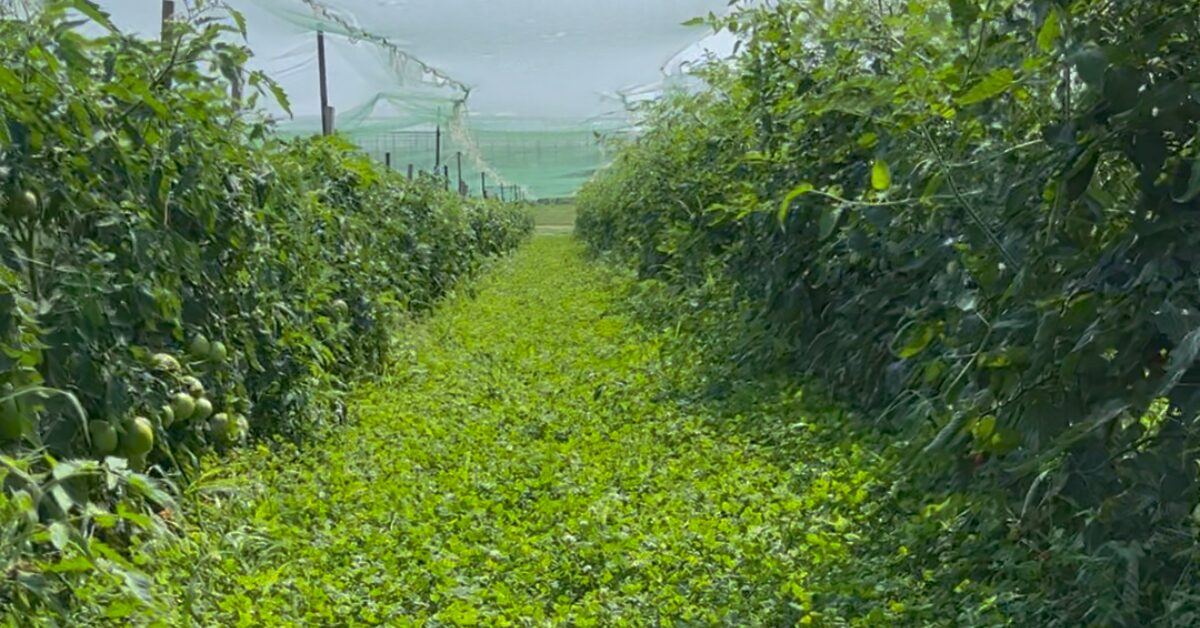
I hardly need to tell a bunch of farmers why this is a compelling concept. Living roots, soil armor, reduced tillage, above- and belowground habitat and diversity, nitrogen fixation, nutrient retention, etc. The promise is obvious, but the competition — or, as I prefer to describe it, the relationship between the clover and the cash crop — has to be managed, and the equipment to scale it has to be problem-solved.
Getting Started
I got interested in CLM after many years of interseeding Dutch White clover into our cash crops at last cultivation. We grow a variety of vegetables at our little farm in the hills of western Massachusetts (zone 5). We have about five acres of sloped fields, and erosion has been our chief struggle through the years. We’ve been religious cover croppers since the beginning (2010), and we use contoured beds, and we did what we could as we learned about tillage reduction.
But the real unlock for us was interseeding that clover. It formed a solid mat by mid/late August, holding the soil in place as we got pummeled by increasingly common hurricane events moving up the coast, and it continued to hold the soil in spring. It was easy to work in the following spring, and it left the ground in good shape for the following cash crop. It was more flexible and reliable than the oat/pea or rye/vetch covers we’d been using. We could interseed almost everything with clover, then disc it in a couple weeks before planting, block by block. We played with different clovers but settled on Dutch White because it will reliably stay low and will reliably overwinter.
For many years, we would interseed the clover at last cultivation (July here, but up to mid-August just below us in the Connecticut River Valley — zone 6), leave it post-harvest (no need to run around in the mud seeding rye!), let it get juicy in spring, disc it in, plant the crops, cultivate, cultivate, cultivate…and then interseed again. Plant it, kill it, plant it, kill it. At some point, we asked ourselves if we could just leave it alone and plant into it. We did the web search I referred to above and didn’t find much. But there was one farmer I connected with who told me I was overthinking it. He said to just go for it.
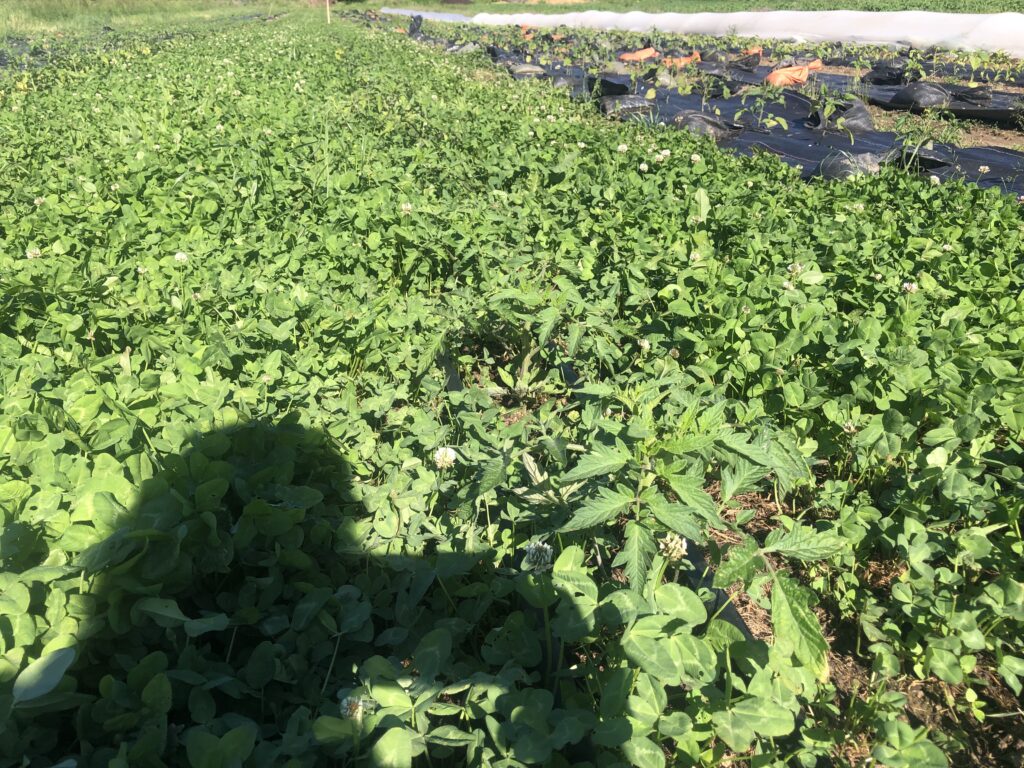
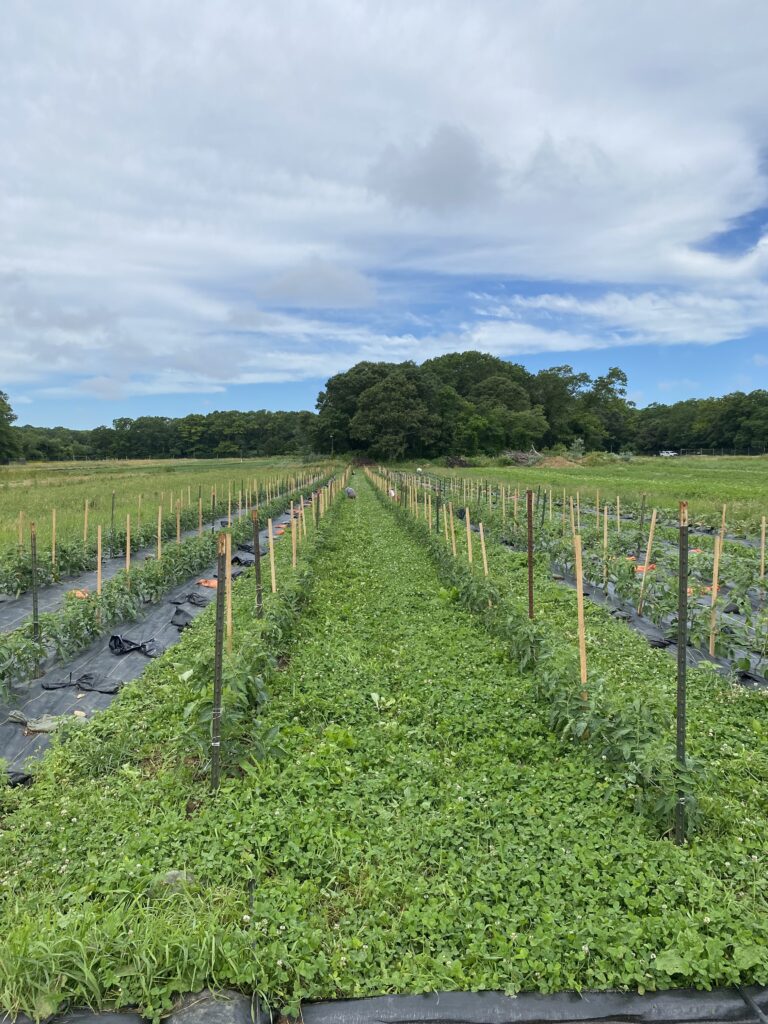
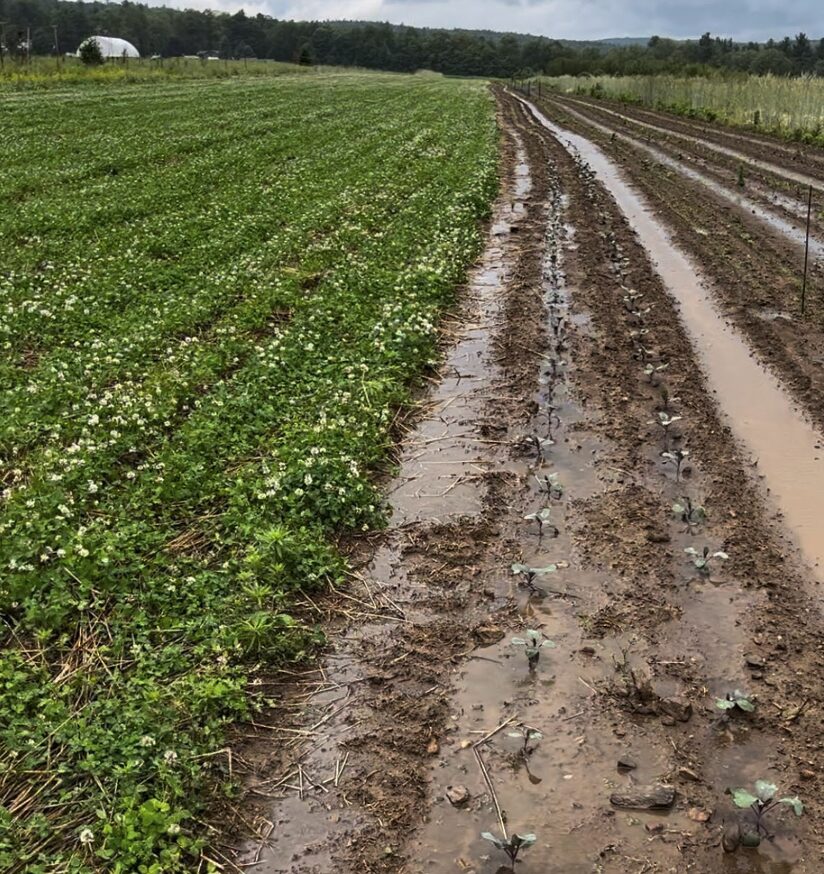
We stuck a few hundred storage cabbage transplants (Storage #4 and Ruby Perfection) in the clover in 2019. We mowed the clover with a lawnmower pre-plant, used a bulb auger on a cordless drill to make ~1.5-inch holes (72-cell trays), backfilled the little holes with a handful of compost, set the cabbages and walked away. I remember taking a photo, thinking, “Yeah, that didn’t work.” The cabbage was getting swallowed by the clover.
But over the season, those cabbages caught up to the bare-soil cabbages in the next row over, and by fall they looked just the same — with zero cultivation and zero management! If we hadn’t accidentally been successful that first year, I wouldn’t have stuck with it. But we were hooked. The questions were 1) what other crops would CLM work for, and 2) how could we modify equipment to scale this system?
We made some decent headway with those questions over the next couple years, but I started to feel very lonely. I imagine some of you have had this feeling. You’re working on something strange and innovative, and there’s really no one to problem-solve with.
In 2023, a friend encouraged me to start Momentum Ag, a nonprofit that would fill the vacuum between university research (they’ve documented all the reasons CLM is great for the environment, but they haven’t focused on the how to) and on-farm reality. My motivation was embarrassingly simple — I just wanted some friends to talk to about CLM. The bigger picture was a real frustration about the fact that no one ever asks (or pays) farmers to do the problem-solving we need to move climate-smart/regenerative/ecological agriculture forward.
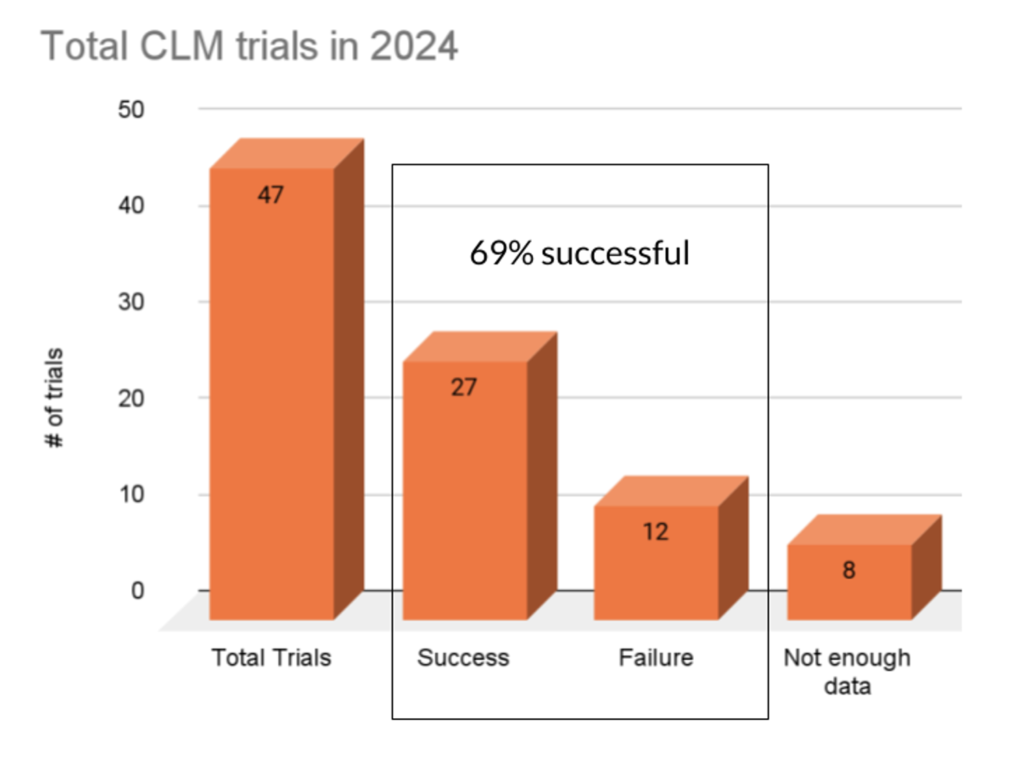
So in 2023, about 20 farmers, mostly in the Northeast, and a couple in the Midwest, got clover established and planned for CLM trials in 2024. And in 2024, we tracked 47 CLM trials on those farms. I want to share what we’ve learned so far with you. If you’re interested in participating in these trials, I hope you reach out to me. No one will save farming but farmers. Momentum’s motto is “Growing Knowledge.” I believe farmers should get paid for the food they grow and for the knowledge they contribute.
The First Results
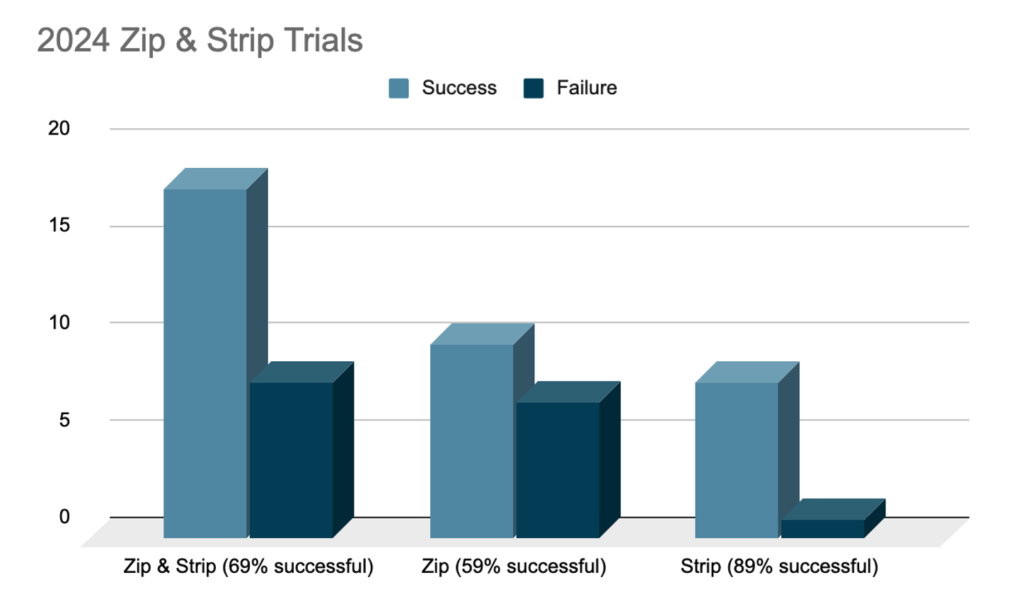
Of the trials where we had good data, 69 percent of farmers called their trial successful. But it turned out that “successful” meant a lot of different things to different people. I thought it would be based on yields that were comparable to their control (each farm has its own control, based on each farm’s “normal” system, whatever that might be), or successful based on profitability — maybe a yield hit, but offset by labor savings. But what success meant was more complicated.
Some trials were truly successful by any metric, and others were unsuccessful by any metric, but most were somewhere in the middle. Farmers felt that they were successful because they could see the path to success, because they were happy with the effects on soil health (more on that below), because they felt they were doing the right thing, or because they were engaged with an interesting community.
We saw a major breakdown in terms of success based on three variables.
- You’ve got to have a fairly pure stand of clover. If you’ve got perennial weeds in the stand, or a spotty stand, you’re better off terminating it and trying again. Clover gets along better with our cash crops than weeds do.
- Cash crop species matters. Some crops (tomatoes and brassicas stand out) get along better with clover, while others (corn and squash) sometimes struggle to reach their full potential with clover (see #3). Unfortunately, there’s also a variety interaction — certain varieties of each of these cash crops do better with clover. But as you know, there are many, many varieties, so we need your help figuring out that part of the puzzle.
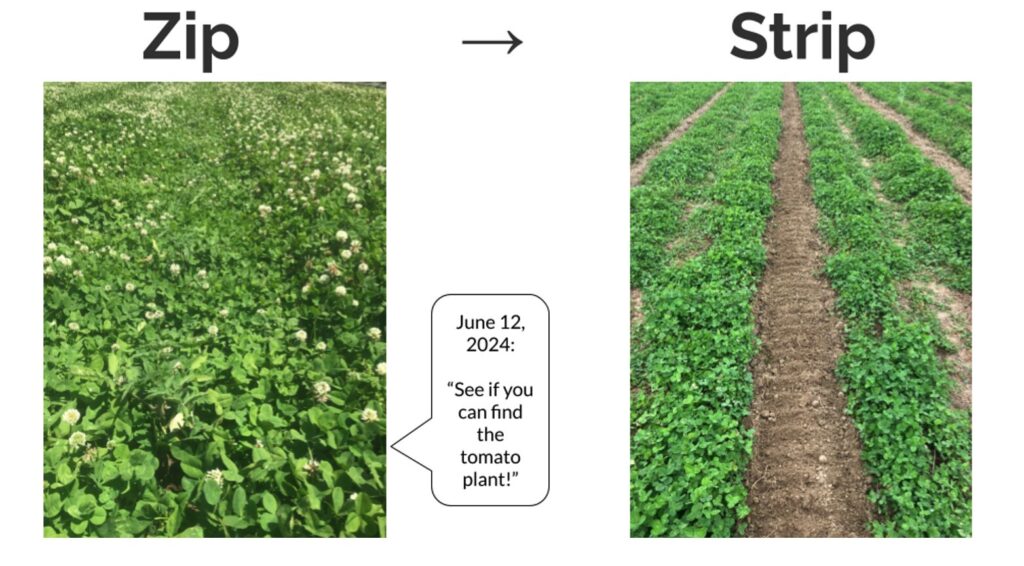
- Management style matters. Most farmers tried one of two methods: zip and strip. Zip means putting the cash crop in with as little disturbance as possible — no till, basically — and strip means creating a zone where the crop goes. Zip is easier because the clover mostly manages the weeds, but strip is easier because the planting zone gets along with your planting/transplanting equipment and allows your cash crop to establish nicely before it “meets” the clover.
See the chart “2024 Zip & Strip Trials”; based on these early results, it seems like a 12-inch or greater strip is successful for most crops. The only unsuccessful strip trial was one planted into just-plowed-down pasture where the soil was chunky and weird, so maybe we shouldn’t have counted it.
So, why not abandon zip altogether? Well, when it works, it’s beautiful. Very little management is needed aside from a clover mowing at cash crop germination and/or 7-10 days after germination/transplanting. But yes, if you’re trying this for the first time, strips are great.
In both cases, equipment is key! Here are some equipment considerations, plus other agronomic things to think on.
- Pre-plant mowing
You can use a lawnmower, a weedwhacker, a brushhog or flail (careful not to scalp!), or a hay mower. Set the clover back low. In early stages of cash crop establishment, you have to make sure the clover doesn’t overtop the cash crop and compete for light. Ideally, you’d do this the day of planting.
- Planting/transplanting for zip
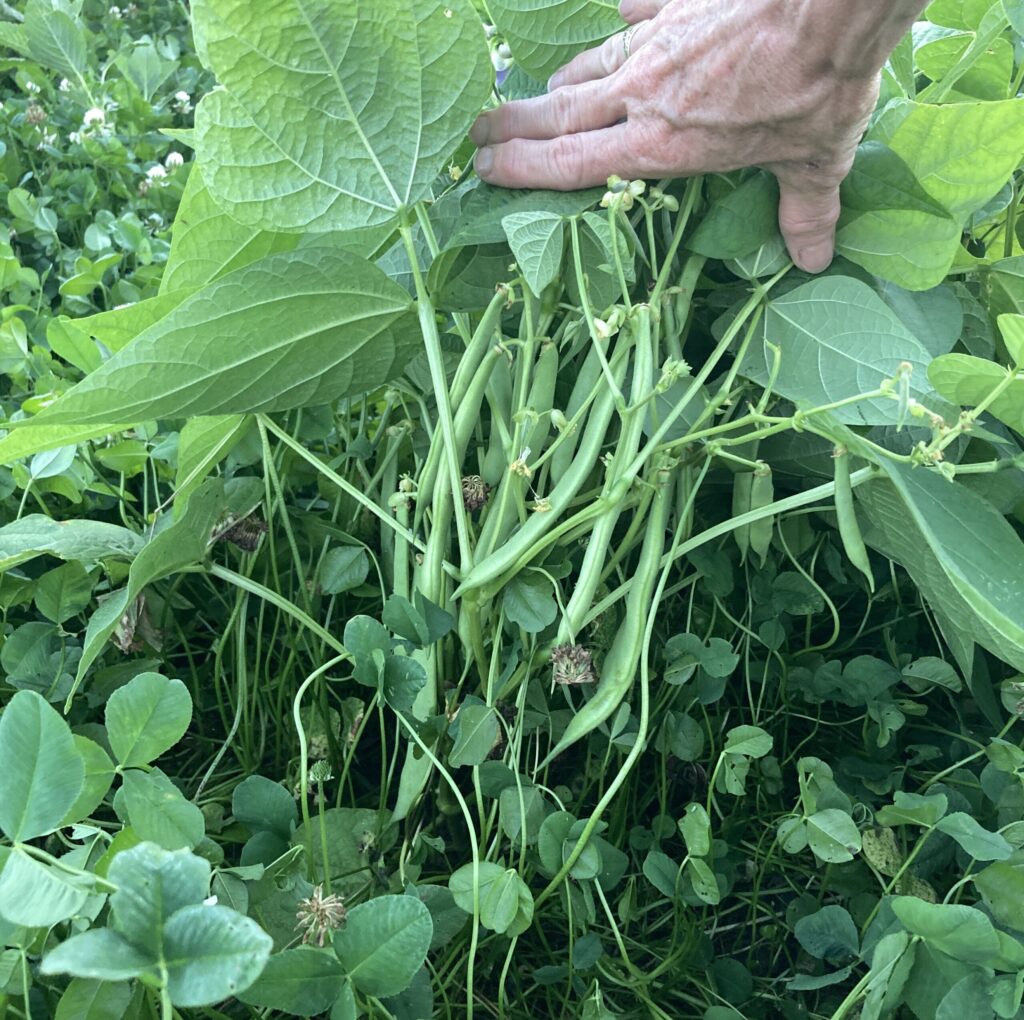
For direct seed, a no-till planter works great. We have a two-row JD MaxEmerge. With added weight on the rear brackets, it’s pretty much perfect. We used to put a coulter on a toolbar right in front of a narrow (ideally 1 inch or less) ripper tooth and then push seed into that slot; this works fine, too. We’ve had mixed luck with zippered field corn (corn seems to like the strip) and good luck with dry beans (we mow immediately at germination).
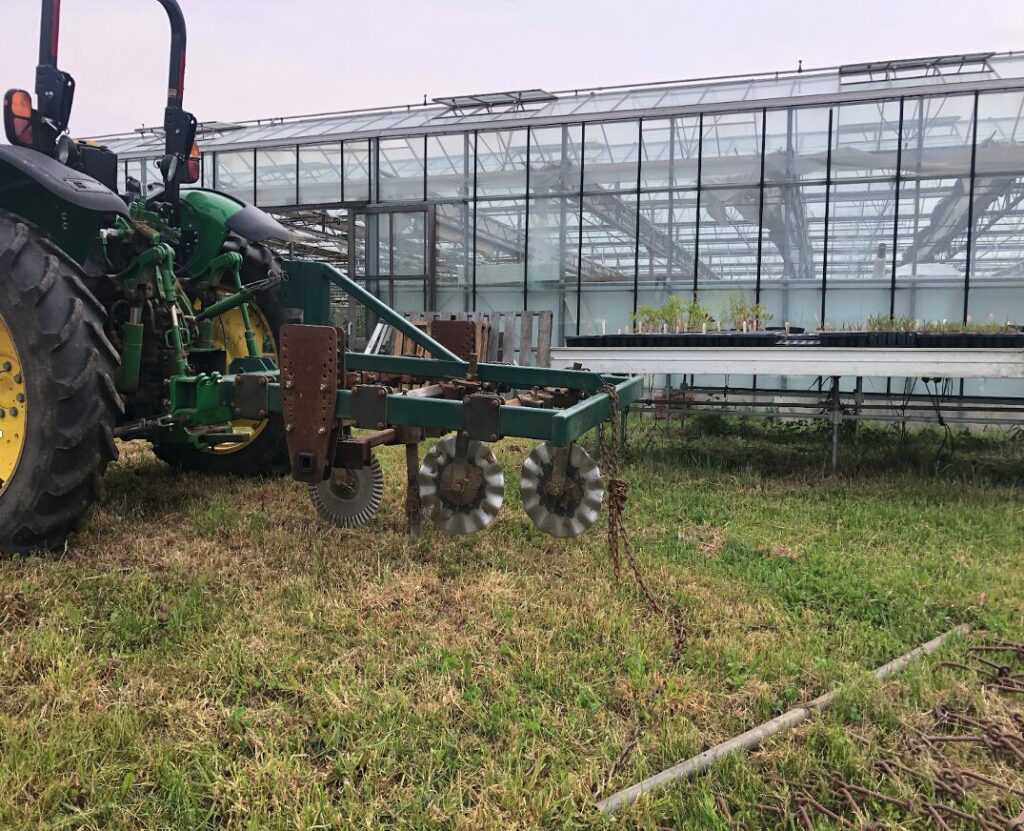
For transplanting, people are using the bulb auger at very small scales or a simple coulter/ripper setup for slightly larger scales. Some folks are hand planting into the slot, and if the slot is disturbed enough (>1.5 inches), you can sneak in there with a waterwheel or mechanical transplanter. At larger scales, we’ve modified a couple of C&M mechanical transplanters with a coulter and ripper running in front of the shoe. In all cases, you have to be extra careful that the transplants are healthy to begin with, are making good soil contact, and are not getting too beat up in the process. Expect to spend extra time in the field to make sure equipment is operating as it should and that seeds/transplants are set with care. When you’re frustrated, remember that the labor in CLM is front-loaded.
- Fertilizing the zone/strip
There are many ways to do this. Basically, we’re trying to put the fert near the cash crop, where it counts. Drop spreaders, drop tubes, you name it. Where the only option is surface spreading, that’s what we do, but there seems to be an obvious benefit in terms of fert use and cash crop growth when we can put it under the surface. This is less of an issue in the strip, where we can more easily incorporate. How much can you reduce fertilizer? We don’t really know yet. At least 25 percent on a per-acre basis.
- Strips
Planting/transplanting into a strip is no big deal if you can drive straight, because once the strip is made, you’re planting into tilled ground. The question is how to make the strip.
For conventional, spray the strip down with RoundUp. Depending on your row spacing, you can reduce rates by >80 percent for wide-spaced crops like winter squash and 60 percent for 30-inch corn/beans. Those rates are based on the field overall, not on the strip itself — the strip will need the full amount of herbicide. There are hooded sprayers that work well for this purpose, but it’s not hard to modify a sprayer to do the job, at least for a few-acre trial. You’ll want to follow with a pre-emerge.

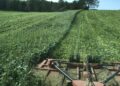
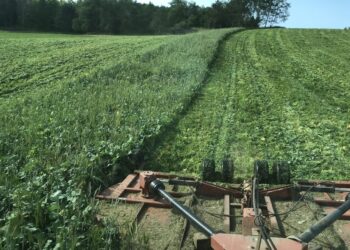
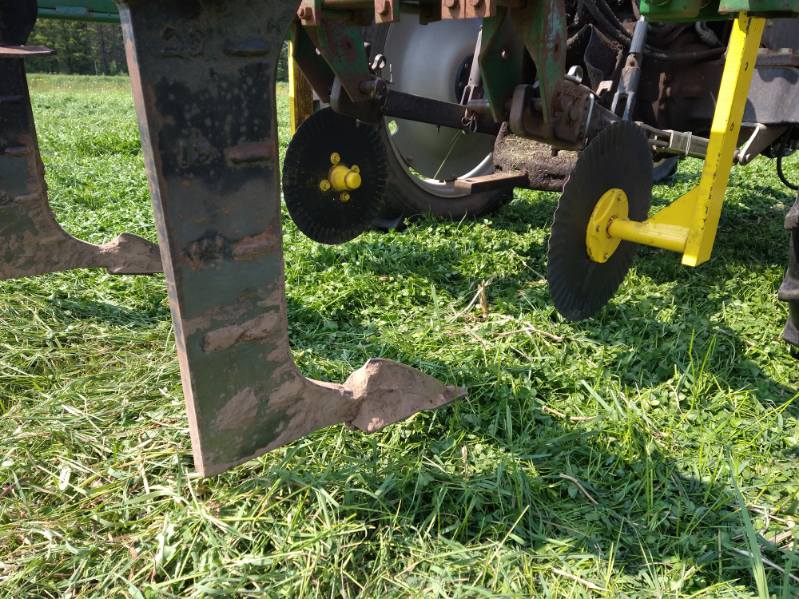
For organic (or conventional, if you like tilling the strips), you can use a strip tiller. For organic, strip tillage won’t fully kill the clover in most cases, so you’ll need to follow up with multiple passes. Or you can use a setup like the one in the photo for the first couple passes and then switch to a setup on a cultivating tractor. Think of all those passes as stale-bedding, or as replacing post-plant cultivation passes with easy, fast, pre-plant cultivation. You’re getting your strips nice and plantable, but you’re also getting rid of weeds every time you pass through. For a cultivating tractor, a good place to start is hilling discs up front to define the strip edges, a ripper down the center, and spiders on the shoulders. There are many workable alternatives, but get ready to play around to see what works.
We had an informative organic trial last year where the farmer took six passes over 3.5 acres of strips, trying to get them uniform and ready for waterwheel transplanting. He was annoyed by how many passes it took, but those strips (in a field in constant veg production for >20 years with a heavy weed seed bank), only needed one post-transplant finger weeding and then he walked away for the rest of the season and got butternut yields that beat the control. There was no hand weeding, so it was a full win in terms of profitability, however you measure it.
This year, farmers are running lots of strip-till trials. It’s too early to assess yet, but one thing is clear: farmers who got out there early and worked the strips multiple times before planting are feeling very positive, but farmers who just beat up a strip a couple times before planting are dealing with emergence issues, growth issues and weed issues.
- Irrigation
It’s great if you can, but it’s not necessary. Transplants do appreciate it while they’re getting established. “Adequate” soil moisture is based on the idea that no other living thing will want moisture aside from your cash crop, so more is better as your crop is starting to root out and thrive. In general, studies (and our trials) show that clover draws moisture out of the soil in spring when the clover is growing and transpiring a lot, but then it has more soil moisture in the hot months due to greater shading/wind cover, and clover growth and transpiration are reduced in the heat.
- Post-seeding/transplanting mowing
I’ll be honest: this part isn’t good. At scale, it’s a real problem. Strips largely solve this problem: if you make strips wide enough that the clover regrowth doesn’t shade out the cash crop, you won’t need to mow except for weeds that emerge through the canopy in mid-July. But for zip or narrower strips, you’ll need to mow, especially 7-10 days after emergence/transplanting to keep the clover from overtopping the cash crop.
At the moment, we’re all doing it with weedwhackers, lawnmowers, or super janky homemade row-mow units mounted on 3-points. Sicklebar mowers on BCS tractors work well, but your row spacing has to be >30 inches. None of us are excited about it. We all think mowbots have great promise, but they’re a couple years out. (If you want to work on mowbots with Momentum, please get in touch!)
For high-value veg growers, mowing can actually still wind up being a fraction of the labor cost of weeding, but for row croppers, it’s a real problem. If you’re dealing with a low-value-per-acre crop, think strips.
- Don’t mow more than you need to
You’d think frequent mowing would be good, but we’ve found there’s no benefit to any mowing unless you have a good reason to do so.
There are two good reasons to mow: 1) to reduce photosynthetic competition between clover and cash crop, and 2) to kill weeds that emerge through the clover canopy. Other than that, mowing seems to reinvigorate clover and lead to more intense clover growth/competition. Plus it adds labor.
I’m interested in that clover “relationship.” Mowing stresses clover out and makes it aggressive. Not mowing allows clover to hum along naturally — to move from vegetative to reproductive, slow its growth, and wait until cooler temps and wetter weather give it a second wind. That second wind happens well after our cash crops have done most of their growing.
- Post-harvest
Put your residue on the ground immediately after cash crop harvest! Many kinds of mowers work. But to get your clover growing and happy through the fall and into spring, you’ve got to give it light. The more even and fine you can shred your residue, the happier it will be.
- Persistence
Persistence is variable. We’ve had a few cases where the clover just gives up under a heavy cash crop canopy, but mostly it’s good enough to serve as a cover crop going into the following year.
It’s too early to assess long-term persistence with our short-term trial data. At my own farm, I’ve seen pure stands persist for as little as two years, and as many as five years. I think you’ve got to walk the field in spring. Let the clover fill out — be patient — but be ready to terminate it if there are perennial weeds in there. The idea here is not permanent no-till but giving our fields the opportunity to experience continuous living cover for as long as possible.
- Reseeding/establishment
Clover establishes nicely when frost-seeded or sown early into an overwintered small grain. This would be in a case where you’re going to harvest the grain or you’re going into a fallow/cover crop year. Clover struggles the most when it’s seeded close to warm-season weed emergence — it’s just not as quick to establish as those weeds are. So, if we haven’t gotten it going early, we like to wait until we’ve bare-fallowed for a while, and then we get it going with a small grain later in the season. Clover likes to germinate with some shade and wind cover. It doesn’t do well on its own.
Another option is the interseeding I talked about in the beginning, but we’ve found that interseeding for newbies often leads to a so-so stand. While we encourage interseeding in general, it may not be the best route to a beautiful stand for CLM if you’re new to it. When we get later into the season, we have to be mindful that clover needs to put down some root reserves to make through the winter. The literature will tell you six weeks before first frost, but that’s not exactly true. Basically, you want it to grow robustly for about two months before daylength and temperatures start to drop. For us in the Hills here, that’s early August (usually seeded with oats), but in the Connecticut River valley just a half hour away, that can be early September. It also depends a lot on your soil type and the following winter. A lot of freeze/thaw with little snow cover will wreak havoc on your clover, so seeding earlier is better.
Equipment-wise, a no-till drill is fantastic, as long as your drop tubes are putting the seed down basically on the surface (not right behind the disc openers, where it falls into the trench) and just lightly packing in with the closing wheels. You can also get a nice stand with broadcasting, as long as you’ve got equipment that has a fine adjustment on the aperture. A big cone spreader is not a good way to put down a tiny seed like clover. But a Hurd spreader or similar can work well. Chest-mounted spreaders are great for small acreages. No incorporation needed in either case. Drop spreaders work, too, as long as there’s enough filler of some kind. For chest-mounted and drop, we like to put in cracked corn as a filler (two or three parts cracked corn to one part clover, by volume), because it’s cheap and easy to see, and makes it way easier to get an even spread.
In all of these cases, we’re talking about seeding rates between 8 and 40 pounds per acre. That’s a big spread, and it depends on two factors. 1) The more faith you have in your equipment, the better the conditions, and the fewer competing weeds you have, the more you can dial it down. 2) The higher value your crop, the higher your rate. Example: if I’m going to broadcast clover onto a field where I hope to grow heirloom tomatoes next year, I would be a fool not to spend an extra $100 to get a great stand. The crop should yield >$50,000. On grain corn, I’m going to aim for a rate closer to 8 pounds, where the profitability pencils out.
Soil Results
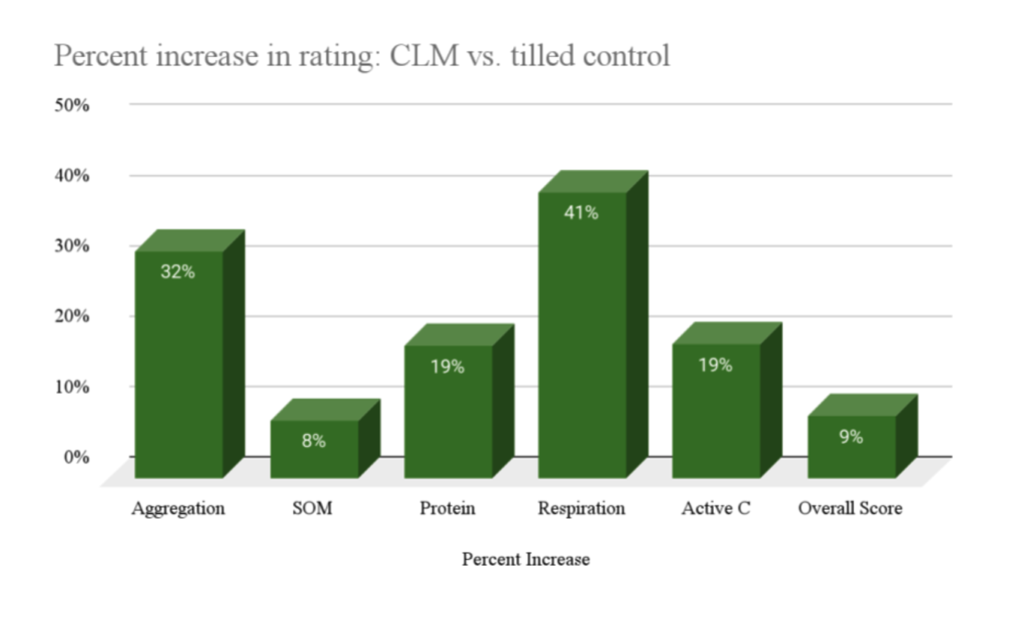
I’d like to end with some info for soil nerds. The results are pretty amazing, as you’d expect for a continuous living cover. Keep in mind that these soil tests were taken side-by-side, at the end of the season, so they’re looking at how CLM vs. control plots diverged, not beginning to end of season. We used Cornell’s Assessment of Soil Health (CASH) test. The first graph is from participating farms where the control was tilled or plasticulture vs. CLM. All the metrics there measure biological activity (except aggregation, which is a measure of tillage and biology).
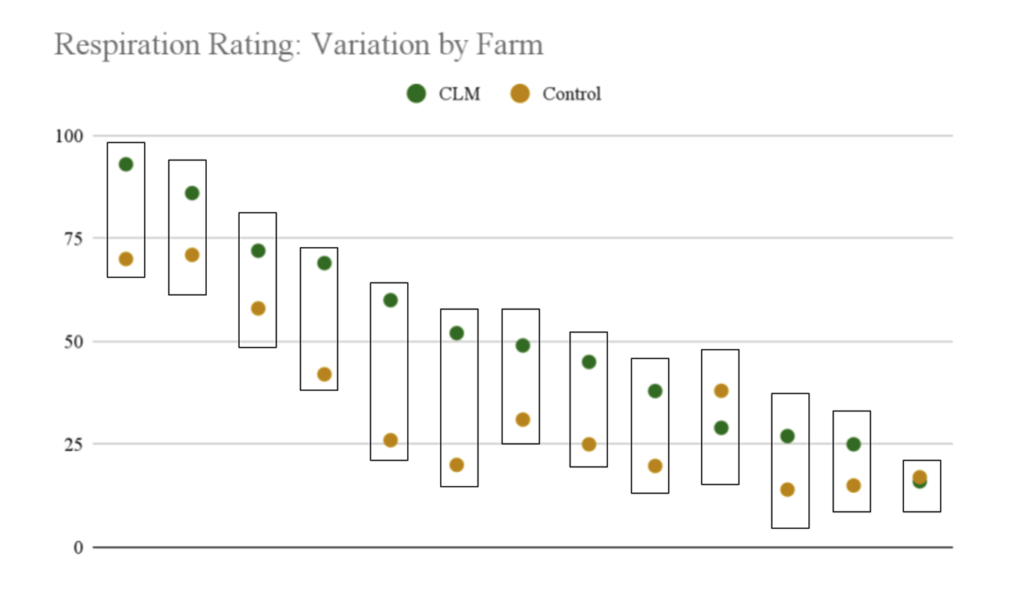
The results weren’t just impressive in aggregate; they held up pretty much over every single individual farm. The second graph shows respiration by farm. Each rectangle represents CLM vs. control, by farm. If you want to get your respiration up, CLM is a good way to do it, reliably.
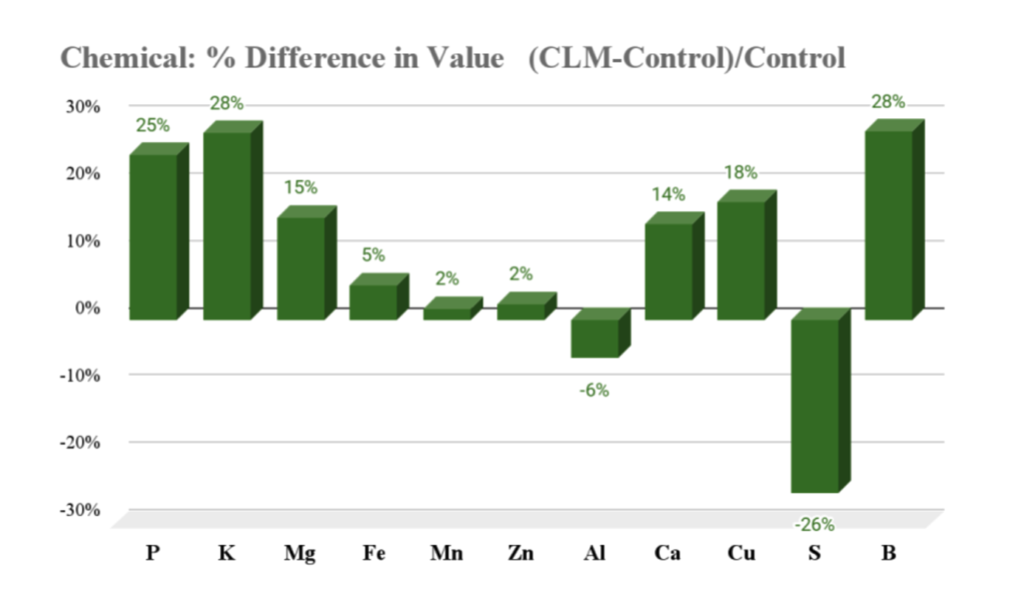
We also saw higher nutrient levels in CLM across almost every nutrient. These increases weren’t as reliable across every farm, but it was still definitely a strong pattern.
Research from Japan has shown that AM fungi help unlock P in CLM, and we found that too. We also found that most critical micros and macros were higher, with one exception: sulfur. Clover needs S to fix nitrogen, so make sure there’s enough to feed your clover and your cash crop. In general, we recommend going into the season after clover establishment with 25-30 ppm sulfur. It’s good to send in a test in spring to make sure everything is available in abundance — you’re growing two things.
The literature refers to the clover/cash crop relationship as competition, but I believe that it exists as a sliding scale between symbiosis and antagonism, and that both can perform better in the presence of the other. I’ve seen it in the field, and I’ve seen it reflected in the world at large. Healthy plants in a situation of abundance get along; they are stronger together, and pests and weeds stay away. Antagonism rears its head when nutrient stress and/or reproductive threats intervene.
Our planet has two blessings: free energy from our Sun and life’s ferocious will to reproduce. The old model sets up a competition between those living things for that solar energy. But we know and we see — we can even feel — that that’s not true. The relationships sustain us. CLM is just one way of moving toward that truth.
Lincoln Fishman has farmed at Sawyer Farm in Worthington, Massachusetts since 2010. He is the director of Momentum Ag (momentumag.org). Learn more about CLM, and get involved in trials, by emailing him at hello@momentumag.org.