
• Home
  • Events

    Upcoming Events

    • Menoken Farm Field Day
    • Eco-Ag Conference
    • View all events →

    Recent Webinars

    • Kyle Richardville
    • David Montgomery
    • Gary Zimmer
    • Taylor Henry
    • Fernando Falomir
    • Megan Neubauer
    • David Knaus
    • View more webinar replays →
  • Bookstore

    Books by Category

    • Soil Health
    • Livestock & Animals
    • Gardening & Homesteading
    • Farm Business
    • Health & Food

    Books by Collection

    • New Releases
    • The Albrecht Volumes
    • Acres U.S.A. Published
    • Eco-Ag Speakers
    • Soil Health Educators

    Books by Level

    • Beginner
    • Intermediate
    • Advanced
    • Kids

    Featured

    • Explore Jon Stika's New Book →
  • Resources

    Continue Learning

    • White Papers
    • Online Courses

    Where to Find Us

    • Acres U.S.A. Podcast
    • YouTube Channel
    Facebook Instagram X-twitter Linkedin
    • Join our Newsletter →
  • Articles

    Articles by Topic

    • News
    • Ecological Farming
    • Livestock
    • Soil Health
    • Opinion

    Articles on Crops

    • Cover Crops
    • Crop Nutrition
    • Disease & Pests
    • Fruits & Nuts
    • Ag Technology

    Magazine Issues

    2026
    • January
    • February
    • March
    • April
    • May
    • June
    • July
    • August
    2025
    • January
    • February
    • March
    • April
    • May
    • June
    • July
    • August
    • September
    • October
    • November
    • December
    2024
    • January
    • February
    • March
    • April
    • May
    • June
    • July
    • August
    • September
    • October
    • November
    • December
    • Explore the archives →
    • Subscribe to the magazine →
  • About

    About Us

    • About Acres U.S.A.
    • Meet Our Team
    • Our History
    • Eco-Ag Achievement Award

    Contact Us

    • 970-392-4464
    • support@acresusa.com

    Acres U.S.A. LLC
    PO Box 351
    Viroqua, WI 54665

    • A New Era of Eco-Ag →
Subscribe
HOME
Events
  • Upcoming Events
  • Menoken Farm Field Day
  • Eco-Ag Conference
View all events
  • Webinars
  • Kyle Richardville
  • David Montgomery
  • Gary Zimmer
  • Taylor Henry
  • Fernando Falomir
  • Megan Neubauer
  • David Knaus
Bookstore
  • Books by Category
  • Soil Health
  • Livestock & Animals
  • Gardening & Homesteading
  • Farm Business
  • Health & Food
  • Books by Collection
  • New Releases
  • The Albrecht Volumes
  • Acres U.S.A. Published
  • Eco-Ag Speakers
  • Soil Health Educators
  • Books by Level
  • Beginner
  • Intermediate
  • Advanced
  • Kids
Resources
  • Continue Learning
  • White Papers
  • Online Courses
  • Where to Find Us
  • Acres U.S.A. Podcast
  • YouTube Channel
Facebook Instagram X-twitter Linkedin
Join our Newsletter
Articles
  • Articles by Topic
  • News
  • Ecological Farming
  • Livestock
  • Soil Health
  • Opinion
  • Articles on Crops
  • Cover Crops
  • Crop Nutrition
  • Disease & Pests
  • Fruits & Nuts
  • Ag Technology
  • Magazine Issues
2026
  • January
  • February
  • March
  • April
  • May
  • June
  • July
  • August
2025
  • January
  • February
  • March
  • April
  • May
  • June
  • July
  • August
  • September
  • October
  • November
  • December
2024
  • January
  • February
  • March
  • April
  • May
  • June
  • July
  • August
  • September
  • October
  • November
  • December
Explore the archives
Subscribe to the magazine
ABOUT
SUBSCRIBE

Full Bale Ahead

Taylor Henry by Taylor Henry
January 20, 2025
0
Home Magazine issues January 2025
5
SHARES
403
VIEWS
Share on FacebookShare on Twitter

Different bale grazing techniques for perennial and annual pastures can help optimize pasture diversity and nutrition

Taylor Henry

As regenerative and ecological agriculture continues to evolve, bale grazing has emerged as a powerful tool for improving soil health and productivity. At our farm, we’ve seen remarkable results from incorporating bale grazing into our systems. This not only enriches the soil with nutrients but also promotes natural reseeding and pasture diversity.  

Bale Grazing on Perennial Pastures

Our approach to bale grazing varies depending on the type of field. For perennial pastures, I like to roll out first-crop grass haybales. These bales often contain a lot of seed heads, making them ideal for overseeding. While the quality of this hay might not be premium, the seeds in the bales contribute significantly to the rejuvenation of the pasture.  

We integrate this practice strategically into our last fall and first spring grazing rotations. The first day, or morning, cattle graze the fresh paddock. The following day, or afternoon, they bale graze, benefiting from the rolled-out hay while trampling seeds into the soil. This method spreads out the nutrients and seeds while maintaining moderate impact to prevent compaction or excessive weed proliferation. What they don’t eat they will use as bedding. The longer rolled-out bales are left unconsumed, the more “waste” there will be.  
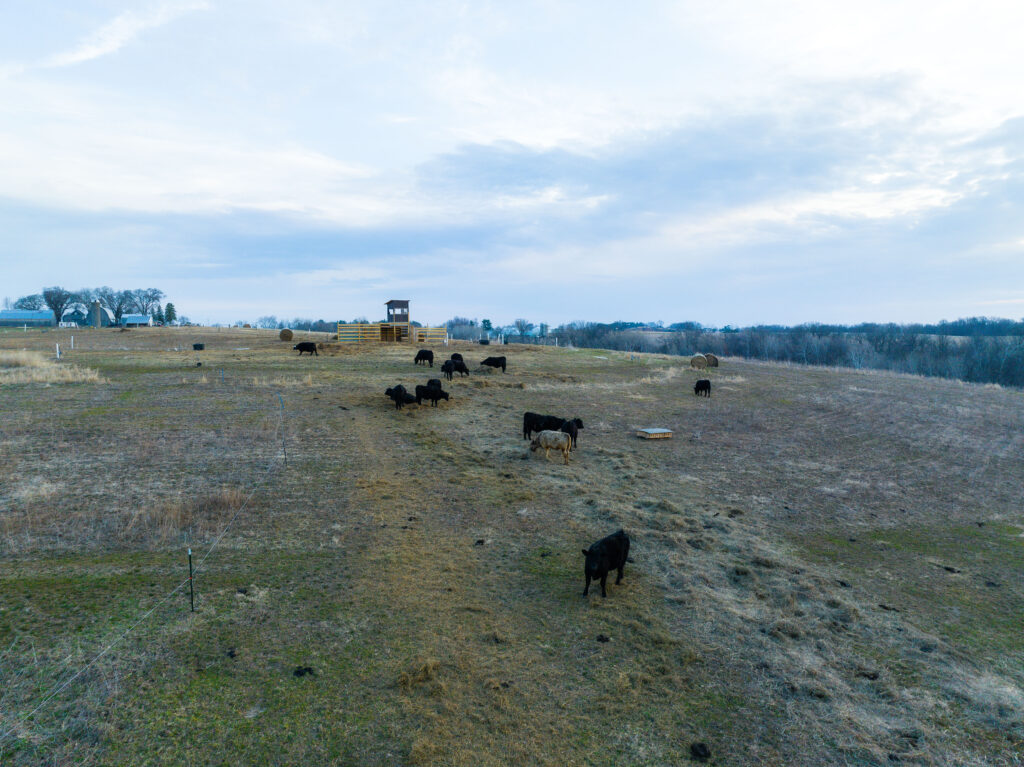
Courtesy of Taylor Henry

First-crop bales also often have fewer thistle seed heads than later cuttings, reducing the risk of introducing undesirable weeds. Over time, I’ve learned to anticipate the types of weeds that might appear by observing the hay before purchase. For example, the timing of oat bales being harvested usually times up with thistles seeding out. 

Traditional Bale Grazing on Annual Cover Crops

In contrast, on annual cover crop fields, we use traditional bale grazing. Here, bales remain stationary, and cattle feed directly from them. This approach concentrates the nutrient deposition, delivering a significant “nutrient dump” in targeted areas. Such concentrated organic matter and manure help restore soil fertility and improve the structure and water-holding capacity of the soil. We then spread out the leftover feed with pitchforks or the tractor in order to avoid the heavy pileup of residue.  

Annual cover crop fields also serve as a buffer for experimenting with heavier cattle impact, knowing that the following crop rotation will address any challenges, such as compaction or weed pressure. We still attempt to stay away from stationary bale grazing until the ground is nice and frozen.   

Bringing Nutrients to the Farm 

One of the most valuable aspects of bale grazing is importing nutrients from other farms onto ours. Every bale of hay represents a bundle of organic material and minerals harvested elsewhere, which we now integrate into our land. This year, favorable hay prices have enabled us to increase the volume of hay we roll out, amplifying the benefits for our soil.  
While rolling out hay may be 10-15 percent less efficient in terms of feed utilization compared to stationary bale grazing, the trade-off is well worth it. The distributed organic matter and nutrients, coupled with the overseeding effect of seed-laden bales, more than compensate for the slight decrease in feed efficiency.  

The Weed Factor: Learning from Experience 

Weeds, particularly thistles, are a common concern when introducing hay into pastures. Through trial and error, I’ve developed a slightly better eye for assessing hay quality (I have a long way to go) and understanding its potential impact on weed populations. 

A heavy impact, such as excessive trampling or overstocking, can exacerbate weed problems. Therefore, keeping the cattle moving and managing impact around the weather are essential for a successful bale grazing system.  

The Payoff: Healthier Pastures, Richer Soil

Bale grazing has significantly enhanced our pastures. We have never fertilized or brought in any other outside amendment, and our soil tests are starting to show the change. (We’re still not up to Gary Zimmer’s standards, though!)

By integrating cattle, hay and thoughtful management, we are mimicking natural processes that build soil fertility and promote pasture biodiversity. Whether rolling out hay on perennial pastures or concentrating nutrients on annual fields, this system aligns with the core principles of regenerative & ecological agriculture: improving soil health, maximizing resource efficiency, and creating a resilient farming ecosystem.  

Bale grazing holds promise as a cost-effective and ecologically sound strategy for improving pasture quality while building healthier soils. With hay prices currently favorable, there’s never been a better time to roll out the bales — and reap the benefits.

Taylor Henry is the owner and CEO of Acres U.S.A.

← Previous LOOK!… a Seed!  Next What Your Corn Eats →
Tags: Bale grazing
Taylor Henry

Taylor Henry

Taylor Henry is a regenerative farmer, land steward, and the owner of Henry Pastures, a multi-species, pasture-based farm in Wisconsin’s Driftless Region. He’s also the CEO and owner of Acres U.S.A., the nation’s leading publisher and educator in regenerative agriculture since 1971. With a background in law enforcement, marketing, and entrepreneurship, Taylor brings a rare blend of grit, vision, and systems thinking to both his farm and the broader agricultural movement.

Next Post

Join the Local Food Revolution: A Celebration of Community and Connection

  • Trending
  • Comments
  • Latest
The Most Important Livestock in Our Fields

The Most Important Livestock in Our Fields

July 1, 2024
Glyphosate Does What It’s Designed to Do — Kill

Glyphosate Does What It’s Designed to Do — Kill

February 19, 2025
USDA organic seal over American farm land

Losing Organic Farms

September 18, 2026
The Take-Half, Leave-Half Fallacy

The Take-Half, Leave-Half Fallacy

July 1, 2025
We Don’t Need Another Bridge — We Need an Off-Ramp

We Don’t Need Another Bridge — We Need an Off-Ramp

3
Under One Roof

Under One Roof

3
A Rose By Any Other Name

A Rose By Any Other Name

2
Terra Preta’s Biological Advantage

Terra Preta’s Biological Advantage

2
Blaming the Wolves

Blaming the Wolves

September 16, 2026
Running Dry

Running Dry

September 10, 2026
What Are Lactating Steers Trying to Tell Us?

What Are Lactating Steers Trying to Tell Us?

September 3, 2026
Remembering Wendell Berry

Remembering Wendell Berry

September 2, 2026

Recent News

Blaming the Wolves

Blaming the Wolves

September 16, 2026
Running Dry

Running Dry

September 10, 2026
What Are Lactating Steers Trying to Tell Us?

What Are Lactating Steers Trying to Tell Us?

September 3, 2026
Remembering Wendell Berry

Remembering Wendell Berry

September 2, 2026

Don't miss an update!

Stay informed on what's new in the Acres U.S.A. community: new articles, upcoming events and resources for regenerative farmers.

Acres U.S.A. is North America’s oldest publisher on production-scale organic and regenerative farming. For more than 50 years, our mission has been to help farmers, ranchers and market gardeners grow food profitably, regeneratively, and with nature in mind.

Facebook Instagram X-twitter Youtube Linkedin Spotify

SHOP

  • Bookstore
  • Online Courses
  • Giftcards

ABOUT

  • About Acres U.S.A.
  • Our Team
  • Eco-Ag Acheivement

LEARN

  • Events
  • Magazine
  • Newsletter
  • Webinars
  • Free Articles
  • Online Courses

Contact Us

Acres U.S.A. LLC
PO Box 351
Viroqua, WI 54665​
info@acresusa.com
970-392-4464
  • Manage My Subscription
  • Advertise with Us
No Result
View All Result
  • HOME
  • ARTICLES
    • News
    • Farm
    • Ecological farming
    • Livestock
    • Crop
      • Crop management practices
      • Cover crops
      • Crop nutrition
      • Crop protection
      • Crops
      • Ag technology
    • Soil
    • Opinion
  • RESOURCES
    • Magazine
    • Online Learning
    • Newsletters
    • Blog
    • Free Articles
  • MAGAZINE ISSUES
    • 2026
      • June 2026
      • May 2026
      • April 2026
      • March 2026
      • February 2026
      • January 2026
    • 2025
      • December 2025
      • November 2025
      • October 2025
      • September 2025
      • August 2025
      • July 2025
      • June 2025
      • May 2025
      • April 2025
      • March 2025
      • February 2025
      • January 2025
    • 2024
      • December 2024
      • November 2024
      • October 2024
      • September 2024
      • August 2024
      • July 2024
      • June 2024
      • May 2024
      • April 2024
      • March 2024
      • February 2024
      • January 2024
    • 2023
      • December 2023
      • November 2023
      • October 2023
      • August 2023
      • July 2023
      • June 2023
      • May 2023
      • April 2023
      • March 2023
      • February 2023
      • January 2023
  • ABOUT US
    • Our History
    • Our Staff
    • Contact Us
    • Community
      • Soil Health Primer Resources
  • EVENTS
    • Eco-Ag Conference
    • Farm Weird
  • SUBSCRIBE
  • Login
  • Sign Up
  • Cart

© 2024 Acers USA Magazine

Lost Password?