

Eco-Farm: An Acres U.S.A. Primer — Lesson 2: The Forgiveness of Nature, Part 1
This is an excerpt from Charles Walters’ Eco-Farm — An Acres U.S.A. Primer, available from the Acres U.S.A. bookstore at bookstore.acresusa.com. Read more excerpts from this book using the category “Eco-Farm” (https://members.acresusa.com/magazine-features/eco-farm/).
Grass is the forgiveness of nature, her constant benediction, wrote old time Kansas Senator John J. Ingalls in his famous paean to blue grass. “Sown by the wind, by the wandering birds, propagated by the subtle horticultural touch of the elements, which are its ministers and its servants, it softens the rude outline of the world. Its tenacious fibers hold the earth in its place and prevent its soluble components from washing into the sea. It invades the solitude of the desert, climbs the inaccessible slopes and forbidden pinnacles of mountains, modifies climates, and determines the history, character and destiny of nations. Unobtrusive and patient, it has immortal vigor and aggressiveness.”
Ingalls was more poet than scientist, yet he correctly saw grass as the most important plant to man. All our breadstuffs—corn, wheat, oats, rye, barley, plus rice and sugar cane—are grasses. So are bamboo shoots on that plate of delicacies in a Polynesian restaurant.
1. Grasses
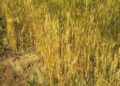
All grasses have stems with solid joints plus two ranked leaves, one at each joint. Leaves have two parts—a sheath that fits around the stem like a tube that has been split, and a blade. Even seed heads have a character all their own. Flowers exist on tiny branchlets, sharing a crowded residence, always paired like the leaves.
Most grasses flower each year. There are exceptions. Some perennials are spread with the aid of underground specialized stems, rhizomes and rootstocks, and fail to flower regularly. Withal, grasses are specialists at simplification.

2. Between the scales of a seed cone blade
Obeying the biblical injunction to increase and multiply is the name of the mandate in nature. Hidden deep in the ovary of the mother flower or between the scales of a seed cone is the ovule. This contains an embryo sac and a tiny egg. The egg must be fertilized by a sperm cell from a pollen tube before it can start to develop into an embryo, and thus perpetuate the parent’s life.

Much like any infant, the embryo needs a special store of food, a formula on which to live after it has become separated from the mother plant. That’s why every seed has its ration of carbohydrates, proteins, fats and minerals. Just what the package contains is programmed by the computers of nature according to the kind of seed. Corn, as might be expected, is heavy in starch. Flax and sunflowers specialize in oils and fats. Peas and beans like protein. Seeds like to hide out their food stores in a diversity of places. Some stash the reserves inside seed leaves. Some place the goodies away in tissues developed from the embryo sac, in the endosperm, or in tissues developed from cells of the ovule that surrounded the embryo sac.
Nature has even programmed a distribution system for seeds. Some travel on the wings of the wind, fitted out with a feathery pappus that serves as both a sail and a parachute. Sticktights attach themselves to animals and hitch a free ride. There are the tumblers, and the passengers in alimentary tracts which are impervious to digestive fluids and gizzard grinding. All seeds need proper temperature vacillation and environment or they won’t grow.

3. A built-in computer
Each seed a farmer deals with comes with a built-in computer. Nature’s programming tells the plant when to sleep, when to wake up, how to translocate nutrients, and how far to go in the food production business. As long as enzyme systems work properly, the seed does what it is supposed to do. It takes trace element keys to activate these enzymes. If the former does anything to upset this fine-tuned computer system, strange abnormalities start appearing in plant, animal and man.
Even so, seed producing plants—or spermatophytes—are merely an end product in a long chain of development. Affected by the process has been not only the reproductive, but also the vegetative structure of plant life.
4. Botany divides
Botany divides the plant kingdom into four divisions, the pecking order being from the simplest to the most complex. The simplest are the algae and fungi in the soil, microscopic plant life that can deliver great benefits and hand out great damage to farm crops. Next are the liverworts and mosses, parasites all, living as symbionts with higher forms of plant life. Above the mosses and liverworts are ferns and fern allies. Highest of all in the evolutionary scale are the seed plants. It is well to have a least a primer knowledge of the plant kingdom before we move on into soil system management, seedbed preparation, tillage, and the grand diversity known as eco-agriculture.
Algae and fungi have sexual reproduction, but the sex organs and spore producing structures are one-celled and very primitive. Almost all algae live in water—in rivers and ponds and in upper layers of soil—and depend on water for function and distribution.

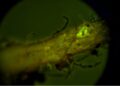
Fungi are classified into too many orders and families for instant comprehension. Yet everyone is familiar with molds common to old bread or rotting oranges, or the growth inside damp logs. Mushrooms are a fungi of a different stripe. Many can be propagated under controlled conditions, and made a profitable delicacy for gourmet tables. Others, kinsmen of toadstools, are quite poisonous. Friendly fungi in the soil are as much a workforce for the farmer as are plant nutrients. Unfriendly fungi—Aspergillus flavus, for instance—are sometimes cancer causers and production robbers. Rhizoctonia is a fungus that causes damping off of seedlings and some older plants. Anthracnose is not only a serious fungus problem for sycamore trees, it is also destructive to beans and commercial plants. Alternaria, a serious blight of tomato plants, is another example of fungus problem. To illustrate the point, here are several fungi.

Not all plants grow in the soil. Some grow on trees, even on telephone wires, or on the scaly surfaces of rocks. Take lichens. Sometimes pale green, sometimes pavement gray, they resemble the worn out hair of an old man’s beard. Sometimes lichens put on their Sunday best and add an orange colored skin to tree branches and rocks. A rootless creation, Spanish moss obtains no nutrients from the surface on which it grows. Several decades ago it was discovered that Spanish moss took its nourishment via leaf and stem, knowledge that was a harbinger of leaf feeding technology now commonly used in eco-farming. Incidentally, it is a mistake to clear Spanish moss off live oak trees as advised by most tree experts. Live oak and Spanish moss go together like ham and eggs. The moss doesn’t harm the tree. It serves as a sponge to soak up rain and store it for later drip irrigation on the roots of the tree, thus keeping it watered over a long period of time.
Liverworts and mosses are land plants. Here the zygote, or fertilized egg, is retained in the female sex organ. There it divides to form a mass of cells. Mosses have sporophytes—that is to say, an asexual or vegetative part of a plant as opposed to the gametophyte, or sexual portion. Scientists define this to mean diploid generation, wherein cells have twice the gametic number of chromosomes. Don’t worry about all this heady stuff now. We’ll touch on just enough of it to make nature’s pattern come clear, then back away and hand off the ball to you for any amount of further study you care to pursue. For now, here are some of the mosses you ought to know about.

Ferns and fern allies represent a big leap forward in the evolutionary process. They have a vessel system. They have plumbing which permits water and nutrients to move rapidly through roots, stems and leaves. Still, they depend on asexual reproduction. When conditions are favorable, small gametophytes—sex cells—are simply disseminated as part of the Creator’s propagation plan.
All the rest are seed plants, either parasitic plants such as dodder and mistletoe, or cycads (symospermous plants that reproduce by means of spermatozoids) and conifers, firs and cedars. The flowering plants are either monocotyledons, monocots for short, or dicotyledons, dicots for short.