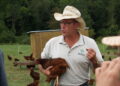
Wendell Berry died in August at the age of 92. His philosophies shaped the organic movement in the 1970s and beyond.
Wendell Berry had a huge influence on the organic farming movement.
I discovered this when I surveyed organic farmers back in 2021 and asked them to list the books and people who influenced them. Maine vegetable grower Eliot Coleman came in first place. And in second place — tied with Rodale Press books and magazines — was Wendell Berry.
Every other author in the top ten wrote practical books about farming methods. But Berry didn’t give instructions on how to grow vegetables in winter like Eliot Coleman or how to raise pastured poultry like Joel Salatin. His books were more philosophical — and they strongly shaped the philosophies of an entire generation of organic farmers.
After Berry died on August 31, 2026, most of the obituaries called him an agrarian philosopher, a poet, a bard, or a novelist. Few of them said much about organic farming, other than mentioning that Berry himself used organic methods on his farm in his younger years. None of them mentioned that Berry was just as influential in the organic movement of the 1970s and beyond as Rodale Press. But he was.
Wendell Berry and Rodale Press
The first mention of Wendell Berry in an organic farming publication was in the April 1971 issue of Organic Gardening and Farming. Jerome Goldstein, a Rodale Press staff writer, included the “organic farmer-poet from Kentucky” in his list of “Adversary Scientists & Agricultural Renegades.”
“Wendell Berry is probably one of the most articulate organic farmers around,” Goldstein wrote. He included several paragraphs of quotes from Berry about the need for “renegade professors” in agricultural colleges who would “attack in print the addiction of the agricultural colleges to chemicals and agribusiness” and do actual research on organic farming.
In February 1972, Bob Rodale reprinted a long letter from Wendell Berry. It was the first Berry writing to be published in Organic Gardening and Farming. The topic? Berry’s new composting outhouse. “The privy is fairly odorless,” Berry wrote. “Whenever there gets to be a smell I add lime, dirt and an extra layer of peat moss.”
The letter was followed up by one from Jim Foote, who described visiting Wendell Berry and using his outhouse. “I was a little taken back when I requested to use the bathroom and was told, ‘No, you may not!’ But I was welcome to use the outhouse,” he reported. “Wendell’s outhouse is a pleasant surprise … This day there was a flower arrangement, and magazines for those who had the time. The interior is bright, airy and clean.”
The next mention of Wendell Berry was in April 1972, where Jerome Olds said that Berry “stresses that cities must start treating their garbage as a resource and relate to agriculture if urban life is to be livable.” In February 1973, the magazine mentioned that Berry was protesting a proposed jetport in Kentucky. That December, Wendell Berry wrote a full-length article, complete with diagrams, about his composting privy.
In 1977, Wendell Berry started writing articles almost every month for Organic Gardening and Farming. When Rodale Press launched The New Farm magazine in 1978, Berry was listed as a contributing editor (along with Gene Logsdon). He contributed articles to nearly every issue up through the beginning of 1981 on topics ranging from “Energy in Agriculture” (November 1979) to “The Native Grasses, and What They Mean” (January 1980) to “Farming in the Andes” (March 1979).
“Wendell Berry and Gene Logsdon have helped to plan the magazine, and have already drawn up long lists of subjects they are anxious to write about,” Bob Rodale said. “The New Farm is giving Wendell and Gene freedom to explore areas of farming they know to be important, but which have been too specialized or commercially oriented to be right for O.G. and F.”
After 1981, Berry didn’t contribute regularly to any magazine. Sadly, he didn’t write much for Acres U.S.A., aside from an occasional interview like the one he did in 2002. His influence in the 1980s and beyond was predominately through his books, especially The Unsettling of America.
Organic Philosophy
While Wendell Berry is mostly remembered as an agrarian philosopher, he did indeed write about organic farming — including in his most influential book, The Unsettling of America. He had a holistic view of agriculture, following in the footsteps of early organic leaders like Ehrenfried Pfeiffer and Sir Albert Howard.
“The soil is the great connector of lives, the source and destination of all,” he wrote. “It is the healer and restorer and resurrector, by which disease passes into health, age into youth, death into life. Without proper care for it we can have no community, because without proper care for it we can have no life.” To be successful, agriculture must treat the soil as a living thing, not as a machine.
His philosophy on health, too, echoes the founders of the organic movement. “The concept of health is rooted in the concept of wholeness,” Berry says. “To be healthy is to be whole.” The soul and the body, the spiritual and the physical, are and must be connected for life and health.
“If all the farms in the country were managed organically, both our people and our land would undoubtedly be healthier and there would be a considerable ramification of the benefits,” he wrote. “And yet the 700- or 900-acre organic farm equipped with up-to-the-minute machine technology cannot be considered the solution to all of our agricultural problems.”
Berry’s agrarian ideal rejected both industrial agriculture and the tendency of environmentalism to focus only on wilderness preservation and pollution control. “We need wilderness,” Berry emphasized. “But we cannot hope—for reasons practical and humane, we cannot even wish—to preserve more than a small portion of the land in wilderness. Most of it we will have to use.” To use without abuse — what Berry called “kindly use” — is at the heart of his agricultural philosophy.
Though Berry understood that the problems of modern agriculture were deep and complicated, he was hopeful that American farmers could learn from successful organic and Amish farmers and break away from their dependence on oil, chemicals, and farm machinery. “For our healing we have on our side one great force: the power of Creation, with good care, with kindly use, to heal itself,” he concluded.
That’s the same force that Bob Rodale called the “R-Force” — regeneration.
Berry’s Contribution to Organic Farming
Wendell Berry’s writings were so influential because they came at a critical point in history. The 1970s were both an exciting and dangerous time for organic farming, as more and more people jumped into the movement for various reasons, unaware of the philosophies and events that inspired organic farming in the first place.
Few of the people who started farming organically in the 1970s knew about Ehrenfried Pfeiffer’s concept of the organic whole. Few had read Sir Albert Howard’s writings on the Law of Return. They were worried about pesticides, pollution, and energy shortages. They knew what they were running away from — destructive technology, unlivable cities, the military-industrial-academic complex — but they weren’t always sure what they should be running toward.
| Read Acres U.S.A.’s 2002 interview with Wendell Berry at members.acresusa.com, or in our collection of interviews, Voices from the Soil. |
By exploring the roots of the agricultural crisis, Wendell Berry helped give the organic and sustainable agriculture movements of the 1980s and 1990s a solid philosophical foundation, one that walked a middle line between the heedless destruction of modern technology and the alluring but ultimately misanthropic environmentalist ideal of a world without humans.
And now it’s up to us to figure out how to adapt and apply that philosophy to the twenty-first century — whether or not we’re blessed with another agrarian philosopher as widely read and respected as Wendell Berry.