
How to rethink the call for summer fallow
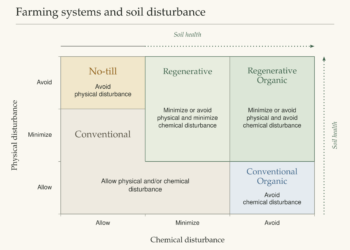
One of the many requests I get from small-grain growers, especially those in wheat-fallow or corn-wheat-fallow systems, is how they can transition to a more regenerative system. How can they reduce their dependence on chemicals, battle fewer weeds, and improve soil health? The best tool I know of is to keep the soil covered with living plants as often as possible.
The practice of fallowing fields is as old as the hills. It is first mentioned in records from ancient Mesopotamia (~1700 B.C.) in a sort of Sumerian “Farmer’s Almanac” as a practice for maintaining fertility by only cropping every other year. Roman farm manuals from the 2nd century B.C. describe a two-field system where a field was cropped one year and fallowed the next, being plowed two or three times to kill weeds — mechanical weed control standing in for what a modern grower would do with a couple of spray passes. These Roman farmers also documented that lupines or beans plowed under as green manure were in some way good for the succeeding crop.
Fast forward to the 1890s American West, where fallowing was reinvented for the arid High Plains. Webster Campbell, a South Dakota homesteader, developed and promoted what became known as the “Campbell System” because he found that continuous cropping simply didn’t work with only 8–20 inches of annual precipitation. This practice would have originally involved deep plowing, followed by maintenance of a surface “dust mulch” to cut evaporation. As we learned in the 1930s, this practice of heavy disturbance wasn’t sustainable, and over time it evolved into our current no-till systems, which rely heavily on chemicals to maintain a fallow field.
Cover crops as a systemized American farm management practice — the kind of thing extension agents told growers to do — really began between 1890 and 1920. Early systems used them almost entirely for fertility (nitrogen and humus) and only secondarily for erosion control, weed suppression, and biodiversity. According to a 1994 USDA Review, “the development and wide-scale use of herbicides and inorganic sources of N during the 1940s moved agriculture away from sod-based or meadow rotations to continuous cropping of row crops.” Cover cropping didn’t fade out gradually so much as get displaced by a specific input-substitution decision, reinforced by the shift toward specialized, capitalized, mechanized operations that don’t fit diversified rotations well.
Why Today?
Today, then, when we know that diversified rotations are not only economically but also environmentally more resilient, why are we still intentionally fallowing? The biggest argument, at least in the arid West, is still a perceived lack of water for back-to-back crops, with lower yields as a strong runner-up. I’d like to dig a little deeper to see if these arguments still hold true.
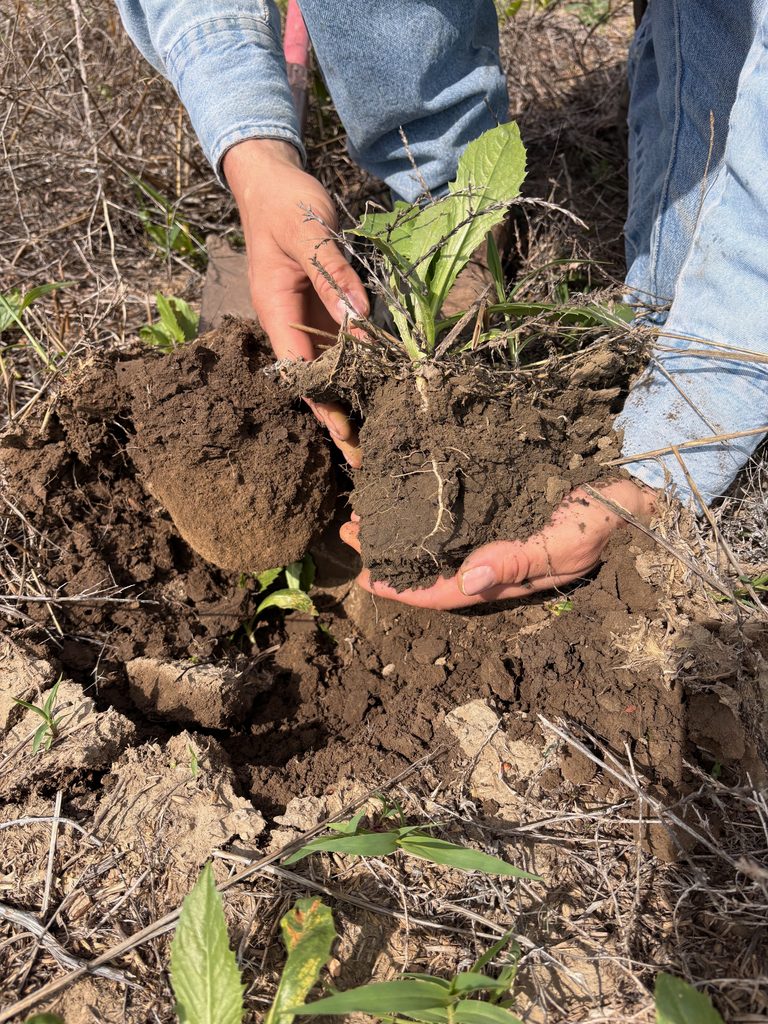
For the growers I work with, and for their fathers and grandfathers before them, that fallowed field was never a mistake — it was the plan. You skip a crop year, let the ground rest, bank the moisture and the nitrogen that mineralizes while nothing is growing, and then cash all of it in with the next wheat crop. That has been standard practice across the semiarid West for longer than most of us have been farming, and I want to be clear that it isn’t irrational; it’s a real trade, and in some places it still pencils out.
But “nothing growing” was never actually nothing. What we were really doing was making a slow trade: banked moisture and a flush of nitrate on one side, and on the other a measurable loss of soil biology, a loss of structure, and — as we repeat that trade, season after season — a loss of options. That last one shows up in the soil carbon numbers: a synthesis across five long-term Great Plains sites (North Dakota, Nebraska, Kansas, Colorado, Texas; 7–28 years each) found continuous no-till cropping in North Dakota increased soil carbon 10.1 percent, while no-till wheat-fallow at the same site declined 13 percent — same tillage, same ground, opposite direction. When we fill that gap with a cover (or even another cash crop!) instead of leaving bare ground, we don’t simply avoid the trade. Done well, we put the gap to work, and what we get back is fewer trips across the field for weed control, a more diverse and resilient soil ecosystem, and fertility built in place instead of trucked in.
What I want to walk through here are the real benefits of keeping the soil covered and how this can work on the ground: which species hold up in low-rainfall conditions, what rotation designs have already been tested across the Great Plains and Intermountain West, and where the case is still stronger on principle than it is in the checkbook.
Mixed Water Messages
Most of the university research on fallow systems shows that there is a precipitation threshold — roughly 27 inches of annual rainfall — below which continuous cropping systems can genuinely struggle to outyield a fallow-included rotation. A Kansas State/USDA-ARS field trial from Garden City, Kansas, found real soil benefits from cover crops — increased organic carbon, reduced wind and water erosion — but the authors warn, “cover crops use water and thus may reduce available water for subsequent crops.”
That threshold is exactly why I can’t tell anyone to just eliminate fallow. It also deserves a caveat: that analysis pooled drylands worldwide, weighted heavily toward subtropical systems with summer-dominant rain and brutal evaporative demand. Growers in the northern and central Plains are working with cold winters, snow capture, and far lower evaporative losses — which is how someone in Montana can farm continuous wheat on a third of that rainfall and stay even. A global breakeven point is a warning worth respecting, not a fence line. It’s also why species selection, sequencing, and timing matter as much as the decision to try continuous cropping at all.
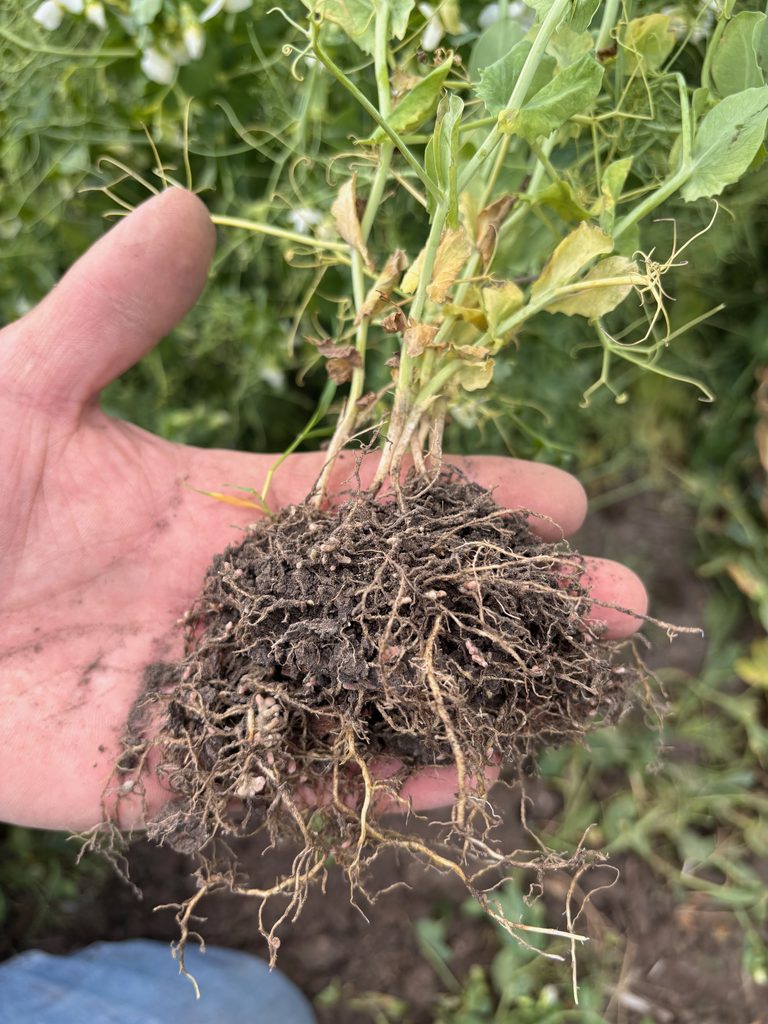
The University of Idaho’s multiyear dryland wheat work found that a late June/early July termination captured 45–50 pounds/acre N in dry zones vs. 70 pounds/acre in wetter zones. In zones with 10–12 inches of precipitation, terminating too early (early June) undershot benefits, but terminating too late (mid-July, pod fill) “used too much water to justify the additional cover crop growth.” A separate Australian dryland trial found proper termination timing increased following-crop yield 12 percent and improved water-use efficiency 10 percent, while late termination (into pod/seed fill) caused a 61 percent yield decline. It’s worth noting that the same study found late termination was actually the best treatment for soil carbon and mycorrhizal fungi — it just cost too much water to be worth it that season. That is the trade in miniature: the biology and the checkbook don’t always point the same direction in a given year.
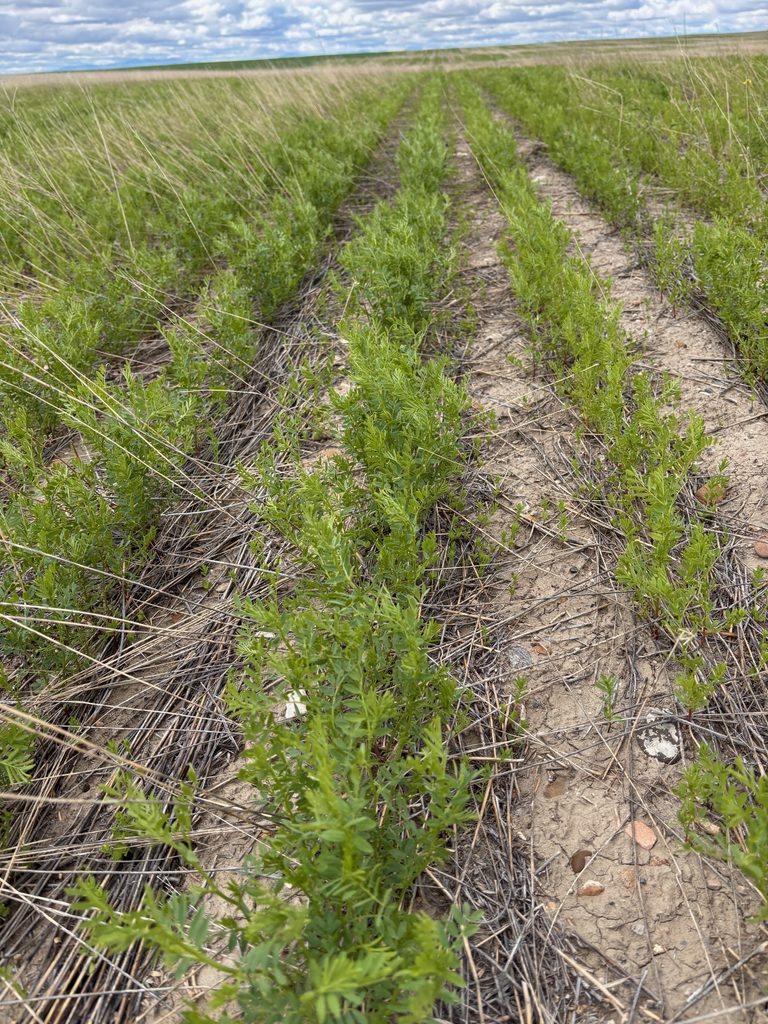
What if the goal isn’t to outyield a fallow rotation? Shawn Preputin in central Montana has been gradually working his family farm away from summer fallow for 10 years. His crop rotation includes wheat (winter and spring), peas, lentils, flax, mustard, and some cover crops. This year’s (continuous-crop) spring wheat yield is close to his average yield following a fallow period, and this is his second year averaging over 40 bushels per acre on continuously cropped winter wheat. If a wheat-fallow grower in his region averages 80 bushels in 2 years, then they are about even, and Shawn’s diverse rotation means that he has other crops to fall back on when there’s a poor wheat year.
Grazing Against the Grain
Grazing is the real lever for incorporating covers into an arid-region rotation. Replacing a fallow season with a cover crop that can be grazed is the best way to make this system pencil out. The 2026 National Cover Crop Report released this fall says that “among producers who grazed their cover crops, 77 percent said it improved their profitability,” and a 10-year USDA-ARS wheat-sorghum-fallow grazing experiment at Bushland, Texas, found grazing added 14–20 percent to total system profitability.
A two-year Kansas State study in Russell County, Kansas, found grain sorghum yield actually held steady or ticked up under grazing, not down. Ungrazed cover crop plots averaged 83 bushels/acre; moderate- and high-grazing-intensity plots both averaged 89 bushels/acre. K-State agronomist Logan Simon makes the case the study was designed to test: “grazing adds another layer of value — it helps make cover crops profitable.”
What if you don’t have a herd and aren’t interested in getting into cattle? In the past decade, temporary fencing has gotten easier to set up and move, and virtual fencing is on the rise. This makes it easier for a neighbor with a herd to graze your covers, and it provides income on a crop that doesn’t have to be sprayed or harvested. When mob grazing is done well, it spreads beneficial biology and fertility evenly across the acres. In three separate recent trials (Nebraska, California, Texas), grazed treatments matched or beat ungrazed-terminated controls on plant-available N and microbial biomass.
Why Mixes Beat Monocultures
In 2006, after Ademir Calegari’s presentation on the importance of cover crop diversity at the No-Till on the Plains conference, Jay Fuhrer and Gabe Brown took this concept home to Bismarck, North Dakota, and started experimenting with multispecies cover crops. That was a particularly dry year, with just 3 inches of rain for the year and only 1 inch in the 60 days after planting, and what they saw astonished them. Where they had single-species plantings, there were burned-up rows of turnips and radishes, and right beside them was a lovely stand of diverse cover crops.
This trial prompted Keith and Brian Berns (founders of Green Cover Seed) to run a similar study in 2008 using moisture-sensing equipment to measure water usage in the soil profile. They planted a variety of single-species covers and two separate mixes side by side with some bare wheat stubble in a field and recorded the moisture through the season. The data showed that the single-species plantings used the moisture that fell and, as they matured, pulled more moisture from the soil profile, but both mixes grew so efficiently that they hardly pulled anything from the soil profile. This is likely due to the kind of belowground resource sharing that doesn’t happen in a monoculture — different species root at different depths and trade through the fungal networks that build up under a diverse stand. Ultimately, the area where the mixes had grown recharged and had no less water available for the subsequent crop than the fallow ground.
Recharging the System
This is an important point in arid environments! No matter your practices, each new season is dependent on a recharge period. In periods of drought, your soil’s ability to capture and retain whatever moisture falls can make or break the following season.
This means that the cover needs to be terminated before your recharge season. While wheat stubble is certainly better than bare soil for water capture, a Texas Rolling Plains study found that once cover crops were terminated, the resulting residue recharged water two to four times faster than bare-fallow plots, given equivalent rain.
Finding a Market
Not everyone has a market for something other than wheat or corn. According to Shawn Preputin, in Havre, Montana, “you can take wheat to the elevator just about any day of the year,” but you may have to do some legwork to find a market for other crops. Fortunately, Shawn has a contract with a local seed dealer for some of his hard red winter wheat, flax, and yellow peas. Growing for seed is a great alternative market, and locally grown seed builds resiliency into farming communities.
Joel Grosbach is a fifth-generation farmer growing dryland and irrigated crops in southwest Nebraska. Since his area often receives less than 10 inches of annual rainfall, incorporating regenerative practices such as cover crops, crop rotation, and animal grazing is critical for water management. Joel has broken out of the conventional grain market by specializing in popcorn and edible dry beans and by growing seed for a neighboring seed business.
Direct-to-consumer markets are gaining popularity and help build security into local food systems. This doesn’t have to mean standing around at the farmers market all weekend to sell a pound of grain or beef at a time. Many of my growers have websites that connect them with folks that want to know that they are not just buying a commodity off the shelf at the store. The Colorado Grain Chain, a member-based nonprofit organization, was developed a few years ago as a bridge in the farm-to-table movement for grains. They connect growers and processors (think millers and malt houses) with end users like bakeries, breweries, and distillers. Pulse crops, specialized forages, and alternative oilseeds like camelina, safflower, and flax are on the rise, so alternative markets are growing.
Filling the Gap
Finding the right crop(s) to add to your rotation depends on your context and will vary from season to season. Think about your goals, and have a plan to achieve them. If fertility is waning, consider adding a cover with legumes. If compaction is a challenge, adding deep-rooted sunflowers as a cash crop can help. According to Keith Berns, the crop choices and seeding densities need to be adjusted to fit the system. You might cut a Midwest cover crop seeding rate by up to 25 percent to account for less precipitation, but don’t go too thin or it won’t do the job.
Some easy additions to diversify an arid grain system are grain sorghum or millet, which are naturally adapted to dryland conditions. In Montana, many growers have been replacing wheat and canola with pulses because they use less water, fertilizer, and fuel. As for covers, a field that would normally be summer fallowed can be planted in early spring to a mix of barley, oats, peas, and flax and terminated in June to provide a cover before fall-planted wheat. Following wheat harvest, a cereal-based rye mix provides something light just to keep the soil in place until spring. And sometimes the better move is to change the cash crop sequence itself — shifting to an earlier-harvested crop opens a planting window instead of forcing a cover into a gap that was never long enough.
Joel Grosbach only plants his covers if he knows there is moisture in the forecast or already in the system to get them established. He says, “If you can get a shot of rain after wheat harvest, you have a good window to get something out of it, and it doesn’t take any water from the subsequent crop.” But that means that this season some of his covers didn’t go in. It’s important to be realistic and to be able to pivot in season.
Using what little water does fall in a dry season to keep soil biology thriving seems far better than letting that water feed weeds that are going to have to be sprayed out. The biggest challenge to implementing these changes is breaking the dogma that it is too dry to add another crop into the rotation.