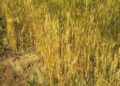


Cereal rye terminated at beer-can height gives northern corn growers a dependable way to capture sunlight, build biomass, and improve soil health between cash crops
In my role as an independent agronomist, I am fortunate to work in a region — northwest Wisconsin — where cover crop adoption existed long before I stepped onto the scene. For years, many row-crop farmers have been planting cereal rye following soybeans in front of the next year’s corn crop, and I’ve had the pleasure of experiencing how these systems function firsthand for half a decade.
Cereal Rye Is a No-No? Hogwash
A little bit about the context up here: we’re north of the 45th parallel, quite literally on the northern boundary of the Corn Belt. We grow 85- to 95-day corn, and our growing season runs May 1 to Oct 1, with a good chance of frost on both ends of those dates.
With such a condensed growing season, our cover crop options are quite limited in traditional corn/soybean rotational systems. Yes, we have some small grain and snap-bean production acres that give operators a much wider, and therefore more creative, cover cropping window. But 95 percent or more of the cover crops in this part of the world are going to be cereal rye following soybeans or corn silage harvest. It doesn’t get planted until late September, in a good year, and as late as November in a challenging year.
There seems to be a perspective in the farming community that cereal rye in front of corn is a big no-no. Hogwash. Cereal rye in front of corn is really the only option we have up here, and because of that, we’ve figured out how to make it work while minimizing the negative impact on the crop.
Those who are adamantly opposed to cereal rye in front of corn could fairly argue that other small grains — oats, barley, or winter wheat — are superior options. Indeed, we can utilize these options here and get some of the benefits of cover cropping. While they may help farmers avoid some of the perceived pitfalls of cereal rye, they also give up the incredible benefits that are unique to rye.
Unpersuasive Concerns
Arguments against rye run the gamut from “allelopathy affects germination” to “it sucks up all the spring moisture” to “it eats all the nitrogen the corn would get.” Every one of these arguments is either non-existent or entirely manageable in our region.
First of all, rye allelopathy has no meaningful impact on corn seed germination or vigor. This is an old wives’ tale rooted in partial truth. Rye is in fact wonderfully allelopathic; it produces three primary chemicals that have incredible inhibitory effects on small-seeded weeds: DIBOA (2,4-dihydroxy-1,4-benzoxazin-3-one), BOA (2-benzoxazolinone), and various phenolic acids. However, when terminated in a timely fashion, there isn’t enough allelopathic chemistry leaching from the rye biomass to have an observable effect on corn seed germination and vigor. One could argue that even in high biomass stands, corn and soybean germination does not appear to be held back.
At-plant seedling moisture availability is crucial to successful seed germination. The perception that cereal rye takes it away from the corn seed is a bit of an overreach in most growing seasons. It is quite rare that early-May soil moisture status is a limiting factor in our region, cereal rye or not. And again, if terminated in a timely fashion, the total quantity of soil moisture consumed by rye is unlikely to be meaningful to the germinating corn crop. In fact, more often than not, soils tend to be too wet to be fit for planting. If the rye can remove some of that moisture, all the better.
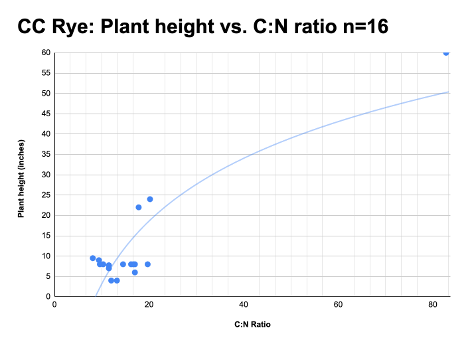
Lastly, nitrogen (and sulfur) sequestration by a cereal rye cover is a legitimate concern; but again, it can be managed effectively. Here’s how: rye termination timing is the most important factor in successfully managing this crop (and the subsequent cash crop). I strongly advocate that the cereal rye be dead or dying by the time it reaches the height of a 16-ounce can (8-10” tall). Why beer-can height? Foremost, it is a height that most can measure with readily available tools (check the box of your truck for cans rolling around). Secondly, a rapidly growing database of cover crop biomass tests shows that at this height, the carbon:nitrogen ratio of this crop remains well below the 20:1 threshold where nitrogen becomes “tied up” in the biomass. With most of the rye at this height coming in closer to a 10:1 ratio, the biomass often melts back into the soil system before the corn crop canopies.
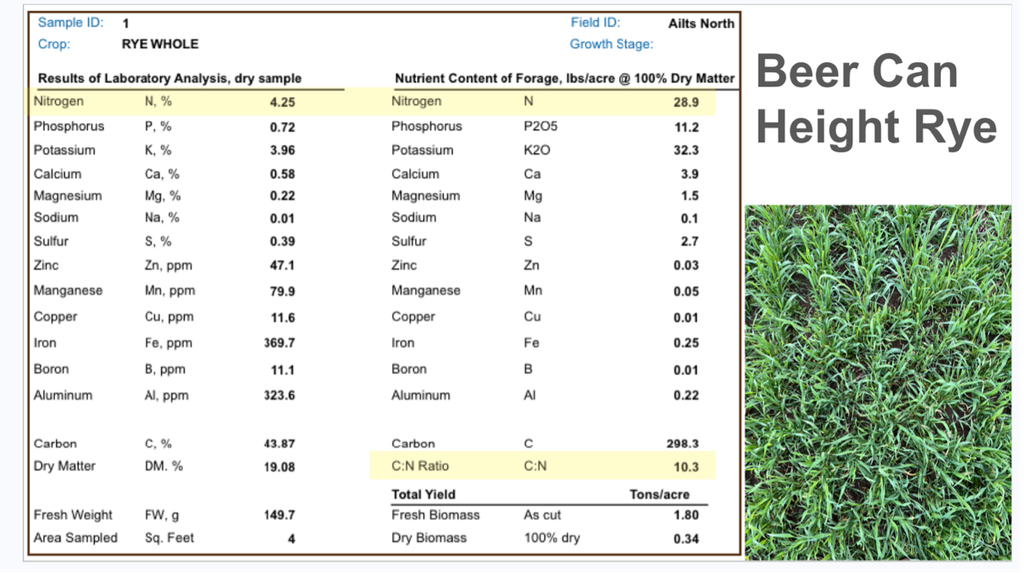
These same biomass tests show that rye at this height sequesters about 30 pounds of nitrogen. Given this reality, many institutions and advisors, myself included, suggest moving 30 units of nitrogen to the “front” of the growing season. Please note that this recommendation is not for 30 additional units to the nitrogen budget, but rather a shift of existing units to compensate for what the rye takes up. You’ll get a portion of what the rye consumes later in the season; how much exactly is a topic of ongoing research.
Making a Fuss for Soil Health
The ideal way to manage the nitrogen aspect of corn into cereal rye is through 2×2 planter placement. Whether the nitrogen is placed 2 inches below the ground and 2 inches off to the side or dribbled over the furrow behind the closing wheels, I’m impartial. The trick is to get the right amount of nitrogen in proximity to early-season root development. Those without the planter setup to row-place nitrogen can use broadcast urea/AMS pre-plant or come in early with a side-dress pass.
Why go through all this fuss? Soil health, that’s why! I do not believe we have a more effective tool to move the needle on soil health, in our region, than cereal rye in front of corn. The reasons are many. Chief among them is that rye is bulletproof when it comes to harsh growing conditions. I’ve seen it broadcast mid-November with zero growth in the fall, producing a beautiful green carpet the following spring. It is always the first species of plant to green up. It’s not uncommon to see green rye emerging through a melting snowpack in late March up here.
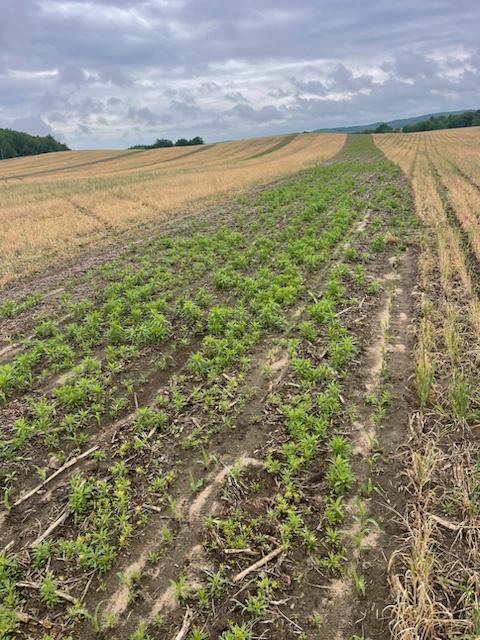
Building carbon, above- and belowground, is the primary default goal for planting cover crops across the board. Sure, erosion control, nutrient sequestration, soil armor, etc. are meaningful goals for planting covers. Yet when it comes to soil health — including system resiliency to crop stress, enhanced soil microbiological activity, increased organic matter, and a host of other factors — the carbon and biomass grown through cereal rye simply cannot be matched in this geography.
The great Jay Fuhrer, creator of the soil health principles, delivered a poignant and succinct line at a soil health field day in Minnesota recently: “Always capture sunlight.”
If we agree about the importance of capturing sunlight and converting that energy into carbon, which then becomes the currency of biological systems that drive crop resiliency and productivity, how does one optimize that in a corn/soy rotation in northern Wisconsin? Cereal rye. It checks all the boxes.