

Researchers found lactation in nearly 20 percent of finished steers; is the cause extreme adiposity, hormonal implants, mammary stimulation, or an interaction that agriculture hasn’t studied yet?
Dr. Ty Lawrence thinks I am looking in the wrong place.
I think hormonal growth implants are an obvious suspect when trying to explain why thousands of castrated male cattle were found producing milk at slaughter. Dr. Lawrence, a meat scientist at West Texas A&M University who oversees the research, doesn’t. His working hypothesis is that modern fed cattle have become so extraordinarily fat that their own adipose tissue is altering their endocrine environment enough to help trigger lactation.
We have spent hours talking and exchanging emails about it. I keep pushing him on implants. He keeps pushing me back toward fat. The interesting thing is that neither of us can yet prove our explanation.
Since I first began reporting this story, another possibility has emerged. A large dairy producer told me he has watched open heifers — females that were not bred — begin producing milk after being repeatedly sucked by other cattle. Then I found a 2025 peer-reviewed study reporting that some commercial beef-on-dairy calf ranches administered implants during the pre-weaning period.
Suddenly I wasn’t asking whether it was fat or implants anymore, but whether we are making the classic mistake of looking for a single cause in an animal that has experienced multiple biological interventions throughout its life.
How I Got Here
For readers who didn’t see my original online Acres U.S.A. article, this investigation began almost accidentally in North Dakota. After I spoke at an event at the Theodore Roosevelt Presidential Library, a man approached me and mentioned that a surprising percentage of steers were lactating when they reached slaughter.
I raise cattle and milk cows and was raised on forage-finished beef. I had never seen a steer lactate. When he told me the number was approaching 20 percent, I assumed he had misunderstood something. Then he showed me a photograph of a research poster.
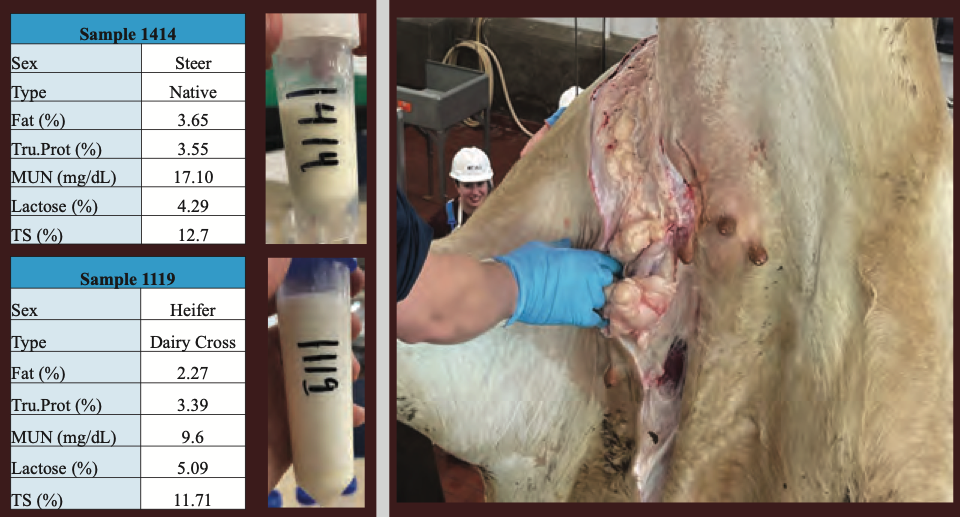
The research was real. Researchers associated with West Texas A&M University and Cargill evaluated 20,481 finished cattle originating from 33 feedlots. Of those animals, 6,078 were lactating. Lactation was observed in 28.77 percent of native heifers and 55.81 percent of dairy-cross heifers.
But what was shocking was the steer numbers: among native beef steers, 14.55 percent were lactating. Among dairy-cross steers, it was 19.66 percent.
The researchers were not simply looking at developed mammary tissue. An animal was considered lactating when manually stripping the teat produced a visible stream of mammary secretion. Samples contained components consistent with milk, including lactose and casein.

My immediate suspicion was hormonal growth implants — partly because I don’t use them and had never seen the phenomenon. I started calling producers and processors outside the conventional feedlot system. A.J. Richards of From the Farm, who formerly ran a slaughterhouse floor, couldn’t remember seeing it. People associated with smaller slaughter facilities couldn’t remember it. Will Harris of White Oak Pastures, who processes substantial numbers of his own cattle, hadn’t seen it either.
Those observations aren’t a control group — different cattle populations are involved, and nobody had been systematically looking — but the contrast made me want an actual comparison.
Hormones, Mammary Tissue, and an Obvious Question
Commercial growth implants can contain compounds including estradiol, trenbolone acetate, and zeranol. They work because they alter physiology, improving growth and feed efficiency. Those benefits are economically meaningful to producers. But mammary tissue is also hormonally responsive.
Scientists have intentionally induced lactation in nonpregnant cattle for decades. Experimental protocols involving estradiol and progesterone have produced mammary development and lactation without pregnancy. A separate controlled experiment examined mammary development in beef heifers treated with estradiol, trenbolone acetate, zeranol, and combinations of these compounds, with some estrogenic treatments producing measurable mammary changes.
None of that proves conventional growth implants are causing steers to lactate. The protocols, doses, and purposes are different.
There is also an interesting human parallel. Published medical literature documents induced lactation in transgender women — biological males who have not experienced pregnancy — using protocols that can include estradiol, progesterone, prolactin-promoting medication, and repeated breast stimulation or pumping.
Again, a human induced-lactation protocol is obviously not equivalent to a cattle growth implant. But it demonstrates an important biological principle: Pregnancy is not always required for lactation when hormonal priming and mechanical stimulation converge. That principle has become especially interesting as this cattle story has gotten more complicated.
Dr. Lawrence Thinks It’s Fat
Dr. Lawrence believes the primary culprit is extreme adiposity. His proposed pathway begins with adrenal androstenedione. Aromatase activity in adipose tissue converts it to estrone. Estrone then interacts with estrogen receptors in pituitary lactotrophs, increasing prolactin synthesis; circulating prolactin can then activate mammary epithelial milk production.
He believes the phenomenon may begin emerging somewhere around 30 to 35 percent empty-body fat. He also points out that dairy and dairy-cross animals can carry considerable internal omental, mesenteric, and perinephric fat without necessarily looking as externally fat as conventional beef cattle.
This is important: Dr. Lawrence explicitly describes this as a hypothesis requiring experimental testing. The original commercial audit did not measure the entire hormonal pathway he proposes. The researchers also did not have the individual implant histories of the cattle. Dr. Lawrence assumes essentially all had been implanted because that is standard commercial practice. That means there was no verified never-implanted control population.
To me, that remains a giant variable in the room. If virtually every animal receives an endocrine-active treatment, a study of that population cannot tell us whether the treatment contributes to the phenomenon. It doesn’t prove implants caused the lactation, but it doesn’t exclude them either.
Dr. Lawrence has tried to obtain funding to investigate the phenomenon further and told me he intends to try again. I hope he succeeds.
How Early Does Hormonal Exposure Begin?
Initially I thought the implant question was relatively simple: Compare implanted feedlot cattle with cattle that never received implants.
Then I began investigating FDA production classifications and realized that “implanted” is itself an inadequate category. What might matter biologically is age at first exposure, compounds, dose, release duration, number of exposures, developmental stage, and time between treatments and slaughter.
Depending upon the animal and production pathway, a legally permissible implant history can potentially span multiple stages of life. Certain approved implants can be administered to qualifying nursing beef calves beginning well before puberty. Animals may subsequently receive another implant after entering a different production phase, followed by implant exposure during confined finishing; some finishing programs specifically allow reimplantation.
Then I found something I hadn’t understood about beef-on-dairy cattle. A 2025 peer-reviewed study surveyed 15 commercial beef-on-dairy calf ranches. All received calves when they were less than four days old. Nearly all were fed milk replacer, and weaning occurred between 42 and 72 days. Most interestingly for this investigation, some participating operations reported administering an implant during the pre-weaning period.

We don’t yet know from the published paper which implant was used, the precise age at implantation, the hormones or doses, or the regulatory classification under which those animals were treated. Those questions need answers.
But it means the relevant scientific question may not simply be whether an animal had an implant before slaughter. In at least some beef-on-dairy production systems, endocrine-active intervention may begin while a calf is still milk-fed.
Then Derrick Josi Gave Me Another Possibility
Derrick Josi, a large Pacific Northwest dairy producer, told me he has seen open heifers — females that were not bred — begin producing milk after other cattle repeatedly sucked them.
Artificially reared calves are known to cross-suck, sometimes directing the behavior toward the udder or scrotal region of other animals. Josi wondered whether beef-on-dairy animals destined for slaughter might receive less intervention to prevent cross-sucking than dairy replacements because future teat function has little economic value in an animal destined for beef.
That remains an untested hypothesis. But my own cattle make me unwilling to assume suckling behavior necessarily disappears with weaning. I currently have a 2½-year-old bull who still attempts to suck his mother.
Mechanical stimulation matters because suckling participates in the neuroendocrine regulation of lactation, including prolactin and oxytocin pathways. This does not establish that cross-sucking causes lactation in steers. It raises a different possibility: Could repeated stimulation act on mammary tissue already primed by another mechanism?
Now the human induced-lactation comparison becomes more interesting. In those protocols, hormonal priming and repeated mechanical stimulation aren’t competing explanations. They work together. Maybe we should at least ask whether something analogous — not identical — could be occurring in cattle.
There Are No Monocausal Explanations
This investigation has made me think about how our biases shape scientific questions.
I am generally skeptical of pharmaceutical interventions in agriculture, so I looked at endocrine-active implants and thought: There is my suspect. Dr. Lawrence has spent his career studying meat science and commercial cattle production. He sees increasingly fat cattle and a plausible endogenous estrogen pathway. Josi is a dairy producer. He thought about suckling and mammary stimulation.
Each of us noticed what our experience trained us to notice — but the animal doesn’t experience variables one at a time. A commercial steer may be castrated, may receive hormonal growth promotants beginning young and again during later production phases, may consume increasingly energy-dense feed, may accumulate extraordinary quantities of fat, and may perhaps experience repeated cross-sucking. Genetics and diet may matter. Agricultural chemicals or other environmental exposures could matter — or prove completely irrelevant.
None of those possibilities currently has enough evidence to declare it the answer. We need more research.
Experiments could compare native beef and dairy-cross genetics, implanted and verified never-implanted cattle, and different objectively measured levels of adiposity. Researchers could record lifetime implant histories and age at first exposure. They could measure estrone, estradiol, prolactin, and relevant implant metabolites, observe cross-sucking, and examine mammary tissue and actual secretion.
If equally fat never-implanted and implanted cattle lactate at the same rate, my implant hypothesis takes a serious hit. If they don’t, the implant question becomes harder to dismiss. If mechanical stimulation changes the outcome, we learn something else. That is the study I want to see.
What If Dr. Lawrence Is Right?
There is another reason I cannot dismiss this story even if my original hypothesis turns out to be wrong. Suppose implants have nothing to do with it. Suppose Dr. Lawrence demonstrates that extreme adiposity alone is enough. Would that actually be reassuring?
It would mean we have become so successful at manipulating genetics, nutrition, castration, and finishing that we can push cattle to a level of adiposity where their own endocrine environment changes enough to activate milk production in castrated males.
Dr. Lawrence himself considers lactation an inefficiency. Energy going into milk is energy no longer going where the producer intended. Perhaps we have crossed the biological optimum while still hitting the economic measurements we reward.
Our Differences Need to Mean Something
Dr. Lawrence points out that American producers are creating extraordinarily consistent, highly marbled beef. Prime cattle are far more common than they once were, while relatively few cattle fall into lower quality grades. To many consumers, that is quality.
Regenerative and organic producers are offering another definition of quality. How was the animal raised? What did it eat? Was it harvesting diverse living plants? Did it receive hormonal growth promotants? Was it confined? How long did it take to finish?
Research has identified nutritional differences between fully grassfed and grass-finished beef and conventionally grain-finished beef, particularly in fatty-acid profiles and some micronutrients. Research also increasingly suggests that the diversity of plants animals consume can influence phytochemicals and other compounds ultimately found in meat.
Our production differences shouldn’t disappear behind vague labels. If you don’t use hormonal growth implants, explain that to customers. If cattle harvest diverse forage, explain why that matters. If they take longer to finish, explain the tradeoff. Consumers cannot reward a different agricultural system if we don’t explain what is actually different about it.
Virality Isn’t Investigation
This story went viral. Millions of views accumulated across videos, memes, and social-media posts, often accompanied by some version of “Another crazy thing they’re doing to our food.”
I understand the reaction, but virality isn’t investigation. If regenerative agriculture is going to offer something better than another ideological tribe, we have to be willing to discover that our preferred explanation is wrong. Dr. Lawrence has been extraordinarily generous with his time even though I continue challenging his hypothesis. I respect that, and I hope his research gets funded.
I also want agriculture to keep asking the questions his current hypothesis doesn’t answer. Lactation in nearly 15 percent of native steers and almost 20 percent of dairy-cross steers is a biological signal worth understanding. Whether the lever is adiposity, hormonal implants, castration, mechanical stimulation, genetics, diet, agricultural chemicals, environmental exposures, time — or some interaction among several factors — we should be curious enough to investigate rather than redefine an unexpected outcome as normal simply because it turns out to be common.
There is a larger question underneath all of this: What are we actually trying to optimize? Efficiency matters — farmers need to make money. Feed conversion, growth, consistency, and carcass quality matter. A farming philosophy that bankrupts the farmer cannot survive.
But agriculture should be capable of a better equation: a win for the farmer, a win for the consumer, and a win for the animal. The farmer should be able to build a viable business producing food. The consumer should receive nutrient-dense, delicious food from a system they understand well enough to choose. And the animal should be allowed to express as much of its natural biology as reasonably possible while living a life worth living.
Maybe we’ll discover that lactating steers are harmless. Maybe implants have nothing to do with it. Maybe Dr. Lawrence will prove that extremely fat never-implanted cattle do exactly the same thing. But even then, the animals may be telling us something our measurements of efficiency have missed. The best agriculture should not require us to choose between the prosperity of the farmer, the health and trust of the consumer, and the biological integrity of the animal.
The goal should be a system in which all three can win. The farmer gets a vote. The consumer gets a vote. And the animal still gets a vote.