

Fungi spend their winters humifying the soil and producing nutrients for plants to use in the spring — yet growers often ignore this crucial time period
With today’s ever-increasing input prices, farmers are becoming more conscientious and more deliberate about where they can cut costs. When finances become tight, the first things to get cut are those that are perceived to be the “extras.” This often means that microbial inoculants and biostimulants get cut out. But that ends up hurting the grower — not just in the long term, but even in the short term.
Something that is not fully appreciated is how we can increase nutrient availability naturally in the soil over the winter months with microbial activity. This can be a big driver of economic performance.
Take forage production as an example. The traditional expectation is that the first cutting in the spring is going to yield the most biomass per acre. That is true historically because of two factors. One is water availability. We often have abundant rainfall early in the spring. And the second, which isn’t fully appreciated, is that we often have an abundance of available nutrition in the spring. We have a large amount of very bioavailable nutrients in the soil that were released from soil biology over the winter months. This is why in some growing seasons, in parts of the country that are blessed with generous rainfall later into the summer, the second and third cuttings still don’t approach equivalent yield in overall tonnage as the first cutting. This isn’t because of an abundance of moisture or lack thereof; it’s because of the differences in nutrient availability in spring versus later in summer.
Higher levels of nutrients in the spring are an expression of soil biology. And this fall-to-spring development can happen immediately — in the first year. You can have very compromised soils with poor biologic activity, with very low levels of organic matter, and you can achieve these types of nutrient releases. In dormant soils in the northern hemisphere, there isn’t a lot of plant growth during the winter months. There’s not an extraction of nutrients. Yet the biology never entirely shuts down in soil during the winter months — not even when the soil is completely frozen. It slows down, but it never entirely stops. Many of us don’t appreciate the degree to which soil biology can release nutrients if it is given the winter season to do so.
Winter Dynamics
Many people over the years have used a fall soil primer program in the spring instead of in the fall — perhaps because their economics were challenged in the autumn and they had more flexibility in the spring. And that has worked for these growers — it’s been quite effective — but the economic impact and the degree of nutrient release is not the same in the spring as when such an application occurs in the fall.
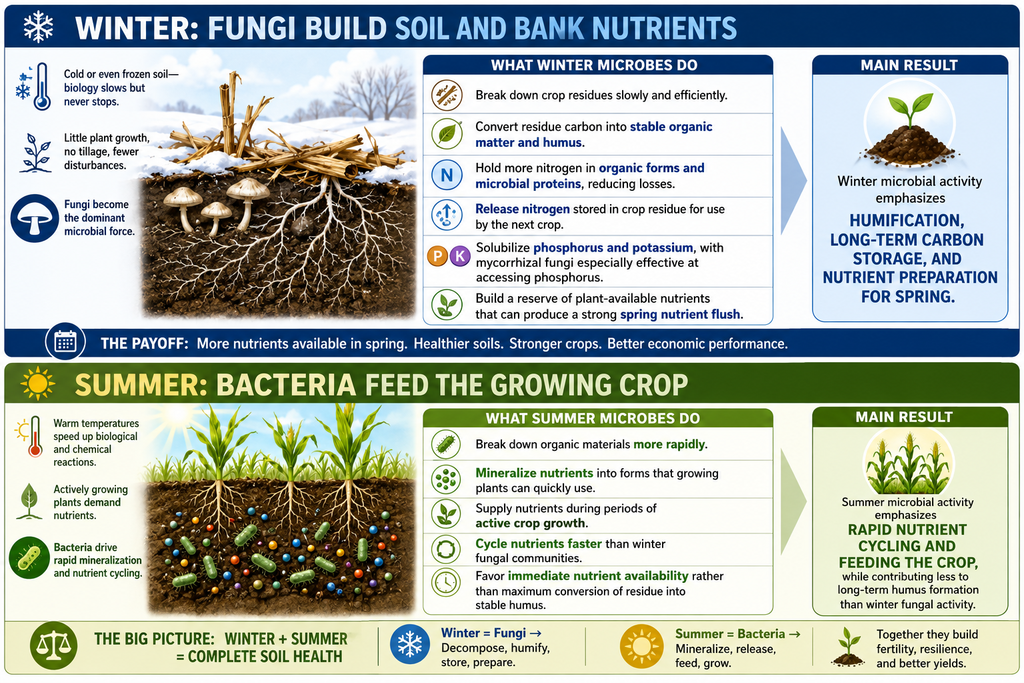
During the winter months, we have no tillage or herbicide interference. We also have more fungal activity from crop residue breakdown and the humification process than we do when we put on these applications in the spring. Consider the residue from a corn crop. Let’s say there are a hundred units of nitrogen contained in that corn crop. If that corn residue isn’t treated and is just left to decompose naturally, a lot of that carbon is going to volatilize into the atmosphere. If you have Bt corn that has very hard stalks with a lot of lignin, that process can take a couple of years. Yet with a little bit of stimulation from biology, greater than 80 percent of the nitrogen that’s in that corn residue can be released and can become available for the crop by the following spring. All of a sudden, soil that might have had 20 or 40 or 50 pounds of nitrogen now has 80 to 100 pounds.
Think about what the soils look like in Alberta or Saskatchewan versus in New Mexico or Arizona. When you have biology working on crop residues in cold soils, all of the chemical reactions slow down and the biology slows down. In that environment, fungal activity becomes dominant. And since you primarily have fungal digestion in cooler soils, this leads to more humification. The carbon in crop residues converts to stable organic matter — to humus. This is why soils farther north — or, more accurately, in colder climates — turn black. They get this black humus buildup much more readily than farther south.
Soils in warmer zones tend to be more reddish. Even when they build up higher levels of organic matter — 3 to 4 percent organic matter or higher — those soils don’t become black. The organic matter fraction that gets built stays more of the golden amber honey color than it does dark black. This parallels the difference in humic acids versus fulvic acids. Or, if you are familiar with raw materials of mined lignite — formerly called leonardite — the ore that comes out of Alberta, it’s as black as midnight, but the ore that comes out of the ground farther south is this golden amber honey color. That is an expression of temperature.

The most effective conversion of crop residues into long-term stable carbon, and that which facilitates the greatest amount of nutrient release, occurs during the winter, not during the summer. This is why biological activity during the winter months is so important. During the summer you get much more rapid mineralization through bacteria. You need this to provide nutrients to the growing crop. If you are only applying biological inoculant in the spring and not in the fall, you can still grow impressive crops, but you won’t build soil as rapidly.
Nutrients Released
When nitrogen from organic residue gets converted in the fall, because the microbial breakdown process is slower, more of that nitrogen will be held as organic nitrogen and microbial proteins. Crops that are both the healthiest and the highest yielding get about 20 percent of their total nitrogen from nitrate and the remainder from ammonium and microbial proteins. In order for that to happen, you have to have some nitrogen metabolism happening during the winter months.
We should be thinking about nitrate more from a plant hormonal perspective than from a nutrition perspective. Nitrate shouldn’t be used to drive vegetative growth, but it does trigger a hormonal response that drives vegetation, which can then be supplied with protein nitrogen.
In terms of phosphorus, most agricultural soils already contain adequate or abundant levels, particularly if there have been phosphorus applications historically. Yet it takes time for biology to extract phosphorus. We get the best response if we do biological applications in the fall rather than in the spring. The same is true of potassium. This is because fungi are much better at solubilizing phosphorus than bacteria. There are some phosphorus-solubilizing bacteria, but they are not nearly as effective as mycorrhizal fungi working during the winter months.
On- vs. Off-Farm Microbes
This process should occur naturally, and it does, but on many soils the microbial activity isn’t significant enough to achieve quorum sensing, and if it doesn’t achieve the quorum sensing status, then it doesn’t produce the desired response.
We’ve found very different responses from on-farm microbes and off-farm microbes. I was recently having a conversation with farmers who have been using compost extracts and compost tea, and they have observed that about 60 percent of the time they get significant improvements in root size and root development in the first month or two following germination on small grains and on wheat and soybeans. But that hasn’t translated effectively into yield differences. This has been our observation as well.
This is because the compost teas and the extracts farmers are producing often don’t have the presence of certain species to facilitate quorum sensing. I’m not saying anything negative about the quality of the product that they’re producing — I think many growers are producing a very high-quality product. But the challenge is that the fungi and bacteria necessary to establish a quorum sensing community are only propagated in the presence of living root systems. This doesn’t happen in your typical compost pile.
The fall soil primer is of critical importance when we’re trying to elevate soil biological activity in the absence of abundant plant growth in the northern hemisphere. While the plants are dormant — while there is very limited or no photosynthesis, and no sugar is going to the root system — this is the time when the microbial community can leapfrog ahead and give you a flush of nutrients and a buildup of organic matter. It also delivers very strong results from an economic perspective.
This, to me, is the heart and the promise of being able to most effectively reduce nutrients.