

More Crop Per Drop
Advanced technology can help farmers get to the root of a growing problem — overwatering in an era of increasing drought and water scarcity. A new UC Riverside system, detailed in the journal Computer and Electronics in Agriculture, can map soil moisture tree by tree, so growers water only where and when it’s needed.
Some growers rely on soil moisture sensors buried in the ground to determine when to irrigate. These sensors are expensive and are typically installed in only a few locations, leaving growers to guess how conditions vary across hundreds or thousands of trees. Even when sprinkler systems deliver the same amount of water throughout an orchard, the soil moisture and its availability to trees can vary greatly from spot to spot within a single field.
One reason is soil texture. Fine soils packed with tiny particles hold water tightly because they have more surface area where water can cling. Sandy soils contain larger particles and fewer small ones, which allows water to drain more quickly. These differences can leave neighboring trees experiencing very different conditions.
The new system replaces limited sensor data and guesswork with detailed maps. A robot moves through an orchard measuring electrical conductivity. These readings, combined with data from the fixed moisture sensors already in the ground, allow researchers to build a statistical model that predicts water content across the entire field.
Electrical conductivity indicates how easily electricity moves through the soil and is influenced by factors including moisture as well as salt and clay content. By pairing those measurements with direct water readings from buried sensors, the system can translate conductivity into accurate estimates of soil moisture. The result is a tree-by-tree picture of water distribution.
Maintaining the right moisture level is important for plant health. Trees that receive too little water become stressed and more vulnerable to pests and disease. Too much water, however, can deprive roots of oxygen as soil pores fill with water rather than air.
The technology may also reduce fertilizer pollution. When fields are overwatered, nutrients applied to crops can wash below the root zone and into groundwater, polluting it.
Natural, Biodegradable Rinse Removes Pesticides and Extends Produce Shelf Life
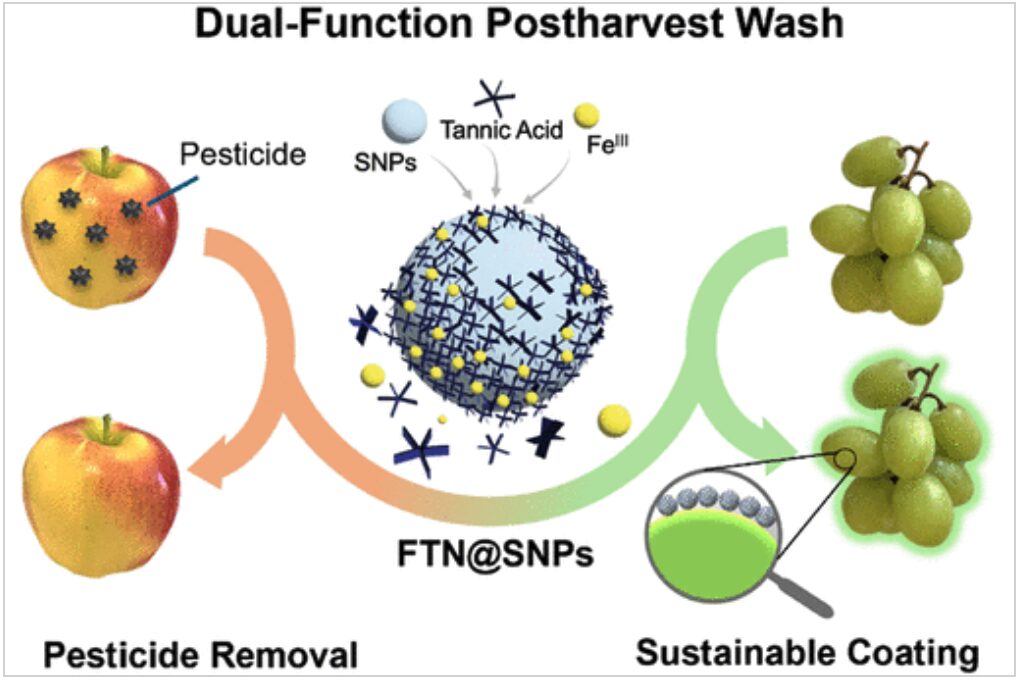
University of British Columbia researchers have developed a natural, biodegradable wash that removes up to 96 percent of pesticide residue from fruit and also slows browning and moisture loss. This could mean safer apples, grapes, and other fruit that stays fresh and crisp for days longer. The findings were published in ACS Nano.
While pesticide levels on fruits and vegetables are tightly regulated, trace residues often remain. For people who eat a lot of the same fruit or vegetables, the amount of residue can go over recommended limits.
The new wash uses tiny particles made from starch — the same carbohydrate found in corn and potatoes — capped in iron and tannic acid. Tannic acid is a plant compound that gives tea and wine their dry taste. When iron and tannic acid join together, they form sticky, sponge-like clusters that can grab onto pesticides and lift them off the fruit’s surface.
The team tested the wash by applying three commonly used pesticides to apples at typical, real-world concentrations of about 10 milligrams per liter. In tests on apples, the wash removed between 86 and 96 percent of these pesticides. Rinsing with tap water, baking soda or plain starch typically removes less than half.
After washing, the fruit can be dipped in the solution once again to form a light edible, biodegradable layer. Fresh-cut apples treated with the coating browned much more slowly and lost less water over two days in the fridge. Whole grapes stayed plump for 15 days at room temperature, compared with noticeable shriveling in untreated grapes. The coating also showed antimicrobial effects.
The study estimated that washing a medium apple in the solution would introduce a safe amount of iron, well below the daily upper limit for adults set by North American food authorities.
Because the ingredients are inexpensive and are mixed using water, the researchers say the wash could be scaled easily for industry use. The team is now working on refining, scaling and testing the formula for use in commercial processing facilities, where fruit is cleaned before shipping. They estimate the coating would add roughly $0.03 per apple — about the same as current commercial coatings.
While reducing consumed pesticides is a win, the tradeoff is the moral hazard — less need for conventional growers to reduce pesticides, which will still have negative ecological effects.

New Framework for Tracing Plant Water Use Could Improve Drought Resilience Prediction
For decades, scientists have relied on a chemical fingerprint inside water molecules to determine where plants get their moisture. The method shaped our understanding of drought resilience, groundwater use, and ecosystem survival.
But there was a problem: the fingerprints didn’t always match. Around the world, researchers reported subtle yet persistent mismatches between the water inside plants and the water in surrounding soils. The discrepancy, known as a hydrogen isotope offset, raised uncomfortable questions about whether the technique itself could be trusted.
A team of three researchers at Oregon State University believes the mystery may have a surprisingly simple explanation, one that could reshape how scientists assess plant survival, food security, and water resource management.
Unfortunately for scientists, plants don’t tell us where they get their water. To understand this, scientists use a technique based on stable isotopes, which are naturally occurring, slightly heavier versions of hydrogen and oxygen atoms. Water from diverse sources, like rain, shallow soil, or deep groundwater, contains slightly different proportions of stable isotopes. These tiny differences in weight act as chemical “fingerprints,” or water’s version of “accents.” By comparing the isotopic fingerprint of water inside a plant to the fingerprints of possible water sources, researchers can determine which source the plant is using. In this way, isotopes allow scientists to trace water’s path without adding any dyes or disturbing the ecosystem.
For decades, scientists assumed that when plants absorb water, the isotopic fingerprint remains unchanged. However, in recent years, this narrative has begun to shift as researchers have discovered puzzling mismatches between the chemical fingerprint of water inside plants and that of water in surrounding soils. These hydrogen isotope offsets led some scientists to question whether plants were altering water’s signature, or whether soils held isolated pools beyond root access.
However, the researchers argue that the explanation is simpler: researchers have been comparing mixed water pools.
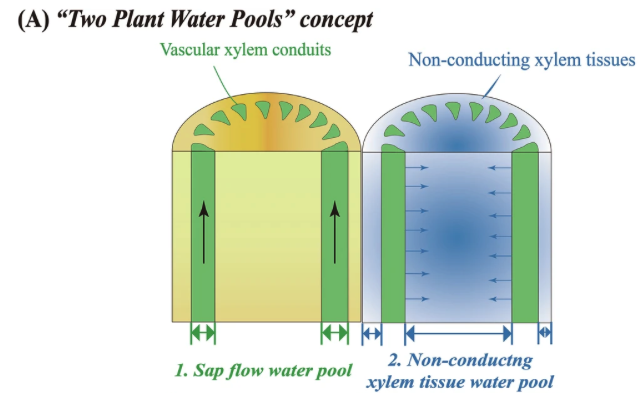
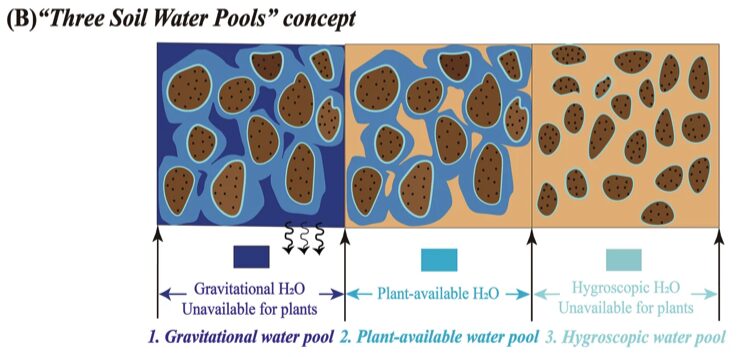
Soil contains multiple types of water, and plants draw from only one of them. Inside stems, actively flowing sap differs from stored tissue water. When the team reanalyzed global data using only plant-available soil water and sap flow water, the offsets vanished. The problem, they suggest, wasn’t the plants — it was the sampling.
Instead of mixing water types, they propose dividing soil water into three pools — gravitational, plant-available and hygroscopic — and plant water into two: sap flow and non-conducting tissue water. By distinguishing among these pools, the misaligned data came together.
The implications of this discovery extend far beyond resolving a technical debate. Stable isotopes underpin decades of ecohydrological research. If scientists have been comparing the wrong water pools, it could mean that some long-held assumptions about how plants survive heat and water stress need to be revisited.
More importantly, by clarifying how to properly isolate plant-available soil water and sap flow water, the framework offers a path toward more precise measurements, enabling sharper predictions of agricultural security and water availability in a warming climate.
Frequent Prescribed Burns Help Young Oaks Thrive Despite Invasive Grasses
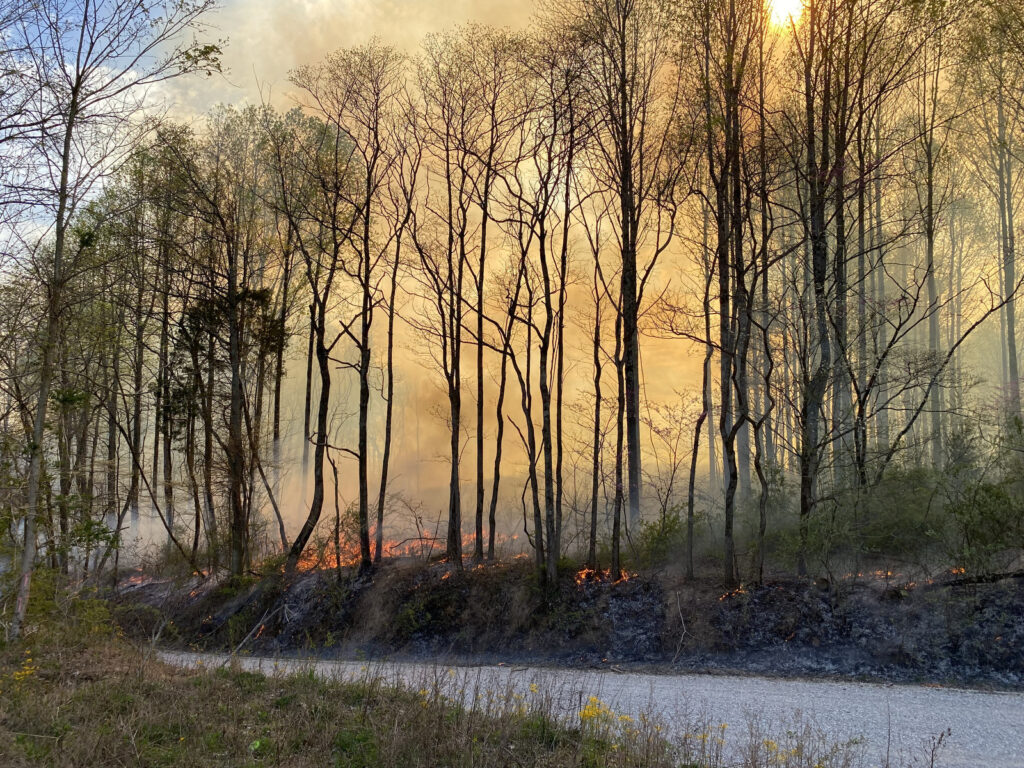
Fire brings more light into forests, which is crucial for young oak tree growth. Yet many land managers are concerned about how non-native plants affect fire intensity and young tree survival rates. A new University of Illinois Urbana-Champaign study, published in the Journal of Applied Ecology, has found that conducting more prescribed burns in forests with invasive grasses creates conditions that benefit young oak trees.
Illinois’ native oak-hickory forests have adapted to survive fires and benefit from controlled burns that remove woody debris from the understory and create canopy gaps for more sunlight to reach the forest floor. This allows acorns to germinate and grow into future forests. However, the introduction of non-native grasses into forest ecosystems has led to uncertainty about the behavior and effects of fire.
Invasive grasses, such as Microstegium vimineum, commonly known as stiltgrass, can cover the forest floor and prevent native plants from growing. Stiltgrass can also respond well to prescribed burns and add to the fuel load, leading to hotter and longer fires that can, in turn, create conditions for more invasive plants to thrive and harm native plants.
To better understand how repeated prescribed fires in Midwestern oak-hickory forests affected invasive species, forests, and oak regeneration, the researchers applied controlled burns in plots with young oak trees in the Shawnee National Forest in southern Illinois. They found that frequent fires increased light in the forest understory and reduced fire intensity. Almost twice as many young oak trees survived and resprouted in plots that had been burnt more often as those with a single burn. Stiltgrass cover also decreased with more frequent fires.
“A lot of research has previously focused on the effects of one or two burns,” researcher Jennifer Fraterrigo said. “This study demonstrates that we need a lot of fire for a long period of time to achieve the results that we want.”