

Once you understand the motive of your plants — sunlight — you can design a system to optimize how they receive it
This is part of Jason Mauck’s presentation from the 2025 Farm Weird field day at his farm in Gaston, Indiana.
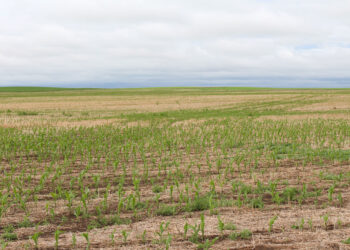
I was in a really bad mood on Friday night. We got three inches of rain in about an hour. In our 66-acre field of monocrop beans, we’re going to have to replant 20. You could have added a jet ski and a little beer and had a party out there.
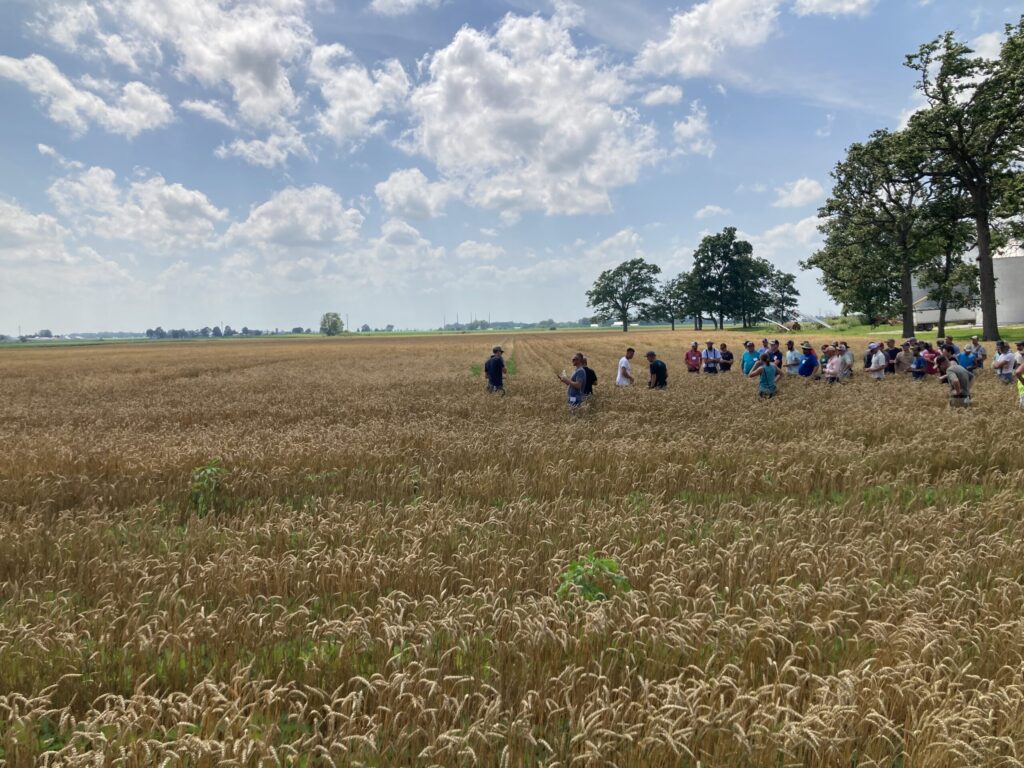
But my relay-crop field right across the road from that — which currently has wheat that’s about ready to harvest, as well as beans — didn’t have any standing water at all. And the reason is that we have a physical, growing plant that allowed all that water to infiltrate — not just the first quarter or half inch. My grandpa called what happens in most fields “a cow pissing on a flat rock.” When that happens for 10 or 20 minutes, you’re no longer keeping that water where it’s falling — it’s moving to the low spot.
If we can figure out how to manage our water, then we can play off of that. We need to be thinking about our supply and demand of water. Most farmers are disc ripping, trying to get the ground black so it warms up, to gas off the moisture, to get it nice and dry so they can go out and plant. But I don’t care if your planter costs a million dollars — how do you protect your fields when you get three inches of rain in an hour?
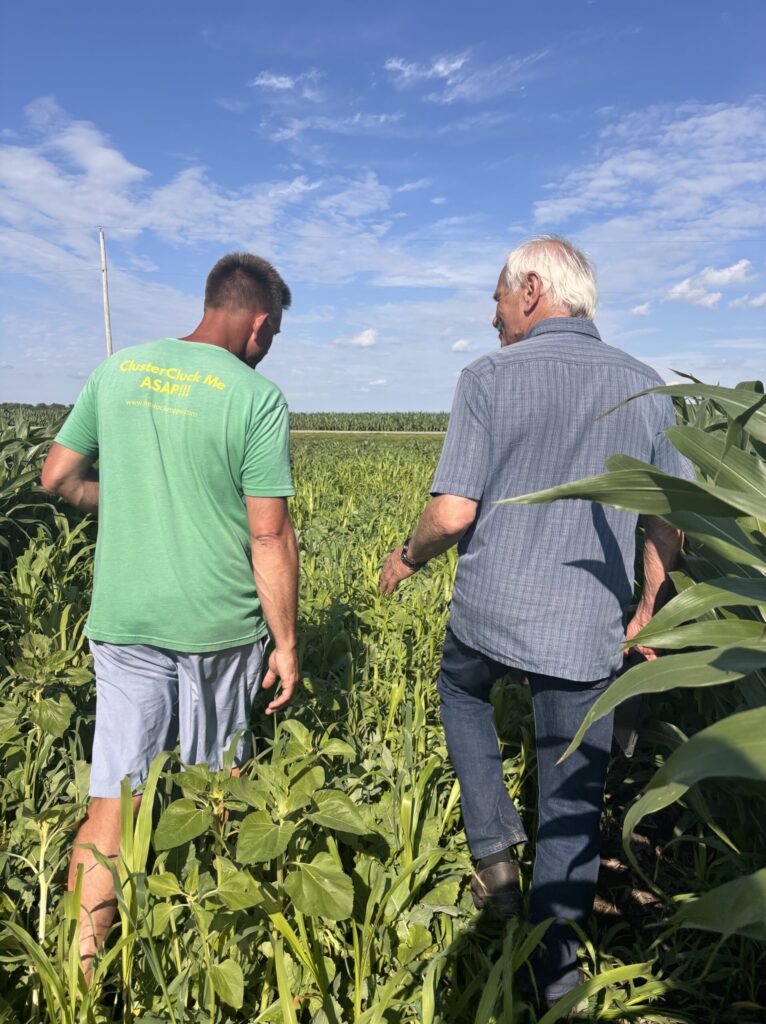
The problem is that when you’re weird — when you’re doing new things that help protect your soil — you don’t have comradery. But if you’re doing it the same as everyone else, and all your soil washes away, people will say, “Well, that’s just farming.”
The Genesis of Relay Cropping
My father passed when I was 30. Until then I had been a landscaper. I worked pretty hard, but I had a lot of vacation time — a lot of golf. But when he got sick, the family needed me to take over on the farm. So, I learned through pain. I started trying some different things. If it didn’t work, though, I didn’t want to be in the same position the next year. I didn’t want to do the same thing my dad had done and that my grandpa had done.
Everything has been a progression. The first regenerative idea I had was wheat and soybean relay cropping. I was selling seed at the time, and Enlist soybeans were coming out [beans that are tolerant to 2,4-D, glyphosate and glufosinate]. I came from the landscaping world, so I’m really good at growing grass. I thought I could just spray 2-4,D on my wheat and that would be my beans’ weed control — easy! And then I thought, heck — I can grow 110-bushel wheat like I always do, and I’ll just plant some beans in there, and they’ll make 60 bushels. This is just picking candy off a money tree!
But what I figured out was that the wheat canopied, and the beans didn’t get any light. I was super evangelistic online about this constant-canopy idea, but it put me in a really bad spot, because I failed. I had to swallow crow.
So, the next year, 2017, we made a change. Instead of planting blocking two, we blocked three. We went from 30 to 37 inches. We planted in March. The ground was so cold that my openers wouldn’t go in the ground, but in the end we got a decent stand. I fertilized with hog manure, the wheat took off, and in spots the beans made around 60 bushels, although the field average was 40 or so. It was a big start.
But I really started to learn by going out to the field at sunset every night with my phone and observing and taking pictures. Ironically, the thing that really helped me figure out this system was that we didn’t have RTK on the tractor. In some places we’d driven a little too tight, and in some places a little bit too wide, and that imperfection created thousands of experiments. I was able to discern what spacing worked best. I saw how much more water and light and biomass I could get to the beans.
I ruminated again the next winter, and I decided I wanted to focus on growing 100-bushel beans. So, I modified a manure tank to have three shanks, and I put a seed box on top of it. I designed it to plant the wheat seed right above the hog manure. I experimented with a bunch of different seeding rates. I knew this was the best way to grow soybeans, because I got living, exuding roots — a living cover crop that went through its lifecycle. It took a little bit of water out of the ground and stopped the downpour.
But the real advantage was the light gain. When I harvested the wheat, the heads were gone, plus two out of three rows were pushed down by the combine tires. Now I had a soybean with 18 nodes all out, and the plants were able to grab light. Light would ping off of that straw and go right up into the bean plant. We had 108-bushel soybeans that year. We did 17 different bean varieties, from a 2.4 to a 4.8, and all our group 4s went over a hundred bushels. The 4.6 went 108.
In 2019, we decided we needed more room for the combine, so we went four on, four off, and that worked out pretty well. We were also able to scale that year. I worked with Joe Bassett at Dawn Equipment, trying to figure out a way to do everything at once. The biggest problem with this system is the equipment — to really optimize it, you’re going to have to modify equipment yourself. We made a strip-till machine, and we tumbled in biochar to keep the nitrogen in place. We injected that into an air seeder on both sides of a strip-till machine. We were right behind the combine, shelling 250-bushel corn. We were throwing the trash all the way, making a little black strip. The wheat came up, all the fertility was right underneath it, and the goal was to make the one machine do both. The beans worked pretty well, but the wheat wasn’t that good. Most of the wheat was in the 40s, but it was a dry year.
Understanding the Plant’s Motive
If you cut down any tree that’s been growing by itself, what direction is it going to fall? South, and maybe just a little bit west. Why is that? Because the tree’s motive is south: that’s the direction facing life. That’s sun. The tree grows toward it. Look at the edge of a woods — all the trees on the edge grow outward. There’s no biomass growing into the woods.
It’s the same thing with corn and beans and wheat. We have to understand the motive of the plant in order to figure out how it’s going to grow. Once you start messing with different spacings, you figure out that the more space you give a plant, the more it’s going to follow the example of a tree — growing south.
So, my goal is to create a corridor and spacing to reflect the height of the plant. When I plant a block of wheat or corn, I know it’s going to conform to phi — the golden ratio — 1.6:1 — from the top of the plants in the center (1.6) to the top of the plants on the edges (1). In a continuous block of plants, the center rows are competing with one another. They grow way up in the air because that’s where the sun is. Their neighbors are stealing the sun to their sides, so they have to go up. With a continuous block of plants, then, you can’t support as many plants. If you have fewer plants, though, you have more free energy, and you don’t need as much nitrogen.
On the edges, we can plant more plants. Corn has 14 to 18 nodes, depending on the hybrid. People always say, “Protect the ear leaf” — the leaf next to the ear of corn, which is the biggest on the whole plant. Well, can the ear leaf get sun when it’s in the middle of a stand? Whether it’s corn, wheat, beans, whatever — look at the attributes of the plant, and design based on that. If you arrange plants so they have different circumstances, those circumstances are your superpower.
Here’s an example of how this works. In 2017 we were potty-training one of our boys, and I decided to use him in an experiment. I transplanted a single corn plant from the field into our garden, not harming any of the roots, and I didn’t put anything within eight or 10 feet of it. I told my son to pee on that plant whenever he wanted. He loved it, and that plant was like, “I got light. I got this kid peeing on me. This is awesome.”
After two or three days, there were two suckers emerging. I thought, “That’s kind of cool. Let’s keep peeing on it.” By the end of the season, that plant looked like it was on roids. It had huge leaves, but it had no motive to go up. And there were ears growing out of all the nodes. That plant had everything that it wanted. It had CO2 from gassing off phosphorus and from the air, it had sunlight, etc.
Corn will actually contort its leaves to figure out how to grab light. And this plant started growing big leaves on the ears, and then it actually started growing two ears on every node. We got 31 ears from that one plant. There wasn’t enough pollen to pollinate it all, but we had about 15 substantial ears, and then we had a lot of ears with just a couple kernels.
It just blew my mind. The point is that when you experiment, and when you make all these iterations, you’ll learn things, and you’ll be able to take that knowledge and use it as a huge lever to improve your design.
Farmers like us are a threat to selling stuff. We create value for ourselves by getting more out of everything. Be a dork, and don’t just focus on what big ag wants you to focus on — which hybrids to use to maximize yield, etc. You do have to be good at that craft — you have to have game A figured out, because you’re not going to be able to do game B on your whole farm at first. But you’ve got to start cultivating game B and doing something that is of service to your farm. Start cheap, start small, and set small goals for each year. Then, after you’ve figured it out, you’re willing to invest in something that further optimizes what you’ve learned.
Optimizing Yield vs. Population
Regardless of the crop, what’s important is the curve of yield to population. Let’s say we plant 30,000 seeds of corn and max out yield at 200 bushels. If we plant 15,000 plants, though, are we going to get a 100-bushel corn? No. If it’s dry, you might even do better — you get airflow and other factors — and you’re probably going to be somewhere around 90 percent — 180 bushels. You might be able to push your population up to try to get a few more bushels, but if it doesn’t rain for three weeks, what happens? It crashes, and it costs you a lot.
So, if we want to be really thrifty, we need to really figure out this curve. If 30,000 plants gives max yield, maybe 24,000 will produce two fewer bushels, but you’ll save a lot of money in seed. That’s the kind of math we have to consider.
But when we start polycropping, we can really start to improve profit. In relay cropping we’re growing two cash crops at once: wheat and soybeans, in my case. And there’s a balance: as we push for greater yield in one of the two, the yield of the other crashes. For example, how do you get 120-bushel wheat? You need to make it short. You need give the plants plenty of room so they sucker and so they can take on more nitrogen. You need to apply fungicide to keep it alive longer. And if you keep it alive longer, then you’re at July 12, and you can’t grow any soybeans. You can grow a forage afterwards, but you’ve missed your window. So, what I’ve been working on for the past few years is how to optimize the system.
Relay cropping allows me to grow two plants together for about 90 days. There’s a lot of iterations I’ve experimented with — single rows, double rows, triple rows, quad rows, etc. I like the principle that width needs to equal height, creating a phi curve with the plant. Phi is basically solar lubricant. If the plant was literally square, the edge of the square would just block the light. But because the plant is in the shape of phi, it allows light to go around it and down on both sides; you’re enabling these cross angles of direct light. And that’s going to drive the plant.
So, this year, I filled up the 40-foot planter with wheat seed, and I was counting about a seed every three quarters of an inch, which I thought was kind of thin, but I decided to just go with it. I got done with a 40-acre field and I had two thirds of the wheat seed still in the box. But I decided to go with it. If you go to that field now, the wind has the wheat plants leaning a bit because of the lower population, but the beans are a little bit taller — they’re not drinking as much water, and they’re a little bit happier. And this is okay, because I’m looking for overall production — not max yield of one crop — even though that would be better for my ego!
The bad economic decision would be to try to max wheat yield. Wheat will be about $5 or $6 per bushel this year, and beans will be about $11. That’s typical — a ratio of bean-to-wheat price of about 2 or 1.9 to 1. If I take my water and my sunlight and try to grow 120-bushel wheat, that might stroke my ego, but it will hurt me big time financially. If I throttle the wheat back, that lowers my seed cost and nitrogen cost, and my nitrogen use efficiency is going to go through the roof because there are fewer plants.
That’s the way we have to be thinking.
| Optimizing Plant Spacing In my garden, if I plant a watermelon and I give it 10 feet around, it will continue to make new leaves and blooms even up to frost. If we allow plants to grow longer, they’ll continue their reproductive and vegetative growth, stacked on top of one another, and the plant will create higher Brix. With all that extra space — understand that you’ll get that money back. That space is not out of production. That space allows airflow. Jerry Hatfield says that a normal monocrop, planted solid across the field, will use up all the CO2 in the morning. But if you get airflow into your crop, it’ll bring in more CO2. Plus, you’re going to dry the dew off. Your plant isn’t going to be wearing a wet wool sock all the time. You’re not going to have the blight; you’re not going to have the white mold. |