

Bridget Gilmore shares how Rodale Institute and Wolf & Associates partnered to create “A Farmer’s Toolkit for 2026,” providing state-tailored data on organic farming and market opportunities
Acres U.S.A. I’m really interested in the “A Farmer’s Toolkit for 2026” resource that Rodale Institute just released. Can you give me a little background on this project? This was funded by the USDA’s Transition to Organic Partnership Program (TOPP), correct?
Bridget Gilmore. Yes. This started because we conducted interviews with the six different TOPP regions as part of our national cooperative agreement with the Organic Trade Association. We talked to each of the different regions and asked, “What support do farmers need to better access organic markets in your region? And one theme that we kept hearing was, “We want to know what can be grown here to replace organic products that we’re currently importing.” The goal is for each region to get as specific as possible with what can be grown and marketed in the organic marketplace. Our consulting team has about 30 people based across the country, we’re in fields every single day, and we have an agronomy and markets focus.
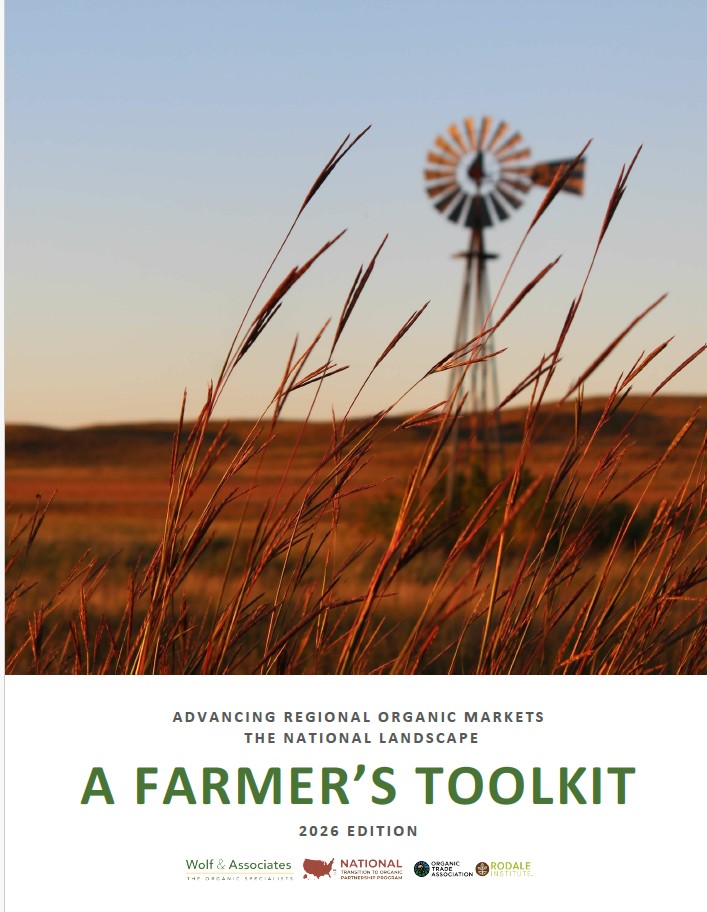
“A Farmer’s Toolkit for 2026” provides data and resources to help farmers identify organic markets in their state and region
Acres U.S.A. How did Rodale Institute get to be the one that did this?
Gilmore. This was funded through the TOPP program, and we worked really closely with Wolf and Associates, so I really want to highlight their work. It took about 19 months of research, and we put together a first draft for each region and shared that in December of 2025. We also took some of the feedback that we received from those toolkits and launched this second edition. The reason we took this on was because we want to grow opportunities for farmers who are transitioning to organic across the country. I think all supply chains saw the impacts of disruptions through the pandemic and through tariffs, and we got to see what a delicate constitution our over-consolidated supply chains really have. So we’re really interested in this opportunity to onshore organic production.
And when we look at regionalizing, it can be challenging to actualize the opportunities. To get pricing right in U.S. supply chains makes sense for all stakeholders — farmers, processors, handlers, buyers. And really making organic products accessible to consumers can be challenging for several crops. We want to first demonstrate the opportunity and take this deeper and deeper, year after year, to help it be more supportive to farmers and stakeholders throughout the supply chain.
Acres U.S.A. I know that TOPP was divided into six different regions. Do we want to go region by region and list some of the highlights? What are the biggest challenges and opportunities for each of those six regions?
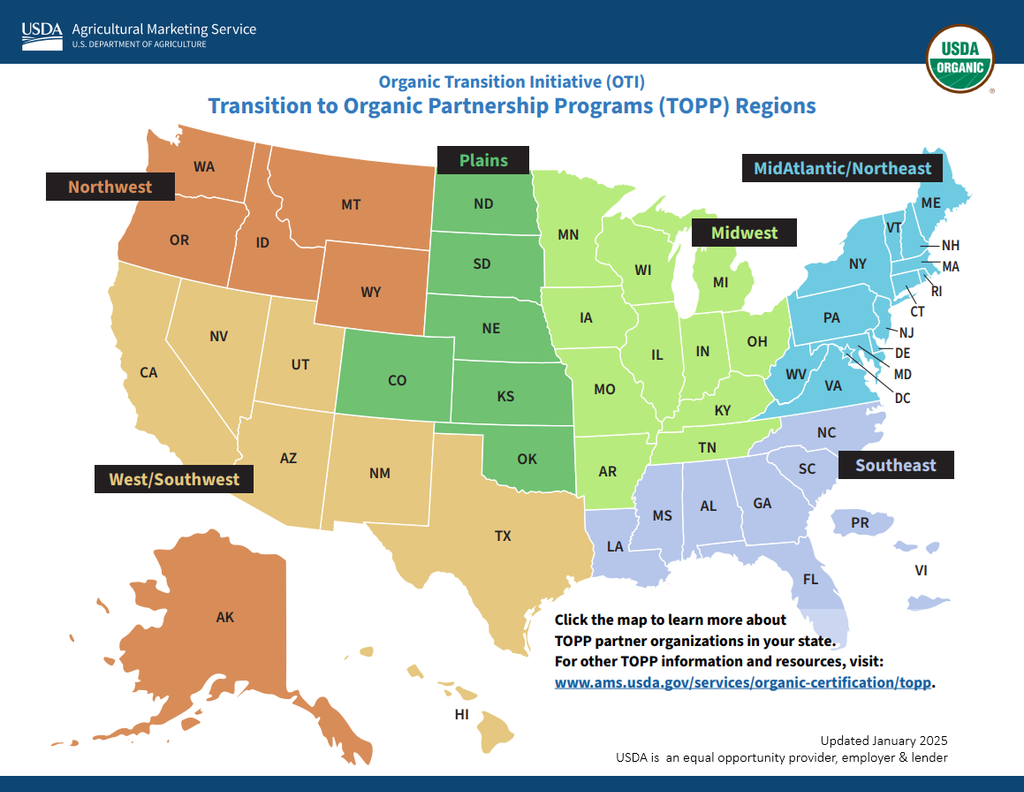
The TOPP program divided the United States into six regions, grouping together states with high and low expertise in organic production
Gilmore. I’ll highlight some of the common themes we saw across the different regions, and I encourage everybody to check it out more in depth. There’s a state-based fact sheet, so we got it as specific as we could with the data that we have. My goal personally is to make it more specific year after year, but I’ll highlight broader strokes and encourage people to dive into their region and their state. We’ll be getting new data in the new year, new National Agricultural Statistics Service (NASS) data, and our goal is to refresh the data and have it to be up-to-date. Right now, it serves as a compass to farmers and stakeholders. It’s not prescriptive, but the goal is to have it be more and more precise to be able to inform market decisions.
Acres U.S.A. So will this be a continuing program? It won’t end with TOPP funding ending?
Gilmore. With funding, it can be a continuing program. So we’re actively searching for funding to be able to refresh this in the future. In my work, I haven’t seen this specifically for farmers. We took the data sources that we know exist and brought them together and tried to find learnings. Again, I’m excited to have that go deeper.
One main theme in this edition, a huge opportunity that we saw in a lot of regions, is to onshore organic grain production to feed the swiftly growing organic dairy and livestock sector. That stands out. We see a common theme as well around infrastructure, with that being the bottleneck. There have been some funding efforts to fill that gap through the Organic Market Development grant. There’s advocacy for funding in the DOIA, the Domestic Organic Investment Act. And then looking at climate change adaptation as an advantage. What can we grow in places with changing temperatures and changing conditions? How can we grow more water-efficient crops in systems that are regenerative? Those three areas stick out to me, and you can get more specific looking at the regions and then state by state.
Acres U.S.A. I watched the National Organic Standards Board Fall 2026 meeting, and they had the regional directors from each region talk about TOPP. I thought it was interesting that the Southeast is the region that struggles the most with organic farming, compared to the West or the Northeast or some of the other regions. Do you have any thoughts on ways you could help farmers in the Southeast transition to organic?
Gilmore. We do have a team there at Rodale Institute. They’re focused on the Advance Markets for Producers (AMP) program, and their work is supporting grassroots with technical assistance. From the market perspective, I see an opportunity for building consumer allegiance for organic. I also think the East Coast receives a lot of organic imports from California. These toolkits are really focused on imports from outside of the US, but maybe there’s an opportunity to have more of what’s eaten and used on the East Coast grown in the Southeast and the East Coast.
Acres U.S.A. In the Northeast, what are some of the biggest challenges and opportunities that you found?
Gilmore. There’s an opportunity in the dairy sector in the Northeast. Also organic grain production. With that, you have to think about markets for the other crops in the rotation, making sure that there are strong outlets that match volume in a reasonable rotation in the growing dairy and livestock sector.
Acres U.S.A. Any observations for the Midwest?
Gilmore. I’d point to grain again, because of its prevalence in the Midwest. We’re working on a rye working group right now, which aims to bring together stakeholders who are interested in building stronger organic rye markets. And we have all different kinds of stakeholders — farmers, millers, buyers, food system advocates, grain gene leaders — who are looking at different ways to incorporate more rye into what people eat in the U.S. And that’s just one example of how we’re trying to take some of what you see in the toolkit and bring it to life and help propel and bring more attention to what’s already happening. I hope this can be used to back those kinds of convenings and coalitions and also inform strategy for investing in missing middle infrastructure — stronger, more resilient regional organic supply chain infrastructure.
Acres U.S.A. Would you say something similar for the Great Plains region, or would you add something?
Gilmore. I’d say similarly for the Great Plains, and that’s where I’m based right now, so I lean more towards livestock. There’s also opportunity for more research and data in the Great Plains area. I know that Joe and Levi of Wolf and Associates really dove into the data.
Acres U.S.A. And for the West — I think they cut it between California and Oregon.
Gilmore. We split California into two areas, too, because California’s so massive. This is why I hope we can get even more specific. We did the best we could — we didn’t decide the regions — but sometimes it makes for some broad strokes and generalizations that really could use some more specific context. I would say in the West, specifically around California, that climate adaptation is an advantage. What crops can be grown and marketed that offer more water efficiency? I would say the same for the Southwest.
Acres U.S.A. What are some of the major differences between northern and southern California?
Gilmore. There’s more livestock in northern California, and southern California is more the salad bowl of the U.S. That’s one way you could look at it. It was just too much to cover in one.
Acres U.S.A. And the Northwest, any specific insights for that region?
Gilmore. In the Northwest, it’s hard to find focus areas. You look at hazelnuts and wine and grain and more opportunities highlighted in those categories. For our events with TOPP, we focused on grain in the Northwest. The opportunities really grow beyond that. There are strong organic buyers and supply chains there as well. I point back to those themes that we picked up throughout all regions — the feed grain deficit, infrastructure, and climate adaptation.
As a compass, I don’t think this is at a point where it could be so prescriptive and so precise that somebody says, “Okay, I’m going to go grow this.” But it really is trying to steer us towards, “What can we grow here?” And how can we build more resilient supply chains that are more regional in the organic marketplace in the U.S.?
Acres U.S.A. What would you recommend for someone who’s reading this transcript and says, “I want to check out these resources”? Where would you have them start?
Gilmore. There are really strong resources that have been created throughout the TOPP program. I would say, start by tapping into the TOPP regions network. Look at who those partners are in your region, if you haven’t already. Even though TOPP is phasing out, really strong networks were built and reinforced. There are also resources that have been created throughout TOPP, they’re on organictransition.org. At Rodale Institute, we have resources on our website and a consulting team of about 30 people based across the country who work to support farmers in their transition to organic.
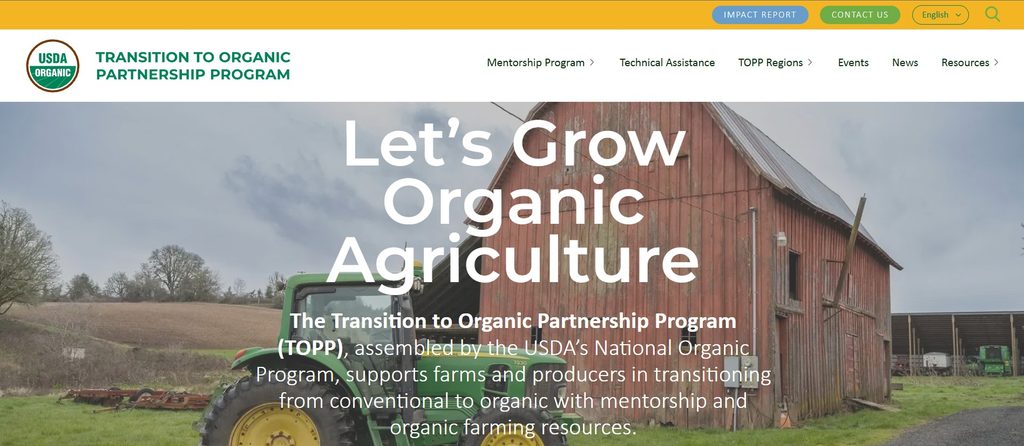
Hundreds of region-specific resources to help farmers transition to organic are available on the TOPP-created website organictransition.org
And I’ll also point out the Organic Farming Research Foundation (OFRF)’s organic research hub. They scrubbed all the different Extension resources, university resources, and organic and other similar organizations’ websites and brought together peer-reviewed articles and resources on their research hub. We worked with them to bring in more business and market-related resources. I’m excited about that, because we just officially completed that work of bringing in more resources there, and it feels like a one-stop shop for resources for the organic transition.
Acres U.S.A. I’m looking at the toolkit website, and you have it divided into different downloads. You can download the whole thing for the whole country, or you can get your region, or you can get your state. The one for the whole country has all of those in one document.
Gilmore. Yep. And we also have some buyer landscape. We conducted interviews with buyers and farmers, so that goes into some best practices for working with buyers and trying to get inside the head of organic buyers. That’s another part of the work.
Acres U.S.A. Let me look at Michigan, since that’s where I’m at. If I’m going to look at the document for Michigan, what would I want to focus on first?
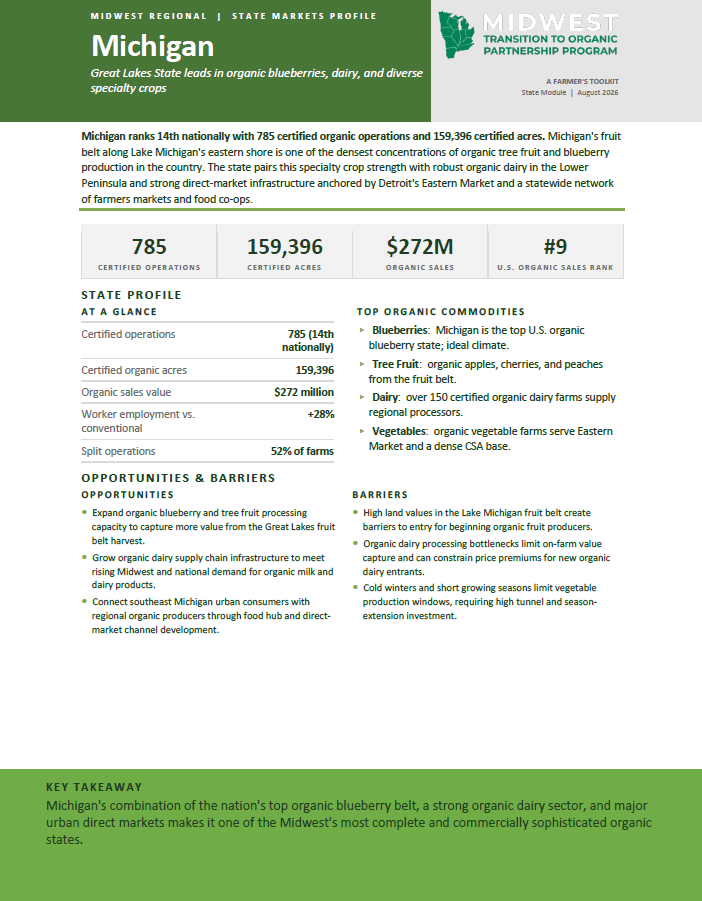
Each state has its own summary page, which lists data about certified organic acreage, operations, sales, and crops
Gilmore. What we’re really trying to do now, with the conference season underway, is get this into the hands of more farmers and get their feedback and questions and ideas to see how we can deepen it in a way that best serves them. It tells you what grows well in your region, and maybe that fills in a gap, and maybe there’s an opportunity you haven’t considered that you can look into in the future based on the crops listed.
Acres U.S.A. I look at this and it says, “Michigan: Great Lakes state leads in organic blueberries, dairy, and diverse specialty crops.” Those are the crops that Michigan leads in in general, because when you drive around where I live in southwest Michigan, you see blueberries. I live right in the blueberry region, so I say, yes, blueberries, definitely. But there is definitely room for a lot of transition there, because most of the blueberry farms I see are conventional. There are a few organic ones, but not a lot.
And then I see tree fruit here, and I say, yeah, that would be cool, because we grow tons of apples and cherries in Michigan, but a very small percent of those are organic at the moment. I’ve talked to growers, and they say it’s such a challenge, especially with pest control, for organic fruits. I’m not sure if that’s even listed as one of the barriers. I know that’s the one I hear from fruit growers in Michigan. I don’t know if you have any resources for that other than connecting with successful growers in the region who are doing it organically.
Gilmore. Yeah. That’s one way. And TOPP had a mentor program connecting experienced organic farmers and new organic farmers. That is living on beyond TOPP through a program called Kernel. Connecting with other farmers in the region who are successfully marketing those crops is one way. And then looking at your operation, seeing what might fit, and leaning into conveners in the region to dive deeper into these opportunities. Let’s look at this barrier, let’s look at this opportunity. What needs to happen to really open the door to make this a possibility, to market this organic crop?
And you could also check out some of the resources that are listed on the next page under the heading, “Resources for Farmers.” If you weren’t connected to these groups, you could reach out to these organizations. If you are excited about one opportunity here, it’s so important to collaborate and work with others and tap into work that is already underway. A lot of these groups are very familiar with the regions they are based in and serve, so they’re great starting points.
Acres U.S.A. I’m looking at some of the statistics you have on these. You have the number of certified operations ranked, so Michigan ranks as the 14th largest nationally. And you also have organic sales ranked, and Michigan is number nine for organic sales. Where did those numbers come from?
Gilmore. The toolkit came from a combination of OTA’s Organic Market Report and National Agricultural Statistics Service (NASS) data. Those sources are named more explicitly throughout the report. We also use Economic Research Service (ERS) data, Agricultural Marketing Service (AMS) data, Foreign Agricultural Service (FAS) data, and a Farm Progress article. And really, we hadn’t seen people bring these sources together. We tried to put our finger on the opportunity of what are we importing and what could we be growing and onshoring in the U.S. The OTA Organic Market Report really focuses on consumer-level organic data. I don’t see that anywhere else. We’re trying to bridge that to find out what this means in terms of true opportunity for farmers.
Acres U.S.A. This is helpful, because every time I write an article about, say, organic blueberry farms in Michigan, I have to go look up how many blueberry farms there are and how many of them are organic. And I’ve found that, on the NASS’s Quick Stats website, there is a lot less organic data than there is regular data. And it seems like they last collected the organic data in 2021, and they don’t collect it every year or every time they do a survey for conventional agriculture. Was that a difficulty in this project?
Gilmore. Yeah. That’s why we’re really excited about the new data that we anticipate coming out in the new year, to be able to refresh this. I’m really curious about what we’ll learn by refreshing with recent data. I hosted a webinar a couple weeks ago with a researcher from UC-Davis and talked about organic pricing data and the gap. So you’re spot-on. That’s something our team experiences every day. And farmers and supply chain actors who are working in organic experience it every day — there’s less available data. That was highlighted through this process and is another reason why we want to make it go deeper in the future.
Acres U.S.A. Some of these other numbers we have here, like certified operations, organic acres, organic sales value, those are all from NASS, right? I think I’ve run across those before. Or is some of that from OTA data, too?
Gilmore. I think most of that is from NASS data. And again, we brought together ERS and AMS data, all the USDA data. The more consumer-facing data is from the OTA Organic Market Report. And some of it is from the OTA’s Organic Hotspots research, which looks at areas in the country that have higher density and concentration of certified organic operations and impacts on the communities. There are job opportunities in organic supply chains, they tracked a higher median income in those organic hotspots.
Acres U.S.A. When the report mentions split operations, are those operations that are both organic and conventional?
Gilmore. Yes.
Acres U.S.A. I know an apple grower who has some of his land organic and some conventional, so he would fall in that category. I’m looking at the Michigan one because that’s where I live, so I can see how to apply that when I look at some of the other areas. Like next we have Minnesota. They rank 10th nationally, but I see that the numbers are a little different here. We don’t have the sales rated, but we have 25 percent more workers versus conventional.
Gilmore. I see Indiana is similar, so that might point to some gaps in data, or maybe highlighting data that is more meaningful for different states or different regions. Our consulting team is encouraging farmers to look at this. I imagine that this will get even more meaningful with that feedback. This is why we broke it out by state. This 214-page report is like a buffet. I definitely use ctrl+f a lot when I’m going through it. That’s why we broke it out into smaller, bite-sized pieces.
Acres U.S.A. Yeah. I find the state summaries really interesting. I looked first at the ones I’m familiar with, like Ohio, which puts an emphasis on the Amish and Plain communities in dairy farming. I used to live in Ohio, I went to college there, so I know that is indeed an important part of Ohio agriculture. I know not all of the Plain communities are organic. There are a lot of them that aren’t, but that’s definitely a group that is interested in it. Certainly there’s room for growth there, because I know they’re not all organic.
Then I look at some of these other ones like Tennessee, which needs to transition away from tobacco. The regions are big, so that’s why Tennessee is in the same one as Ohio and Michigan. Is there something you want to say about that, how TOPP made the regions a little bit different than how they’re normally divided into climatic regions, so that they could have states with organic expertise and states that had fewer organic farms work together? The USDA used to divide the country into nine regions; now it’s only four. But the TOPP regions are slightly different than the normal USDA breakout regions of the country.
Gilmore. We tried to also break up the country into different regions for our consulting team’s purposes, and it was a journey trying to find the right divisions that made sense. And it can’t be perfect. Tennessee is part of the Midwest for TOPP, whereas I could see a lot of other delineations of the country putting Tennessee in the Southeast. I see advantages and challenges of that through TOPP. That’s one reason why we broke these out into states. You could see a lot of crossover between, say, southern Colorado and northern New Mexico. So I recommend looking at the states that are nearby as well, surrounding states close to a border, because we know that these borders don’t tell the whole story when it comes to our watersheds.
Acres U.S.A. And you can even have very different regions within one state. Like you split California into north and south, but there are also very different regions as you go from east to west. The coast is different from the Central Valley, and that’s different in the north and the south.
Gilmore. Exactly. And when you look at regional markets, you can also think about it this way and be creative with how you cluster the states. Look at the opportunity within your state, and then in nearby states.
Acres U.S.A. Something I thought was interesting in the Fall 2026 NOSB webinar, the leader from the Northeast TOPP region explained how it was helpful that the region was larger than it would normally be for the Northeast, because farmers from states with a lot more experience in organic farming, like Vermont or Pennsylvania, could help farmers in Virginia or West Virginia. They extended further down for the mentorship than these farmers would normally interact with other farmers, and that was really helpful because they were able to spread that expertise further than it perhaps normally would. The state and regional organizations were smaller than that region, so they worked together more than they did before that, and she saw that as a big positive.
Gilmore. And from a market lens I also see that as a positive, connecting farmers in different states. Regional clustering, but also connecting a brewery that was certified organic in Pennsylvania with one that was certified organic in California. They weren’t competing as much for the same buyers and marketplace but could learn a lot from one another. I see the overall national network cross-pollination as very powerful. That’s another way you could slice and dice some of the data, by looking at certain crops that are grown in different places in the regions where those markets are strong. That’s what we’re trying to do with the rye working group — bring efforts around the country together to see how we can propel every regional initiative around rye markets.
Acres U.S.A. So there’s a place for both. On the one hand, you need that local engagement, people that are familiar with the climate, with what kind of crops you can grow in a specific locality. But on the other hand, to have that cross-pollination between the different regions, the different states, the country as a whole, is also valuable because the markets are all connected, the country is connected with transportation. So finding that balance between both, between the local and the national, to make both do better.
Gilmore. I think that’s really powerful. I think that combination is really powerful, yes.
Acres U.S.A. And would you say TOPP was very successful in striking that balance?
Gilmore. I think it was really successful in reinforcing and assembling those networks. And I hope that they continue to stay connected post-TOPP.
Acres U.S.A. What were some of the best things that TOPP did that hopefully we can continue?
Gilmore. I think it supported strong work. A motto our team uses is, “Show up, and show up again.” It’s really important to be able to be there for farmers throughout the transition period and know that there’s a place for farmers to go beyond the three years and into marketing your crop. What I really want TOPP to continue to do is support, not only those farmers who are transitioning into organic, but encouraging and supporting farmers with the tools and research that they need to stay in the market, too. TOPP allowed organizations to show up and show up again. What really stands out to me are the networks it highlighted, established, or reinforced across the country — that ability to cross-pollinate between regions and build stronger resources to dispel some of the mysticism around organic transition.
Also, we learned a lot from different organizations through our work helping farmers transition into the organic marketplace. We learned how different regions work differently and how we can better collaborate with one another. It was a big initiative, and so many people involved in TOPP wear so many hats. I’m hoping that we continue to see the ripple effects of benefits from the work.
Acres U.S.A. What were some of the highlights for you personally working on this project?
Gilmore. I was able to attend a lot of our buyer/seller mixers and market development workshops in all different places across the country, places that I didn’t necessarily expect to go. I was just impressed by the different communities and the strength around organic in different places, especially where organic is less commonplace. I was really impressed by the farmers and the people I got to meet through this work and TOPP. From Nebraska to my own state, Colorado, plus events in Wisconsin and Pennsylvania, getting to see the different communities around organic in different places and some of the common threads. A lot of resilience and creativity. That is inspiring.
Acres U.S.A. What were some of those common threads that you saw?
Gilmore. Resilience and creativity. One of our mottos as an organization is “Healthy soil equals healthy food equals healthy people,” and that was a common thread as a driving force and factor in transition for a lot of different farmers. Feeding families, feeding communities, and seeing the benefits of healthier watersheds and communities and people who work on farms to grow food in the organic industry.
Acres U.S.A. That’s really good to hear, because that shows me that organic farming is staying true to its roots, because it was always about the connection between soil and health and soil, plant, animal, and human health from the beginning, from the 1940s when J.I. Rodale was first bringing that to the United States. He was the popularizer; there were many others who came up with the ideas that he then presented to everyone else. But that was always the foundation of organic farming. So it’s good to hear that that’s still what organic is about, and that’s still what is attracting people to it.
Gilmore. I see that integrity in a lot of people we get to work with. That keeps me in the work. I’ve been fortunate to meet some of the early players in organic, and I find a lot of inspiration. And also, some of the younger farmers and people who have newly transitioned into organic, just the confusion of new energy and excitement. The market has grown consistently since the inception of the organic standard. I’m personally invested in helping grow it. On challenging days, I find hope and excitement in envisioning the revitalization of regional organic food systems and value chains. I really want to see funding invested towards supporting regional infrastructure and strong organic communities.
Acres U.S.A. Yeah, we need more younger people in farming. Farming in general, but even the organic movement has been dominated by the Baby Boomer generation for so long. And they were amazing organic farmers, and now they’re retiring, and we need younger people to take on that responsibility.
Gilmore. Yeah. And have support in that transition, have mentors they can trust, and land access, and strong, compelling markets. That’s something we don’t dive too deeply into in the toolkit, but I also feel passionate about this.
Acres U.S.A. Are there any takeaways that you would get from this toolkit? How would you encourage farmers to use it?
Gilmore. Use it as a compass. “A Farmer’s Toolkit 2026” is for all types of farmers and ranchers in every state across the country. It was designed so a farmer in Iowa taking a break in his tractor could download his state fact sheet in less than a minute, but also go more in depth with a National Landscape and Buyer’s Landscape while sitting at the kitchen table. It’s intentionally farmer-friendly with both distillation and breadth of timely, relevant information and insights. It’s there to inform the organic market’s decisions.
Use it to help find organic market development opportunities in your region and your state. Use it to open up discussions with other potential collaborators in bolstering stronger regional and resilient organic supply chains. And send us your feedback. We want to encourage and support farmers who are transitioning to organic and have certified organic farms to thrive and not just survive. We want to hear your feedback on how this can help you. I can see organizations supporting organizations, providing technical assistance and doing advocacy work. I hope this can serve some of their efforts as well. Again, coming back to the main goal of the toolkit, to demonstrate what we can onshore that we’re importing.
Acres U.S.A. So it’s a starting point. It’s got the information, the data, and now we take that and we run with that and say, “How can we actually use this data to grow organic farming?”
Gilmore. Yeah. And applied to your specific context. And again, we have a lot of ideas for how this can be deeper and more meaningful. With funding in the future, we could refresh this on an annual basis.
Acres U.S.A. How much of it would you be able to do, with what we were just talking about with the USDA data not being collected every year? How much of it would you be able to refresh annually?
Gilmore. That’s a good point. The OTA report comes out every year. I think we learn by repeatedly refreshing it, how different it is from edition to edition. I’m really curious about what the new NASS data will reveal. We’ve made vast improvements based on feedback from the very first edition of this toolkit, but the data pretty much stayed the same. If we refresh it each year, we can have people like you focusing on your state, and we can add more to those specific factsheets based on lived experience. Maybe we tweak the opportunity listed to be even more specific, or even point to a more direct resource about a group that’s convening to try to tackle that barrier. That’s my goal. We’ll learn more as we get this into the hands of more people. So I appreciate you highlighting this.
Acres U.S.A. I think this will be a great resource. I hope the readers of Acres U.S.A. will check out this website. “A Farmer’s Toolkit for 2026” is available online at rodaleinstitute.org/education/resources-overview/farmer-toolkit. I especially encourage people to check out the fact sheet for their state. It has all the resources right there. You could search on the internet and find all this, but it would take quite a bit of time, and now it’s all right there, all laid out already, and it’s a great starting point.