
A Four-Year Update on the Transition to Organic Partnership Program
The final months of 2026 mark the end of the USDA’s landmark Transition to Organic Partnership Program (TOPP). This one-time program provided $100 million dollars between 2022–2026 to fund educational resources to help farmers make the transition from conventional to organic production. As part of this fall’s National Organic Standards Board meeting, the leaders from the six TOPP regions reported on the program’s successes.
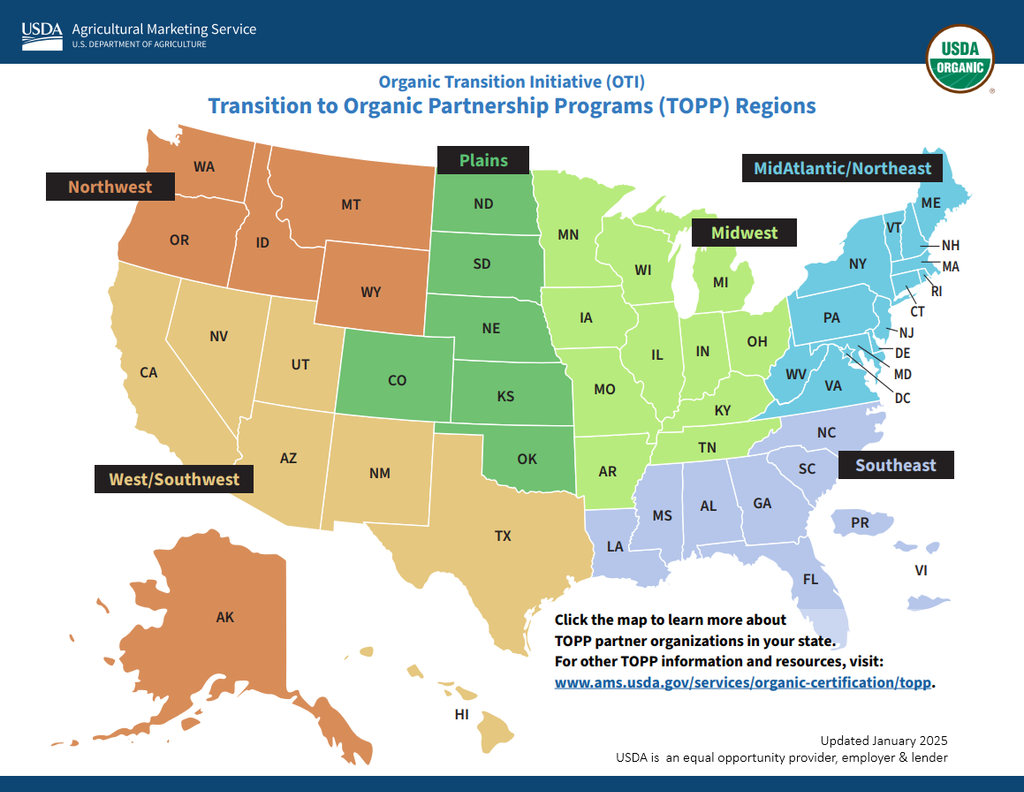
TOPP Regions (Source: USDA) – The TOPP regions were designed to include states with both high and low numbers of organic farms
TOPP was the “opportunity of a lifetime,” said Allison Walent, the program lead for the Midwest region. According to preliminary data, 7,423 operations accounting for 600,681 acres of farmland started the transition process to certified organic as a direct result of TOPP outreach.
Leilani Durand, the lead for the Northeast/Mid Atlantic region, said that one of the program’s greatest strengths was its cross-state and cross-regional networking. The six TOPP regions were designed to include both states with strong organic farming communities and states with fewer organic farms.
The Southeast has the fewest organic farms of any TOPP region. Extreme weather conditions—heat, humidity, year-round pest pressure, and hurricanes—make this a challenging region for organic farming, explained Kyndra Love, the Southeast lead. But TOPP still made important advances. One TOPP-funded bus tour pushed twenty farmers into transition; the state of Mississippi produced its first-ever organic crop guide, and a survey identified the need for organic grower cooperatives to pool produce for larger markets.
Ben Bowell, the lead for the Northwest region, emphasized community building. TOPP funded 3,234 events, 30 percent of which were field days. On average, each farmer involved in the program met 22 others and formed deep relationships with six other farmers. Again, the states with the fewest organic farms benefited the most from cross-state partnerships—some of the partners in Idaho had never held an organic workshop before, but the state now has an organic extension agent thanks to TOPP.
Jessy Beckett-Par, the lead for the Southwest region, highlighted the need for workforce development. There is a shortage of trained organic inspectors—82 percent of certifiers need more inspectors than they’ve been able to hire. There’s also a huge need for certified crop advisors with organic experience.
Even though most TOPP funding for workshops will be done by the end of the year, the resources created for the program will endure. They’re currently housed on two TOPP-created websites—organictransition.org and organichandlers.org. Organic Transition provides resources for farmers, and Organic Handlers has 13 chapters of searchable online tools on certification and compliance for organic handlers.
Overall, everyone agreed on two things—TOPP has been a great success, and there’s still a great need for resources to help farmers successfully make the organic transition. Whether or not there’s ever more federal funding, hopefully the partnerships started by TOPP will endure. TOPP has shown the power and effectiveness of providing farmers with both locally specific farming advice and the energy and knowledge of cross-regional—and even national—collaboration.
Want to learn more about the future of organic farming?
In our interview with Bridget Gilmore of Rodale Institute, we explore how A Farmer’s Toolkit for 2026, developed with support from TOPP, is helping farmers identify organic market opportunities in their regions. Discover how this new resource uses state-specific data to support organic transitions, strengthen regional supply chains and connect farmers with emerging markets.
Read the full interview: Data for the Organic Transition →