
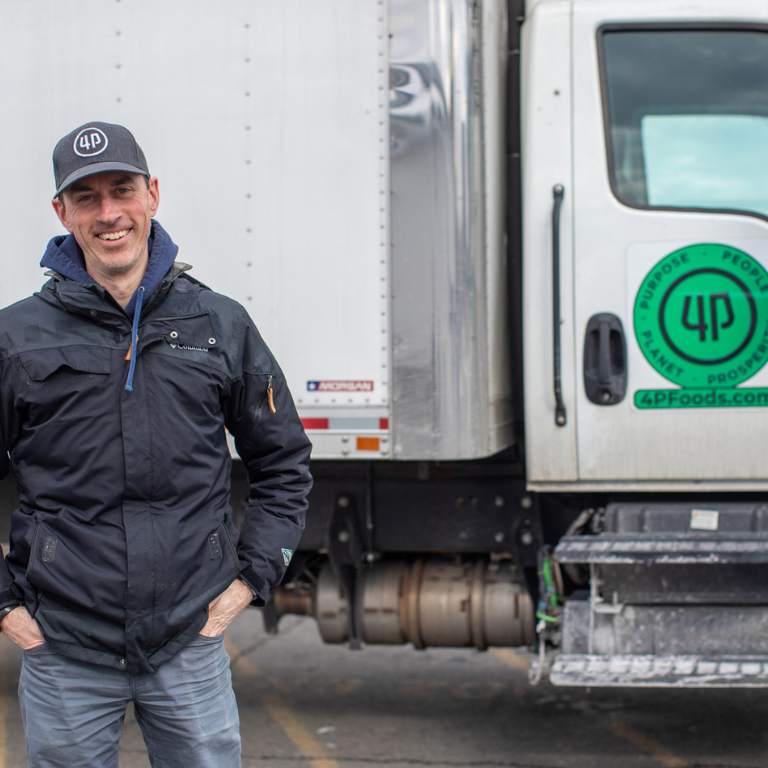
Tom McDougall explains how 4P Foods is building a regional food network to help farmers reach institutional buyers
Acres U.S.A. Can you give us some of your background — how you came to be in the food and farming world?
Tom McDougall. Sure. I grew up not on a farm, but in a farming community, in the Hudson Valley region of New York. It was a wonderful upbringing — an agrarian lifestyle. My backyard, where our two-acre plot ended, became a 200-acre dairy operation. But it got sold because the farm family was struggling, and it became a golf course. Then the same thing happened with the property across the street — they used to graze cattle, and it became a McMansion and a housing development.
Meanwhile, during that same period, my father worked in small grocery stores. There was a chain called Grand Union, and he was an assistant produce manager. His job was to buy the apples from the farm across the river and make them look really good on the display when you came in. He loved it — in part, I think, because of that connection to where food was coming from.
I remember him getting excited about bringing strawberries home in July. As a kid, I’m like, “Why only July strawberries? Why aren’t we excited about them in January?” And now of course I know why. But also, it wasn’t just the job — it was his whole community. All of his friends, all of the people that were at my baptism and my graduation, and later my wedding, were his friends from Grand Union. But they went bankrupt in the ’90s.
So he lost his job, and the community with it. He went on to a few other small stores, but his whole 45-year career working in grocery stores followed the consolidation of food retail. This was the second step that began with Earl Butts’ get-big-or-get-out philosophy on the production side of things — we consolidated production, we consolidated aggregation, processing, and distribution, and then we consolidated retail. And we’re left with the food system we have today.
So, as a nine-year-old, of course I didn’t understand any of those dynamics. But looking back, it makes a lot of sense that the food system is kind of in my DNA.
But I went to community college and then moved to D.C. to finish my degree and got very far away from food systems. I studied international business and studied abroad in China, and I thought I wanted to go to Wall Street. Very quickly realized I didn’t. My first career after school had nothing to do with food, but it had everything to do with supply chains. I spent a good chunk of that time doing projects that were based in China — manufacturing and then import-export work to figure out how to get the things that we were making to our clients. I sold tchotchkes — all that crap with logos on it. It was a super fun job. I learned how to collapse supply chains, because in that industry — like many industries — there were lots and lots of middlemen and women. There was an importer and a broker and a warehouser and a supplier and a decorator and a distributor and so on and so forth. We were this little five-person company working with some big businesses, and we were able to do that by going direct from the factory to the customer — and this is kind of what our business model is now. Instead of seven or 10 or 12 links in a traditional food supply chain, it’s the farmer, us, and then the customer.
All of that, though, really fired up what would become my inner activist, because in that process, two things happened. One, I picked up Michael Pollan’s book The Omnivore’s Dilemma, and I got all angry about corn. And two, I signed up for a CSA. I started down this intellectual rabbit hole of studying food systems, and my childhood upbringing started to make sense. I was like, “Oh, that’s what happened to the farm. That’s what happened at Dad’s job.
That was happening at the same time that I was seeing and living and benefiting personally from a global capitalist system that allows for and in fact rewards externalities — where the price of the thing that we were manufacturing and importing really in no way represented the real and true cost of those things. From an environmental degradation standpoint, from a human rights standpoint, from a transportation and petroleum standpoint, there were a lot of costs that weren’t captured in the $2 we paid for a baseball hat.
I started to merge those two worlds and thought processes together. That same dynamic exists in our food system — the price of the food we’re consuming in no way represents the real cost of that food. We’re paying the price in terms of environmental degradation, the hunger-obesity crisis, and these things called food deserts. I started to get very animated and activated, not just about food systems, but the global economic system and power structures within which our food systems are nestled. So, I identify comfortably as a social and environmental activist stuck inside an entrepreneur’s body. And that shows up in what we’re doing now at 4P.
Acres U.S.A. So, you were doing that supply chain work, you had this Michael Pollan–type quarter-life crisis — and were immediately like, “I need to start an aggregator?”
McDougall. No, what became the kernel of our business model was my CSA. I signed up for a CSA with Big White Barn Produce in Maryland, outside of Frederick. They’re still at it today.
I would get on my bike and go across the city on Wednesday evenings to get this random box of vegetables, and I got very excited about it. I became that guy at the cocktail party that was trying to convince my friends that they should sign up for a box of kohlrabi and kale every week. And they were like, “No, I’m just not going to do that. I’ll go to the farmers market when I’m in town” — which ends up being twice a year to buy a tortilla or whatever. So, my friends became the initial addressable market to try to create some sort of CSA 2.0.
We described it as a CSA on training wheels. We launched as a direct-to-consumer model, and it was sort of a CSA, but the differences were that you could pay as you go — so you didn’t have to sign up for a whole season and could cancel whenever you wanted to — and you could pause a week. We would send out a list and say, “Here’s what’s coming this week from these eight different farms.” And because there were eight farms, we could provide more variety and could avoid the kale hangover issue that happens with a lot of CSAs.
This was in 2014 or so. I had gone to a conference and had met some folks in Charlottesville called Local Food Hub. It was a 501(c)(3) nonprofit food hub. And I was like, “Ah, that’s what we’re trying to do — be a food hub, I think.” So, we launched as a B2C model to try to address that market of folks — you and me and my friends, who loved the CSA, but family dynamics made it a little bit challenging. We wanted to make it a little bit easier and to provide delivery.
Acres U.S.A. Did you start off as a 501(c)(3)? Because you’re a Public Benefit Corporation now, right?
McDougall. Yes, we are a Public Benefit Corporation. We started off as a PBC and haven’t changed. A lot has changed for us, but the mission has not, and our structure has not. I think we might have been the very first Public Benefit Corporation incorporated in the state of Virginia. Maryland was the first state in the country to recognize PBCs in 2012.
Acres U.S.A. Can you explain what a PBC is and how it works?
McDougall. Sure. I’ll explain what it isn’t first, because it’s often conflated with Certified B Corporations. This is more in the zeitgeist because B Corps are consumer-facing — typically retail. Ben & Jerry’s ice cream is a B Corp; there’s that little circle with the B logo on it. It’s a third-party, good-housekeeping seal of approval — an audit on your business practices. Do you have recycling? Do you have employee health insurance? Do you have a 401(k) program for them? What’s your supply chain look like? You get points for each of the things that you’re doing in a sustainable direction, and if you get 80 points or more on their 200-point scale, you get to slap the B logo on your brand. It’s a signal to consumers that the company is trying to be a good steward.
We’re not that, though we of course hope to be good stewards. What we are instead is the much lesser-known thing — our legal structure is as a Public Benefit Corporation. It’s a state-by-state thing, and not all states call them that exactly. There are over 30 states that offer something like this. When you form an entity, you get a form and you check a box in your state, and then you do so for the feds and the IRS as well. In these states, you can be an LLC, an LLP, a C Corp, an S Corp, or, now, a Public Benefit Corporation. And that’s what we are.
What does this mean? Well, in traditional corporate law, C Corps in particular, you have a very clear fiduciary obligation to your shareholders. And if you fail to fulfill your fiduciary obligation to your shareholders, you as a board and/or management team can be subject to not only criticism, but potentially to lawsuits. This is why Ben and Jerry’s ended up getting sold to Unilever — despite Ben and Jerry themselves not wanting to do that, they kind of had to. Now, Unilever’s done a good job with the brand, so it’s no shade on Unilever; I’m just saying that it sent Ben Cohen and a handful of others on a tear to figure out a different way for businesses to exist and also serve more stakeholders than just their financial shareholders.
So, in our PBC corporate charter, it very clearly lays out that our purpose is not to maximize fiduciary returns to our shareholders, but rather to maximize benefit to our stakeholders. It’s a minor language difference, but it means the world because our stakeholders include our shareholders — but importantly, on equal footing, they also include our farmers, our community, our environment, and our team.
So, when we’re making big decisions about the future of the company, those voices have equal say and equal footing as it relates to the decisions that we might make.
Acres U.S.A. And then do the shareholders have less legal ability to sue you if you’re not totally maximizing profit?
McDougall. Correct.
Acres U.S.A. Can the stakeholders sue you for failing to make an impact?
McDougall. Yeah, they could. I’m pretty sure that wouldn’t hold a whole lot of water with a judge.
Acres U.S.A. That’d be difficult to prove, potentially.
McDougall. Yes. And if we had disgruntled shareholders, they could sue us. They probably would not be able to win or extract any sort of value, though. I think even more helpful, though, is that the investors and partners we’ve attracted all know this. They know what train they’re getting on. They know that 4P Foods is trying to not just build a food business. In fact, we are trying to build a food system. It’s going to work on long timelines. We’re going to take into account all of these stakeholders. If money is somehow to be made in the buying and selling of local carrots — which is very hard to do, as it turns out! — that money should be shared among the farmers and the team and the staff and also the investors — but definitely not exclusively the investors. They’re one part of this whole journey.
So, having this structure has attracted impact investors. It’s attracted folks that want their money back — don’t get me wrong — but if they were looking to maximize their money, they probably would’ve taken that same money and put it in Meta or AI.
Acres U.S.A. Does your structure allow you to accept charitable donations, like a 501(c)(3)?
McDougall. This is a cool trick that I did not know when we founded the company. When we incorporated as a PBC, we did so because I thought the customer base and the farmers were really going to care about that. It turns out I was wrong. Neither of them cares about it. In the case of farmers, they’re like, “Well, great — regardless of your legal structure, are you going to buy a lot of food from us? Are you going to be a good partner? Are you going to pay your invoices on time? Because that’s what we care about.” Understandably so. And with the customers, it’s sort of the same thing: “Are you going to curate good food? Are you going to deliver it on time? Is it going to be relatively price competitive? Okay, cool.”
What I didn’t expect — and what has been a wonderful surprise — is that the answer to your question is yes. We’ve raised a fair amount of capital over the past 12 years, and it’s been this really beautiful and elegant blend of different types of capital that mirror the different functions we have as an organization.
About a third of the capital we’ve raised has been equity capital. This is from the impact investors of the world. We’ve done a Seed Series and a Series A. And then about a third has been philanthropic and grant capital. This is typically by way of what’s called “expenditure responsibility grants.” This is particularly helpful because it’s the pocket of capital that allows us to invest in programmatic development and infrastructure development that is really focused on mission alignment. If we didn’t have that form of capital, we probably wouldn’t be able to do those things because, as pilots or as standalones, it’s very hard to make the math work, at least out of the gate. So it’s been really catalytic to have that form of capital. And then we’ve had debt as well — for things like our trucks and our warehouse.
Acres U.S.A. Are those grants from federal or state sources or from philanthropic corporations?
McDougall. All of the above. We’ve received state funding to do a feasibility study on the work that we’re doing. We’ve received federal USDA grants, like an RFSP grant that we’ve been managing for the building of a regional system. The Rockefeller Foundation is a supporter of our food-is-medicine work. And local-area health legacy foundations are supporting us in various ways.
Acres U.S.A. And a C Corp with that private label certification couldn’t do that, correct?
McDougall. Correct. Maybe if you had a really good attorney who figured out how to do an expenditure responsibility grant nestled inside of a demonstration project, and it passed the sniff test of the IRS — maybe. It’s kind of risky though. It’s a gray area that is being tested right now.
But yes, for us as a Public Benefit Corporation — because it’s in our charter, because our mission is so clear, and because we try our best to walk the walk on the mission — that makes it much easier for folks to see that the work we’re doing is important and has what the IRS would consider to be a charitable impact.
Acres U.S.A. You don’t do home deliveries anymore, correct? Can you talk about how you made that decision? And what are your distribution avenues today?
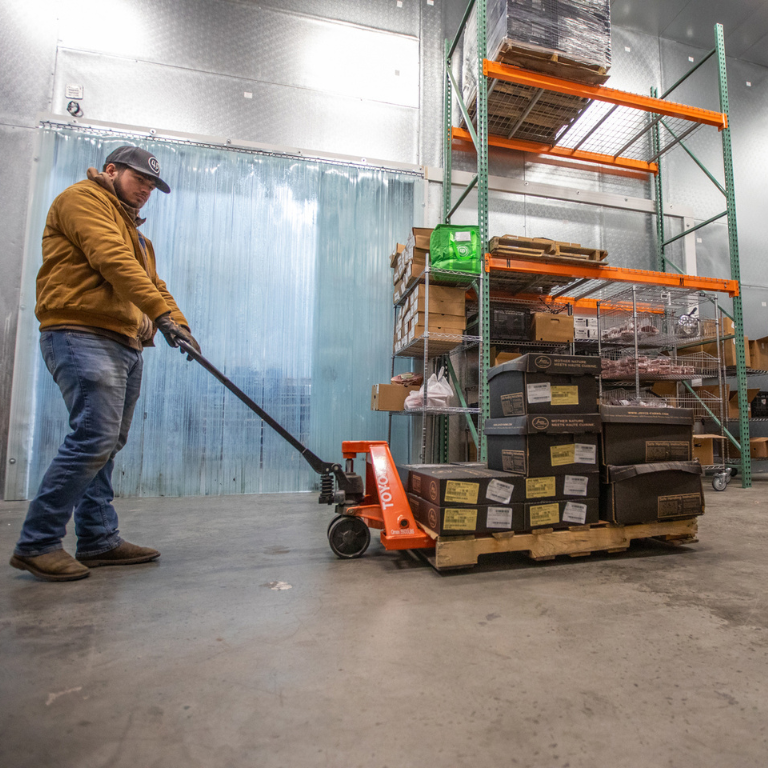
McDougall. Sure. We were B2C for our first several years. In 2019, we began a long conversation with the team at Local Food Hub, which was in Charlottesville. We had been buying from them from day one, so they were one of our vendor partners. They bought from local farms, and then we would buy from them and pack it up and put it in CSA boxes. That was great because they were buying from 30 or 40 farmers that we weren’t buying from directly, from farms farther away from our operating area. They were a nonprofit. As a 501(c)(3), they were very good at the programmatic side of the work. They ran an education farm for a while. They did a lot of food access work. They weren’t as dialed in or focused on the unit economics of last-mile delivery of a wholesale distribution business because they didn’t have to be at that moment in time.
We were sort of the opposite. We were really trying to fine-tune our business model and figure out how to bring this local food into other places and spaces in a way that’s sustainable — good for farmers and good for the consumers. But as a non-501(c)(3), and prior to having raised the capital we just talked about, we really didn’t have two nickels to rub together to do any of the programmatic food-systems work.
So, we acquired their wholesale operation, which freed them up as a 501(c)(3) organization to really focus on the programmatic side because they got out of the distribution business. And for us, it became this other arm — we had B2C, and now we had B2B. They were selling to the University of Virginia and to restaurants and grocery stores. We hadn’t done that yet, but we wanted to, so we bolted that on. That was in 2019.
Then, 2020 was supposed to be the year where we harmoniously integrated inventory and routing and everything else. But of course COVID happened — and there’s a whole long, separate story about what happened to food systems during COVID. We participated in a bunch of COVID response programs. We were the primary contractor for the Local Food Purchase Assistance program. We did a whole bunch of work with Farm to School. The American Rescue Plan and Inflation Reduction Act funding mechanisms allowed a whole lot of really interesting and cool work to be done.
By 2024, though, we stopped and looked around and realized that we were jacks of all trades and masters of none. We had a B2C arm, a food-is-medicine arm, and a farm-to-institution and -restaurant and -grocery arm. We were doing a lot of things kind of well, and we were doing zero things exceptionally well. Something had to give.
We had to consider, “How do we simplify this business?” It started with the mission. What pieces of our business do we want to lean into that are going to have the biggest impact on serving our community — specifically those in underserved and historically marginalized parts of our region — and that can also create the most market opportunity for farmers? What are the things that check those two boxes?
As much as we loved our B2C business, it didn’t check those boxes. It was predominantly serving affluent white people in Northern Virginia and D.C. Which is great — it had good margins, and it was getting shoppers out of Whole Foods and into a local food system. But it wasn’t serving the underserved.
Also, that business model didn’t scale. The only thing that made that business scale was a global pandemic, and that’s not a particularly good business strategy. As I looked around the country, I couldn’t really find any last-mile, home-delivery, perishable grocery business from local and regional food systems that did, in fact, scale. And I understood why: because it comes back to the unit economics of that last mile. It falls apart outside of a certain density of delivery routes.
We decided to sell that arm of the company to one of our longtime partners, a local business. They operate one of the biggest, best dairies in our region. They were delivering milk to people’s doors, and they also had a growing grocery delivery business, so it bolted on there really nicely for them.
That freed us up to focus on the lanes we wanted to lean into, which now are really just three: farm-to-institution, classic B2B, and our food-is-medicine business. So we’re not doing home delivery anymore, except for food-is-medicine. It’s been great. We took a step back and we’re now taking a leap forward, because the business has significantly simplified. We are much better at doing fewer things. It’s business 101; it just took 12 years to get there.
Acres U.S.A. How many different schools and hospitals and businesses are you delivering to, and how many farmers do you now work with?
McDougall. Depending on the time of year, we have anywhere between 300 and 400 individual wholesale accounts. We have another several hundred food-is-medicine patients or families that we’re delivering to by way of our produce prescription programs. A few years ago, we were working with 644 public schools in the state of Virginia and 12 major universities. We went down to 30 because of the stop in federal funding, but now we’re coming back up to a couple hundred.
The number of farms we work with also depends on the time of year, because of Mother Nature’s availability — anywhere between 110 and as many as 200 farmers and food producers. We buy produce, meats, dairy, and also a growing category of value-added items.
Acres U.S.A. For schools you deliver to, you’re not providing everything a school cafeteria needs, correct? Do you think of yourself as competing with Sysco?
McDougall. This is a really timely and interesting question and conversation because it begins to foreshadow where 4P Foods wants to go over the next 10 years. The answer to your question in terms of recent history has been “no.” We’re the apple vendor. There are some programs that have allowed us to get a foot in the door. One example is FFVP, the Fresh Fruit and Vegetable Program, which is exactly what it sounds like. It’s federal dollars that a school has to apply for, and if they qualify, these dollars work alongside, but separate from, their breakfast and lunch procurement contract.
Acres U.S.A. That’s a USDA program, right?
McDougall. Yes. And it’s exactly what it sounds like — it’s a chance for the school teams to introduce children to fresh fruits and vegetables. If you’ve never had a starfruit, here’s a starfruit. If you’ve never had a pineapple, try one. We’ve had a lot of success with that program, but it’s a sidecar.
Interestingly though, I think schools are perhaps the single most exciting market we’re going after. One of the gazillions of mistakes we’ve made over our past 12 years is starting with supply and trying to find the demand for it. In other words, “Farmers, what are you growing? Purple okra and cucamelons and string beans and tomatoes? Okay, cool. Let’s go find someone that wants those things.” We did that for a long time. What I’ve come to appreciate is that farmers don’t necessarily feel strongly about growing purple okra. They just feel very strongly about growing what’s going to sell.
Acres U.S.A. About getting 60 cents to the dollar instead of 15.
McDougall. Exactly. We had that fairly obvious realization, that our job should be to go get demand. Then we can work backwards to supply. We’ve learned that if we come to farmers and say, “Hey, we know you grew cucumbers for us last year, but we’ve got pretty significant demand for tomatoes. Would you be open to growing tomatoes for us this year instead?” the answer is almost always “Yes,” as long as you’re going to buy them at a price that makes sense.
Acres U.S.A. Give them a contract.
McDougall. Exactly. The contract is key.
Schools represent a type of demand that checks three very important boxes that are typically missing from local and regional markets. Number one, it’s a big market. The Virginia Department of Education alone spends somewhere in the neighborhood of $300 million a year on food, of which 6 percent or less comes from Virginia farmers. Meanwhile, agriculture and forestry is the single largest industry in our state, and it has one of the highest rates of business failure. Farms are going out of business because they can’t sell their food. They’re growing food and don’t have a home for it, and our taxpayer dollars are buying apples from Washington state. That’s a solvable problem.
Two, school food contracts are long-term and consistent. In theory, you could get a contract not just for this season but for the next five years.
And three, importantly, it’s written down. It’s a government-backed contract. That becomes important because that then functions as a piece of collateral that could be leveraged to unlock capital to make investments in the system — notably the infrastructure to be able to meet that demand.
Acres U.S.A. It’s not the same as selling to a restaurant, which could cancel you next week.
McDougall. Exactly. So, we’re pursuing that strategy pretty aggressively, because it involves policy levers. We’re advocating and educating at the policy level to try to get bills introduced that could help incentivize, or mandate, or both, this type of procurement. We’re advocating for the change of state-level procurement law so that someone at a school district could just buy local apples. Because historically, we have only been the vendor for a couple of things, which is really hard. That’s not unlocking markets for farmers. If we can supply apples, that’s great, but what about the squash and cucumbers and tomatoes and ground beef and chicken and eggs? There’s so much more there. And it’s really hard for our business to make the math work if we need to go to 138 schools with a refrigerated 26-foot truck dropping off three cases of apples. If we could drop off three cases of apples and three cases of cucumbers and three cases of tomatoes and three cases of something else, now we start to find our way.
I’m happy to report, however, that this is beginning to change. We’ve been working with districts to help them think about their RFPs [Requests for Proposal] a little differently. And they’ve been working very closely with one another to realize, “Maybe we actually could create language that does incentivize or mandate or give preference to geographic proximity and local ownership.” There are a lot of ways to incentivize this beyond just price.
We just won our first full-produce contract for a major city here in Virginia. This is a big deal for us for obvious reasons. It means, though, that we now also need to buy and sell bananas — which are obviously not locally sourced in Virginia. I’ve come to terms with this because look at how many more tomatoes we’re going to be able to sell from local farmers as a result of the banana contract.
Acres U.S.A. Right. So, let’s talk about tomatoes! It’s a good example because schools are not open in June, July, and August, when tomatoes are naturally ripe in Virginia. How do you work through that? Are you going to have some flash-freeze facilities for veg and for fruits and berries? How do you deliver 100 percent of the produce a school needs in February?
McDougall. Yeah, great question. Specifically for tomatoes: You’ve heard of the Idaho potato, you’ve heard of the Florida orange; have you heard of the Hanover tomato? It’s a thing! Hanover County, Virginia, is just the right microclimate for tomatoes. We actually have the right soils, both on the east side of the state and southern part of the state, for growing tomatoes. On the Northern Neck — that piece of land that sticks out in Chesapeake — there used to be 42 canneries. Today there are zero — zero canneries in the whole state that I’m aware of, at any semblance of scale.
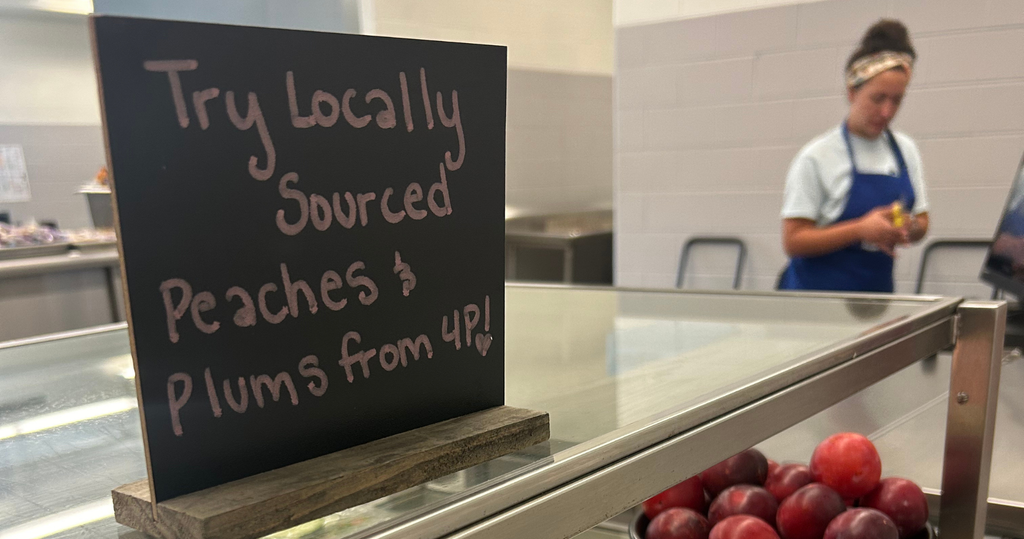
So we run immediately into the problem you’re shining a light on. Tomatoes are great in August, but kids aren’t in school in August, and universities are closed. Blueberries are amazing in June, but we’ve got the same problem. The answer to your question is that in the winter months, we will move as much product as we can that’s grown locally indoors. We have lettuce year round. We have storage crops — apples, for example — all the time. We try to lean into proteins, though there’s a challenge around pricing because of the economies of scale and the growing practices.
And, increasingly, we pull from our regional neighbors. We follow Mother Nature as she breathes in and out up and down the Eastern seaboard. In December, we’re down to the end of any sort of field crops here in Virginia, but that’s the very beginning of citrus season for our friends that own and operate a food hub in South Carolina called GrowFood Carolina. They’re just starting to get going on satsumas and persimmons and pink limes and heirloom grapefruit and oranges — things that we’ll never grow here in Virginia.
We become a local and regional distributor of small-farm-sourced produce and fruit. We get it from farms with the same practices, just a bit farther away now. In 2020, we became a founding member of an organization called the Eastern Food Hub Collaborative, which is exactly what it sounds like. There are about 18 food hubs now, up and down the Eastern seaboard from as far north as Maine to as far south as Georgia. Our primary purpose is to support each other, but also to do business with each other — to have inter-hub trade.
I think the answer to the question, “What is the alternative to industrial supply chains?” looks a whole lot like regional and regenerative supply webs — hubs and spokes that form a network that supports its members and is far more resilient as a result. If you look at a map of the Eastern Food Hub Collaborative, it represents all but one of the USDA growing zones found in the state of California. So, as it relates to practical, year-round growing ability and capacity and variety, we’re onto something.
The answer to your question is that we try to pull from regional hubs to continue to have some semblance of variety. But it still doesn’t answer the other part of the question — what about processing and freezing? This is also part of our new chapter.
Acres U.S.A. I would assume too that school food workers would prefer a #10 can of diced tomatoes to something they have to cut up themselves.
McDougall. Exactly. And not only is it preference — it’s also equipment. Does the workforce know how to peel and break down a butternut squash? Do they have the recipes? Do they have the ovens anymore even to cook a patty pan? Usually not. There’s a whole series of things that points school food procurement toward things that are mostly, if not fully, prepared. That definitely points to the need for processing, which is part of what we hope to build out next.
What would it look like to bring all the components of a food system onto one campus and have a partner that’s doing K-12 processing at scale, including IQF blueberries and a tomato cannery and highly acidified bottling lines — and next to that an entrepreneurial incubator for food startups, and then a food-is-medicine clinic where we could measure nutrient density and long-term health outcomes.
Acres U.S.A. What does this look like for a farmer? What scale of farm are you working with?
McDougall. I think our smallest farm is a quarter acre, and our biggest is about 1,700.
Acres U.S.A. So you work with CSA farms that want to start doing wholesale.
McDougall. Exactly. They have another 10 acres and don’t want to add 400 CSA members and a fourth farmers market. They’re thinking about wholesale but don’t want to call Walmart. We are often that farm’s first wholesale customer.
The hope, if we get that right, is to help them. Because a lot of times they’re like, “I know what tomatoes sell for at the farmers market, but what’s a good wholesale price? And what do you need for food safety? Is GAP required?” A lot of our job initially is to show them our 12 years of data — here’s what we’ve paid our farmers historically for tomatoes, whether for one case or one pallet or one truckload.
Our thinking has also evolved on this. The number of farms we’re purchasing from has shrunk intentionally — not because we don’t want to help everyone but because — back to the purple okra example — we were having a really hard time making it work buying four cases from 200-plus farmers. So we strategically decided to go deeper with our existing farms.
My primary job is business development. Right now we have more farms on a waiting list than we have demand, and even our current farms could produce more food than we are currently buying. So our job is to push demand. We need to go get more markets so that the supply can meet that demand when the time comes.
Acres U.S.A. What does a contract look like with a farmer?
McDougall. It’s less of a contract and more of a plan. This is a direct byproduct of the fact that we don’t have contracts yet with all our customers. That’s what we’re pushing for, going back to the idea of serving schools and universities. We have yet to unlock that magical system where someone puts a commitment in writing to buy, say, 1,000 pounds of tomatoes a week for 12 weeks between August and October. That’s what we’re pushing for, but we don’t have it. And because we don’t have it, we have a hope and a plan for how many tomatoes we’re going to sell next month. And we’re pretty sure we’re mostly right about that, but it’s always going to be off somewhat. It might be up, it might be down. We bring that transparency to our farmers and say, “Our plan is to buy 600 pounds from you. Here are the price ranges. Does this work? Okay, here’s the plan on a Google Doc and a handshake.” In a perfect world, what we want is a contract from the end user so that we can then directly contract with the farmer, and they’re tied to each other.
Acres U.S.A. What would you do differently if you could go back to 2014? But also, what would you recommend for somebody like you today? You’re passionate about the system. We know a lot more about food aggregators and food hubs than you knew back then, because people hadn’t tried it yet. Is it possible to start it fairly locally, or is there a certain scale that’s necessary to get going on this?
McDougall. A couple things come to mind. There’s a saying in the nerdy food hub world that if you’ve seen one food hub, you’ve seen one food hub. Which is to say there is no right way to do it. The good news is there’s also no wrong way to do it. I think food hubs at their best are a direct reflection of the communities they exist to serve. The food hub in Oklahoma looks totally different than us and is different still than the one in Chicago.
I think that’s part of the spirit of regeneration. It’s not about the playbook; it’s about the outcomes. It’s about maximizing the benefit to the ecosystem. The same can be said, I think, of the actual nuts and bolts and infrastructure of food-system building — it’s about the outcome. It’s about creating markets where farmers are thriving economically. It’s about creating access that is equitable to all people regardless of who they are or where they walk. That’s what we’re trying to do. How you do that needs to reflect that space that you’re in. Doing so in a city is different than doing so in a rural community.
The thing I wish I had done differently would be to realize that if you build it, it doesn’t mean they’re going to come. I see a lot of food hubs in development that are precariously perched on the idea that the chef at the local hospital said he definitely would be interested in buying food if we had a hub — so we’re going to go build a hub. But there’s a material difference between that chef saying he would be interested and his boss’s boss realizing that there is a food service contract with one of the big three that has rebates and kickbacks and preferences. There’s a whole lot tied up in what that chef actually won’t be able to do. I wish I had known that sooner and had gotten some of these commitments sooner.
Similarly, the money. My wife and I put our life savings into this, and our house was the collateral to underwrite the loan. If we had gone out of business, we’d be broke and homeless. That’s a huge amount of stress that I’ve carried for a long time. Most of my job the past 12 years has been trying to raise capital. Now, thankfully we’ve done it, and we’ve turned some corners here, and that’s the good news.
But to answer your question directly, earlier on, we would’ve gotten more commitments instead of just relying on people saying they were interested. I’d get that in writing, and then I’d use that piece of writing to unlock the capital so that it didn’t have to be my children’s swing set acting as the collateral.
Acres U.S.A. You have done it and have turned some corners. I should have mentioned this at the beginning, but congratulations are in order for winning the Aspen Institute’s McNulty Prize recently — that’s great.
McDougall. Thank you. All of the credit appropriately is directed to our team that’s actually doing the hard work, and our farmers and our community. Really the whole movement, I think, deserves the credit that comes with the spotlight of that moment. The Aspen Institute has been a wonderful partner, and I went through a fellowship program with them. They’re going to be giving me a microphone to get on some pretty influential stages in the months and years ahead. We need a new food system that regenerates our planet and serves all communities, and we need to do it now. Let’s go build it. That’s the drum I’ll be beating.