

Most Farmers Want to See Proof That New Technology Works Before They Buy It
How do farmers decide whether to adopt a new technology? By watching other farmers, according to a recent survey by Progressive Farmer.
Based on a survey of 258 subscribers, Progressive Farmer found that only 12 percent of their readers self-identified as being the first to try a new technology. The majority—49 percent— “adopt after early adopters prove use.” Another 32 percent “wait until technologies are widely established.” And the final 7 percent “avoid adopting new technologies unless necessary.”
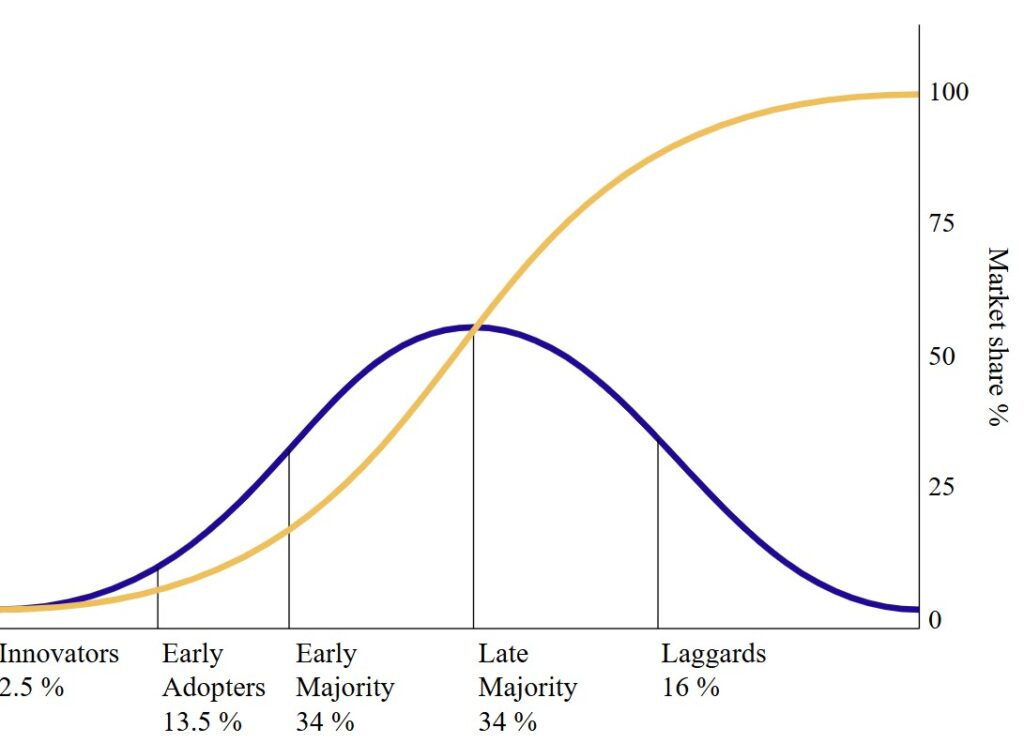
Diffusion of Innovations (Everett Rogers, Wikimedia Commons) – A recent survey by Progressive Farmer confirms Everett Rogers’s classic diffusion of innovations bell curve
These results are reminiscent of the classic bell curve used by sociologist Everett Rogers in his 1962 book Diffusion of Innovations. Rogers said that adopters of a new technology generally fall into five categories. The first—innovators—are the ones who actually develop the technologies and are thus the first to use them. They’re about 2.5 percent of the population. The next 13.5 percent are early adopters, the opinion shapers who are the first non-developers to use and promote a technology.
Most people fall into the next two categories. The early majority are deliberate and “adopt new ideas just before the average member of a social system.” They’re 34 percent of the population. The late majority are skeptical, waiting to adopt a new technology “until most others in their social system have done so.” They’re another 34 percent. Finally, there are those who never adopt a new technology. These “laggards” or “traditional” people are 16 percent of the population.

The Progressive Farmer survey distribution is similar, except that more of their subscribers are early majority and fewer are laggards than the population as a whole. Of course, people who aren’t interested in new technologies probably don’t subscribe to a publication called “Progressive Farmer.”
Another important finding is that the majority of farmers don’t consider buying a new tool or adopting a new practice unless they see other farmers using it. “Farmers still trust other farmers more than anyone else when evaluating a new technology,” explains Katie Micik Dehlinger, Progressive Farmer Editor-in-Chief. Fifty-nine percent of farmers listed other farmers as their primary sources of information, followed by equipment dealers (40 percent) and farm media (38 percent).
What does this mean for eco-ag? Well, the same principle applies to organic farming—farmers need to see it demonstrated in their area and be sure it works before they’ll try it. That’s why organic farms are often located in clusters—once more than one farmer demonstrates that it works in a specific area, others will follow suit.
So how do we convince more farmers to transition to organic? The group to target is the early adopters—those 12 percent of Progressive Farmer subscribers who identify as the first to try new technologies. If they all adopted organic and demonstrated that it worked, the early majority would quickly follow—and then the late majority. And if we someday reach the point where only the laggards are still using chemicals, they’ll be forced to change because nobody will buy their crops otherwise.