


Two relatively new understandings of how plants and microbes work together — rhizophagy and exclusion-zone water — help explain why regenerative practices work better in some soils than on others
The rhizophagy cycle presents a different model of plant nutrition than we have previously understood. It asserts that plants should absorb nutrients through biological systems.
My understanding of how the rhizophagy cycle works is different today than it was even a year ago.
Understanding Rhizophagy
To begin to understand the rhizophagy cycle, imagine a plant root tip that is growing through the soil. At the tip of the plant there is a zone that is very porous, and this porous tip will move through the soil very quickly when the soil has stable consistency. It can extend two inches per hour, as long as the soil pressure and soil consistency is the same. Whenever that growing root tip encounters a layer of compaction, though, it stops or slows down, and then it continues forward. If it experiences a decrease in compaction, it stops or slows down, and then it starts moving forward again. So, if you have lots of variations in soil density, root growth is not all that rapid. Some fascinating research by a USDA researcher in Arizona about 20 years ago found that a corn plant could completely fill a vessel six feet in diameter, six feet deep, in 72 hours — as long as the soil density was exactly the same.
What we’re discovering with rhizophagy is that in this porous root tip, as it is extending through the soil, it can absorb at least three different types of microbial bio-organisms: bacteria, algae and fungi. These organisms can be absorbed from the soil profile and are then moved back through the root system into the growing root. A few inches back from this growing root tip, there is a very oxidizing environment. The plant root deliberately releases reactive oxygen species and nitrous oxide to strip off some of the cell membranes. Those membrane-less bacteria and algae and fungi are then transported throughout the rest of the plant. But some of them aren’t transported to the rest of the plant, and they begin accumulating. This local accumulation of bacteria, which occurs about two to four inches back from the growing root tip, triggers the formation of new root hairs.
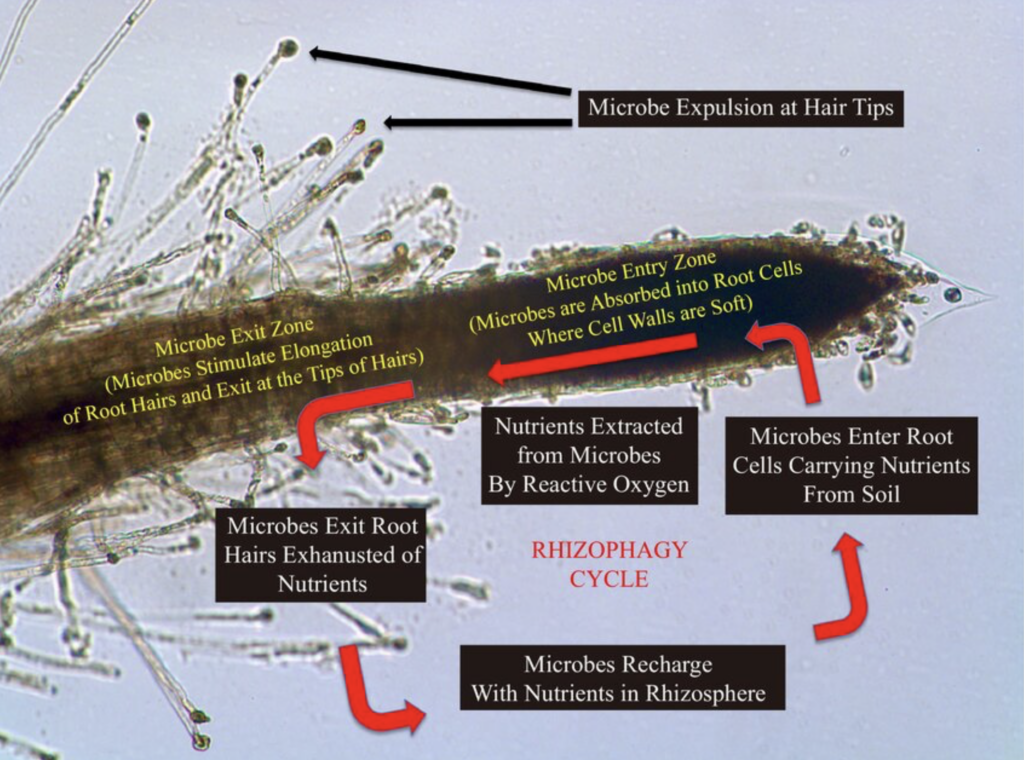
These bacteria then begin moving out through the root hairs, back out into the soil environment. And not only does the plant send out these bacteria; it also sends out mucigel compounds — not just carbohydrates, but very specific compounds that these bacteria need to reform their cell membranes. And in this process, the plant also signals to the bacteria in the soil — as well as to fungi and other microorganisms — what its nutritional requirements are. It tells them, “Hey, I need more zinc,” or “I need more manganese,” or “I need more phosphorus.” And then, when those microbes are transferred back into the soil environment, they communicate that signal with the rest of the soil microbiome.
And in a matter of minutes, as soon as these bacteria move out from the root tip into the soil, they communicate to the other soil microbes that, “Hey, the plant we are supporting needs more manganese.” And fungi at a distance of yards away from that plant will immediately begin selectively extracting manganese and channeling it back to the plant. Isn’t that amazing?
These plants are essentially farming bacteria, farming algae, and farming fungi. They have this symbiotic relationship where they are providing the microorganisms with sugars, and these organisms are providing them with nutrients.
How to Shut Down Rhizophagy
But if you want to shut this rhizophagy cycle down, the easy way to do it is to provide the plant with excess of levels of nitrogen or excess of levels of soluble nutrients like phosphorus and potassium. When you give the plant an abundance of soluble nutrients, the plant has no motive to release sugars for bacteria. They don’t need to support the bacteria. They will use all the sugars for themselves.
It’s common for farmers to experiment with starter fertilizers in-furrow, particularly on corn and soybeans, and they get this very impressive growth response early on in the plant’s life. Four to six weeks after planting, you can see very clear visual differences between where the starter was applied and where it wasn’t. Yet in many of those cases, there isn’t a corresponding yield response.
Thousands of farmers have had this experience. The reason for this is that the early dose of soluble phosphorus or soluble nitrogen temporarily suppresses the rhizophagy cycle. The plant has an abundance of soluble nutrients; it doesn’t need to support the biology. But six weeks later, the plant has utilized all of the soluble nutrients that were applied with the starter fertilizer, and now it needs phosphorus and nitrogen and other nutrients. But the rhizophagy cycle has been shut down. It isn’t working effectively anymore, and now the plant is playing catch-up for the rest of the growing season to try to sustain its microbial community.
Direct Nutrient Absorption via Microbes
For years I have been intrigued with how plants can absorb nutrients in the absence of soluble soil ions. If you read agronomy textbooks, there is always this obligatory introductory paragraph on how plants absorb nutrients via ion channels, ion pumps, diffusion, mass flow, etc. — all based on the premise that nutrients are soluble in the soil solution.
But consider the trees we’ve all seen that seem to be growing straight out of rocks. How do they receive nutrients in the absence of water-soluble ions — in the absence of soil?
When Dr. White first started publishing his work on the rhizophagy cycle, I was very intrigued by the possibilities, because all of a sudden there was a foundation for the absorption of plant nutrients in a completely biological system that has no soluble ions.
Think about an undomesticated ecosystem — forest CRP land that is not being fertilized, for example. Rhizophagy is the process by which plants generally absorb most of their nutrients in these undomesticated ecosystems where there is not an abundance of nutrition. I had also observed several farms we were working on that had no cover crops, no compost and no manure — dryland farming in very challenging climactic conditions — where farmers were producing 220 to 240 bushels per acre of corn, consistently, with no outside nitrogen inputs.
Where is the nitrogen coming from? We know it takes nitrogen to grow the crop. How is it possible for soil biology to deliver that quantity of nitrogen — and not just nitrogen, but also other nutrients — with no inputs being applied to this soil for years at a time? I began to realize that this model of plant nutrition can work very effectively when our soils are managed well.
As we started working with farmers using biological inoculants and cover crops, the benefit of using sap analysis to see what is happening inside plants soon showed us very clearly in which soils this process of biological nutrient delivery was working well and in which it wasn’t. It’s true that on some soils, it has not been working well. And I’ve been trying to understand why that is — why is it that on some farms we are adding microbial inoculants, we’re incorporating cover crops, we seem to be doing many things properly — but the results aren’t quite there yet.
Nutrient — and Microbe — Transport via Fourth-Phase Water
I think I uncovered part of the answer to that question in the last year.
What happens with these bacteria and algae and fungi that are being absorbed by the root system? They need to move from the root system upward through the plant stem. There’s a fascinating paper that was published about 70 years ago, shortly after they had isolated radioactive elements, where the scientists injected radioactive isotope tracers in nutrient applications at the base of a redwood tree, and they measured how rapidly it reached the furthest tip of the tree. They found that the tree transported those nutrients that they injected from the base of the tree, 130 meters up, in four seconds. The problem with the experiment was, and is, that the models of ionic nutrient flow are based on hydraulic flow and pressure models, and they can’t explain that rapid of transport through the tree’s vascular system.
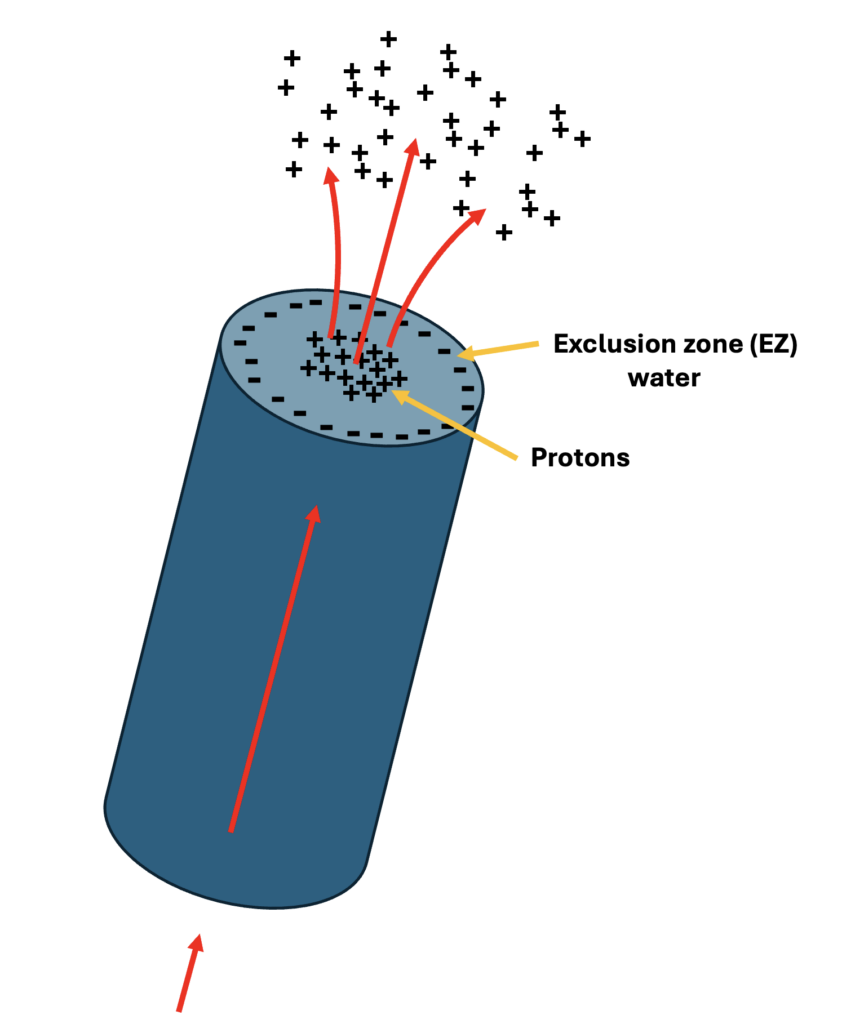
It was because of this puzzle that I was so fascinated by Gerald Pollack’s work at Washington State University on exclusion-zone water — the fourth phase of water. Dr. Pollack has identified that there is a fourth state of water. We’re familiar with the first three states: solid ice, liquid and gas. He describes that in both living and non-living systems, anytime water is against a surface that has a charge, and is exposed to infrared radiation, the water develops this lattice crystal structure and begins building up these layers, and the more infrared energy it’s exposed to, the thicker the layers become. He did a fascinating experiment with an aquarium filled with water that contained colored plastic beads, and they dropped a straw into the aquarium. The straw was lying horizontally on the aquarium bottom, and they exposed it to infrared radiation, and with no other energy being applied — no motion, no agitation — in a matter of a few minutes, they could see the plastic beads moving through the straw. Why? Because the plastic straw carried a charge on the surface, and that charge resulted in exclusion zone water on the inside of the straw.
Imagine that instead of a straw, you have plant vascular tissue — you have xylem that is transporting water and nutrients upward. Dr. Pollack describes how, because of the charge that’s on the xylem wall, or on the straw wall, there is this buildup of multiple layers of water that is in a gel state. The fourth phase of water is water that has the consistency of jello, in a liquid-crystal form. As the gel-state water builds up, you end up with a channel in the center of the xylem, or the straw, in which all the nutrients can be carried by charge differential.
In their straw experiment, the colored plastic beads were not touching the sides of the straw; they were all flowing right down through the center. There’s a layer of charge buildup of gel-state water in the center, and everything else moves through the center. In the case of plants, this means nutrients moving through the xylem; or, in this case of the rhizophagy cycle, these bacteria and fungi and yeasts and algae are moving up through the center of the xylem, without touching the sidewalls. This process can transport soluble ions as well as bacteria and algae cells. And this process of transporting materials upward is not dependent on water flow — it’s dependent on charge differential.
So, in the case of the redwood tree, when we have a highly charged xylem tissue, the speed of bacterial movement or nutrient movement is extremely rapid. You can move nutrients up to the plant very quickly in the absence of water flow. This is very important. This idea of moving nutrients in the absence of water flow would revolutionize plant health for most growers — if they realized the opportunity that it represents.
Bacterial Truckers
When we have perennial crops such as tree fruit or berries, and they emerge from dormancy in the spring — particularly for the plants that bloom right as they break dormancy, like apples and cherries — getting good nutrition from the soil, from the root system, and from the nutrient stores in the trunk and branches to those buds early on is extremely important. In the traditional model, getting nutrients to move requires two things: increased temperatures and water flow. If you use water-soluble nutrition, that requires water flow.
About two years ago, we were working with a lot of apple growers in the Pacific Northwest, and they had a very cold, wet spring. The trees bloomed, and there was pollination, but they didn’t have full leaf-out for another six weeks because the temperatures were cold — it was wet and rainy. Because of the conditions, there wasn’t any water flow from the root system up to the upper parts of the tree, which meant that there was no calcium flow from the root system up to the upper parts of the tree. That year, across the entire industry, there were major fruit storability problems because they couldn’t get enough calcium into the fruit in that early stage, and they were never able to catch up for the rest of the growing season.
We have been told that on the surface of very large plant cells there are small bacterial cells. These bacterial cells arrive, and the plant cell begins absorbing these much smaller bacterial cells. The entire bacterial cell moves into the plant cell and then gradually becomes enveloped. This process is called endocytosis. This process has been well known in human cells and livestock cells for decades. It’s more recently that we knew that it occurred in plant cells, but that’s now very well established as well.
But my understanding had been that this process of endocytosis was, in essence, a one-way street — a one-way gate. The bacteria and algae and yeast and fungi moved into the plant cell, and the plant cell would then disassemble them and use all of the nutrients and the components that they contained for the plant’s own energy needs; the microbial cells would be completely utilized.

But that was not correct. What actually happens is that these bacterial cells are loaded with nutrients — with amino acids containing nutrients, and nutrients in various forms — and there’s some fascinating biophysics and chemistry that occurs at the cell interface. There’s a group of lipids called the sphingolipids that form what we call “sphingolipid rafts.” As the bacterial cell is enveloped during the endocytosis process, we get these sphingolipid rafts that wrap around the cell, and they move the bacterial cell in. The bacterial cell is then stripped of all the free nutrients that it contains — or you could say that it releases them.
We don’t know what the drivers of this mechanism are, but this bacterial cell releases all its free calcium, manganese, zinc, amino acids, amino sugars, lipids — whatever free compounds it contains. It delivers them to the plant cell, and then it goes back out again. The endocytosis process happens in reverse — the bacterial cell is ejected back out of the cell through a process called exocytosis, and then it goes back down the stem to the root system, picks up more nutrients in the soil, and goes right back in. These bacterial cells are truckers. They are nutrient delivery systems.

The Calcium Threshold
But there’s a dilemma. The process I’m describing does not function well in most plants because of nutrition mis-management problems.
The challenge for many crops is that this process of endocytosis and exocytosis is dependent on the plant cell being able to maintain strong voltage across the cell membrane. If you want to shut down this process of developing exclusion-zone water, there’s two ways of doing it. One way is for the water that should be forming exclusion zone water to be contaminated with excessive electrolytes. If you have excessive electrolytes, that means you have a solution that has good electrical conductivity, which means that it dissipates charge, so you don’t get charged accumulation on the wall.
There are five major electrolytes in plant sap: sodium, chloride, magnesium, potassium and nitrate. If you have excessive levels of those nutrients in combination, that will limit the development of exclusion-zone water, which will limit nutrient transport and bacterial transport throughout the plant. And as a result, you get nutrient accumulation in the lower, older leaves, and nutrients don’t move well throughout the plant’s vascular system.
The other way to shut down the process of developing exclusion-zone water is to have imbalanced plant nutrition such that the xylem wall or phloem wall doesn’t support a strong enough charge. This requires generous calcium, silicon and boron levels — in combination.
Calcium is actually an electrical insulator. From a biophysics perspective, that means that it enables a strong charge differential across the cell membrane. Seventy years ago, William Albrecht and Carrie Reams and other pioneers in this space described the primal importance of calcium. They taught that in order for plants to be healthy and to thrive, you have to address calcium first — you have to take care of the calcium foundation.
What I’m describing is just a fresh understanding of new things that we’re learning that go back to those same foundational principles. This is why calcium nutrition is so foundational. This is why, to go back to what I mentioned earlier, there are some farms that have added biological inoculants, that have been using cover crops, that have been improving soil biology, but plant nutrition isn’t working very well. It’s because there isn’t a strong enough foundation of calcium.
Calcium in soil has been thought of as a function of cation balance — that we need to have 70 to 75 percent base saturation and that we need to maintain calcium in ratio to magnesium. That understanding is not incorrect, but it is incomplete. It is incomplete because on some soils, having 70 to 75 percent base saturation calcium is not enough. We know that if we want to produce abundant soybean yields, for example, not only do we need to main potassium levels in a 3 to 5 percent base saturation window, but we also need to have a minimum threshold of potassium. We commonly think of potassium as having a minimum threshold level in the neighborhood of 125 parts per million, which is about 250 pounds per acre.
We need to think about calcium in the same way. Where the ratio begins to fall apart is somewhere than the vicinity of about 10 CEC. When we have light, sandy soils that have a cation exchange capacity of less than 10, we may need more calcium than 70 to 75 percent base saturation. As we’ve looked at different soils and crops in many different environments in light of the foundational question of what calcium levels support plants that are thriving and healthy and disease resistant and insect resistant, and where this biological system of plant nutrition delivery seems to be working well, the threshold is about 1,000 ppm calcium.
You should never let soils fall below 1,000 ppm calcium. What this means is that if you are growing crops in sandy soils in Florida, Arizona, New Mexico, Michigan or Wisconsin — any sandy region — then 70 percent base saturation calcium, which translates to 600 ppm, is not enough. It’s not enough calcium to form the structure and the foundation for a very healthy plant. The calcium-to-magnesium ratio is still important, as is the calcium-to-potassium ratio. But in low-CEC soils, we need to start looking at these ratios in terms of ppm nutrient levels to each other instead of as percent base saturation. The minimum threshold that is needed for plants to thrive and to do well is calcium at 1,000 ppm, magnesium at 150, and potassium at 125. If you fall below that, crop nutrition, crop yields and crop performance is going to suffer.
Boron: The Most Rapid Economic Response
I’ve been focusing on calcium nutrition, but remember that silicone and boron are vital as well for developing exclusion-zone water.
It’s often possible to produce very rapid economic crop responses by addressing zinc or by addressing cobalt or by addressing molybdenum. But boron is the one nutrient that is widely and broadly deficient. On most farms we make a recommendation to address boron, and it is the nutrient that produces the most rapid and greatest economic response.
There are several reasons for this. The first is that when a crop has adequate boron levels, in most instances you can reduce insecticide needs by about 90 percent. Very simply, when plants have adequate boron levels, insect susceptibility goes into the tank. And it is true that it is easier to produce a boron toxicity than it is to produce a zinc or manganese toxicity — in low-calcium environments. That’s the key. It only happens in low-calcium environments. I am of the persuasion that if most crops had adequate levels of boron, the insecticide market would drop by 70 to 80 percent. Maybe it’s no wonder that we are constantly getting these warnings about applying “too much” boron.
Soils that have the greatest level of disease and insect resistance have a ratio of a 1,000 ppm calcium to 3 ppm boron; that’s one to two times higher than what is often recommended. Some laboratories will suggest 2 ppm boron, and others will suggest 1. But if you have a heavy soil with a high calcium content — where your calcium content is 2,000 part per million — you need 6 ppm boron. There’s a baseline level of 3 ppm, but the ratio should be 1,000:3. Now, boron is cheap, and calcium is cheap. And if we address calcium and boron, this biological system begins performing and functioning so much better.
Boron leeches from the soil profile the same way sulfur or nitrate nitrogen does, because it is an ion. The way we hold these ions stable in soil is with carbon — with organic matter. Clay doesn’t hold ions stable — it’s carbon that does. So, ideally, we build soil carbon and organic matters to the point where they can hold boron stable until it’s required over time. This is more challenging in sandy soils and some soil conditions, though, so our rule of thumb is that for every 10 inches of rainfall, we want to apply a half pound of boron per acre per year. If you’re in a zone with 30 inches of rainfall, that means you need one and a half pounds of boron to just replace what has been leached. And the less carbon your soil contains — the sandier it is — the more boron you’re going to require.
One of the things I’ve been talking about for years is how we can substitute some nitrogen with calcium, because we can get significant vegetative growth energy from calcium instead of from nitrogen. For that process to work well, we also need boron — to facilitate calcium transport. So, my preferred approach is to apply calcium and boron at the same time. That way you can be certain of not creating a boron toxicity.
We have been indoctrinated to think about calcium as a soil amendment — that we apply calcium as limestone or as gypsum once every three years or once every five years. But we can actually get much greater crop responses, and much greater economic responses, when we begin thinking about calcium as a fertilizer.
I think about calcium management in two stages. You need calcium as a replacement for some of the nitrogen during the vegetative growth stage. And then you need calcium in the cell division window, which is two to three weeks post-pollination. Those are the windows where you have the greatest economic crop response. We apply gypsum or pelletized limestone or whatever form of calcium fits our soil conditions as a fertilizer, either at planting or pre-planting, in such a time window that the release curve of the product that we’re applying matches the plant’s demand curve.
We have many soils that have 1,000 ppm calcium, or even 3,000 ppm, and yet the crop doesn’t get enough calcium. This happens for two reasons. One is because the soil doesn’t have enough boron. And second, this can happen when the soil doesn’t have enough biological activity and so the rhizophagy cycle isn’t working well.
Calcium delivery from the soil to the plant is driven by biology, not by chemistry. When we talk about thinking of calcium as a fertilizer, this means that it’s simply a kickstarter — a band-aid to get the system working in order to produce a good crop. But the long-term solution is to get calcium delivery from the tremendous reserve of calcium that we have on our soil profile so that we don’t need to be constantly adding more. And to achieve that, we need two things. We need boron supply, and we need really good biology.
What does this look like in tree fruit — for apples and cherries? They’re emerging from winter dormancy, and they immediately begin blooming and pollinating. We need peak calcium supply right as they begin emerging. There’s lots of variables here with soil temperatures and moisture conditions, but gypsum and limestone applications are going to have a release curve of about 30 to 45 days post-application. So, putting on a gypsum or limestone application on the fall on an orchard won’t produce the maximum economic crop response. The greatest economic crop response is going to occur when we apply it in very early spring, a month before dormancy break — that’s how we produce fruit that stores very well and that has exceptional flavor and quality.
Now, with corn, where your pollination window is 45 days to 60 days after planting, the ideal window for calcium application is actually at planting time, not earlier in spring or in the fall. There are many farmers who have used gypsum applications as a soil amendment, and their soils have changed for the better, but they haven’t observed a crop response. That’s because they were doing the right thing, but they were doing it at the wrong time. You can have a significant crop quality improvement if you simply get the timing right.
And Silicon
Finally, silicon. It’s 23 percent of the earth’s crust, but silicon release from the soil mineral matrix is dependent on the rhizophagy cycle working well. There’s a little bit of a chicken and egg question here, as there so often is in these biological systems — they’re self-perpetuating systems. If you want to have a plant that is silicon deprived and that doesn’t have enough silicon for these vascular system walls and for cell membranes, it’s very easy to do that — you just put on starter fertilizer at planting and they won’t have enough silicon, because you’ve shut down the biology.
There is an abundance of research on the value of silicon for disease resistance and for insect resistance, but particularly for disease resistance for foliar airborne diseases, rusts, mildews, etc. But this research is actually quite interesting — the results are very mixed for foliar applications of silicon. The results of foliar applications of potassium silicate or calcium silicate are very variable. Results are extremely good about 40 percent of the time, 20 percent of the time they’re neutral, and the other 40 percent of the time there are no positive results. You can have a negative effect on plant health if application rates are too high, and the threshold of what’s too high is different for every crop. Too high levels for tomatoes are not enough for rice. It’s very difficult to deliver silicon in the optimal amount for the plant as a foliar.
But when you rely on soil biology, your microbes already have it figured out. They don’t need written instructions. They will supply exactly the silicon amount that plant needs for optimal health.
How to Shut It All Down
This brings us back to the key point: if we want to deliver abundant calcium and silicon and boron from the soil, we need to have a lot of biology colonizing the root system and making these nutrients available to plants. And if you want to shut the process down, you deliver one of two things. The first is an excess of electrolytes — nitrates and chlorides are often the primary culprits. Or, second, you shut down the process by providing too much soluble phosphorus or soluble nitrogen fertilizer in the furrow at planting.
Keep in mind that you can do this as readily in organic systems as in conventional systems. You can apply a high dose of liquid dairy manure or hog manure that has high levels of chlorides from the salt in the diet and that has high levels of nitrates. This can give you excess electrolytes in the root zone right at planting. When you use that type of a system, you can get high yields, but you are relying on soluble ions — i.e., the historic agronomic system. You are dependent on soluble ions in the soil solution, not on biology.
The downside of this system is it is dependent on water supply. If you have drought conditions, or if you have excess water, those water-soluble nutrients can leach, or they can become locked up. The beauty of the biological system is that it is incredibly drought resilient because when nitrates and nutrients are captured inside bacterial cells, they are plant available even in the absence of free soil water.
So, if you want to produce drought-resilient crops — soils that can deliver nutrients even in drought conditions — you need to become dependent on this system of microbial nutrient delivery.
John Kempf is the founder of Advancing Eco Agriculture and the executive editor of Acres U.S.A. magazine. This article is an edited transcript from his presentation at the 2024 Acres U.S.A. conference.